


IP67 Waterproof Lens Supplier for Long-Term Outdoor Application
05/09/2026
How to Choose Industrial Camera Lens for Machine Vision Applications
05/11/2026
Introduction
Choosing the Best Low Distortion Lens Manufacturer is essential for companies that rely on accurate imaging and stable machine vision performance. In modern industrial environments, even minor image distortion can affect dimensional measurement, robotic positioning, barcode recognition, and automated inspection accuracy.
As machine vision technology continues to expand across manufacturing, logistics, robotics, and intelligent transportation, the demand for high-performance industrial lenses is growing rapidly. A reliable low distortion lens ensures that captured images maintain geometric consistency across the entire field of view, improving system calibration and reducing software correction requirements.
For industrial buyers, selecting the right lens manufacturer involves more than comparing focal lengths or sensor sizes. Optical quality, distortion control, production consistency, and OEM customization capabilities all play critical roles in long-term project success.
What Is a Low Distortion Lens & Why Industrial Users Need It
For industrial users, understanding the basics of low distortion lenses is the first step to making an informed purchase. Below is a clear breakdown of key concepts and application values:
1. Definition of Low Distortion Lens
Distortion refers to the visual deformation of objects captured by a lens—edges of straight lines appear curved, leading to inaccurate spatial positioning and size measurement. A low distortion lens is defined as:
- Industrial standard: Distortion rate ≤ 2% (general industrial use);
- High-precision standard: Distortion rate ≤ 1% (for measurement, positioning, and other high-precision scenarios);
- Ultra-low distortion: Distortion rate ≤ 0.5% (for advanced machine vision systems).
2. Common Types of Distortion
- Barrel distortion: The center of the image is expanded, and the edges are compressed (common in wide-angle lenses);
- Pincushion distortion: The center of the image is compressed, and the edges are expanded (common in telephoto lenses);
- Complex distortion: A combination of barrel and pincushion distortion, which requires professional design to correct.
3. Why Industrial Scenarios Must Use Low Distortion Lenses
High distortion can cause serious consequences in industrial applications, including:
- Measurement errors: Inaccurate size and distance data, leading to defective products;
- System instability: Affecting the judgment of machine vision systems, resulting in misoperation;
- Increased costs: Rework, product scrapping, and system maintenance costs;
- Safety risks: Inaccurate positioning in robotics and AGV scenarios may cause equipment damage or accidents.
4. Key Industrial Applications of Low Distortion Lenses
- Machine vision measurement: Detecting product size, flatness, and assembly accuracy;
- Precision assembly & positioning: Guiding robots to complete high-precision assembly tasks;
- Industrial inspection: Identifying surface defects, cracks, and flaws in products;
- Robotics & AGV: Assisting in path planning and obstacle avoidance;
- Intelligent surveillance: High-fidelity image capture for traffic monitoring (ITS) and factory security.
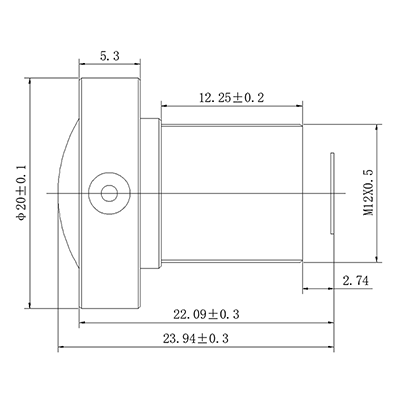
8-Megapixel Low Distortion lens
Core Parameters for Evaluating Low Distortion Industrial Lenses
When selecting low distortion lenses for industrial use, focusing on the following core parameters ensures that the product matches your application needs. We use bullet points for easy skimming:
- Distortion rate: The most critical parameter. ≤1% is excellent for measurement scenarios; ≤2% is suitable for general industrial inspection.
- Resolution: Determines image clarity. 5MP is basic, 8MP/12MP is suitable for high-precision detection, and 4K is for advanced machine vision.
- Sensor format: Matches the camera sensor. Common formats include 1/2.5”, 1/2”, 1/1.8”, and 2/3” (the larger the format, the better the image quality).
- Mount type: M12/S-mount (miniature, board camera), C-mount (industrial machine vision, ITS), CS-mount (surveillance, day/night use).
- F-number: Affects light sensitivity. A smaller F-number (e.g., F2) is suitable for low-light industrial environments.
- Environmental adaptability: Operating temperature (-20℃~60℃ is common), shock resistance, and dustproof/waterproof performance (for harsh industrial sites).
- IR correction: Essential for day/night surveillance and low-light inspection (TOWIN uses multi-coating technology for IR correction).
- Coating technology: Multi-coating reduces flare and ghosting, improving image contrast and clarity.
Parameter Comparison Table: TOWIN Low Distortion Industrial Lenses
To help you quickly compare and select products, we have sorted out TOWIN’s hot-selling low distortion lens series, combining the product parameters from the official website:
Product Series | Distortion Rate | Resolution | Mount Type | Sensor Format | F-number | Key Features | Typical Application |
|---|---|---|---|---|---|---|---|
TOWIN M12 Low Distortion Lens | ≤0.8% | 5MP | M12×0.5 (S-mount) | 1/2” | F2 | Miniature, board-mountable, multi-coating | PCB camera, industrial inspection, small equipment |
TOWIN C-Mount Ultra-Low Distortion Lens | ≤0.5% | 8MP+ | C-mount (17.526mm flange distance) | 2/3” | F1.8-F2.8 | High precision, IR correction, shock-resistant | Machine vision measurement, 3D cameras, ITS traffic monitoring |
TOWIN CS-Mount Low Distortion Lens | ≤1.2% | 5MP | CS-mount (12.526mm flange distance) | 1/1.8” | F2.0 | Day/night use, multi-coating, manual/auto iris | CCTV, network camera, IP camera surveillance |
TOWIN Custom Low Distortion Lens | Customizable (≤0.3% optional) | 5MP-12MP | M12/C/CS-mount optional | Customizable | Customizable | Tailored design, full customization, fast sampling | Special industrial scenarios, custom equipment |
Note: All TOWIN low distortion lenses support multi-coating technology to reduce flare and ghosting, and most models have IR correction for day/night use. For specific parameters (e.g., focal length, operating temperature), please contact our technical team for details.
How to Select the Best Low Distortion Lens Manufacturer
Choosing a manufacturer is more important than choosing a product. For industrial buyers, the following 6 criteria can help you identify the best low distortion lens manufacturer:
1. Professional Optical Design Capability
- Has an in-house R&D team that can simulate and optimize low distortion lens designs;
- Can provide custom design solutions according to specific application scenarios (e.g., special distortion requirements, size restrictions);
- Master core technologies such as optical correction and multi-coating.
2. Precision Manufacturing & Strict Quality Control
- Owns advanced production equipment to ensure consistent product quality;
- Implements strict quality inspection procedures (e.g., distortion rate testing, resolution testing) before delivery;
- Has stable product qualification rate (≥99.5% is ideal).
3. Complete Product Line
- Covers mainstream mount types (M12/S-mount, C-mount, CS-mount) to meet diverse camera matching needs;
- Provides lenses of different resolutions, sensor formats, and distortion rates for different industrial scenarios;
- Offers supporting accessories (e.g., lens adapters) for one-stop procurement.
4. Customization Service Capability
- Can customize key parameters (distortion rate, focal length, size, wavelength) according to user needs;
- Has a fast sampling cycle (7-15 days is ideal) to shorten product development time;
- Provides technical guidance throughout the customization process.
5. Stable Supply & Fast Delivery
- Has sufficient production capacity to meet large-order needs;
- Guarantees fast delivery (3-7 days for standard products, 15-30 days for customized products);
- Has a global logistics network to support timely delivery to overseas markets.
6. Global Service & Technical Support
- Provides 24/7 technical support (email, phone) to solve after-sales problems;
- Offers product installation and debugging guidance;
- Has a clear after-sales guarantee policy (e.g., 1-year warranty).
Why TOWIN Is the Best Low Distortion Lens Manufacturer
Based on the above criteria, TOWIN perfectly meets all the requirements of a top industrial low distortion lens manufacturer, and has the following unique advantages:
- Professional Design & Manufacturing Integration: TOWIN has an in-house R&D and production team, focusing on optical lens design and manufacturing for many years, with rich experience in low distortion lens optimization.
- Complete Product Line: Covers M12/S-mount, C-mount, and CS-mount low distortion lenses, with resolutions ranging from 5MP to 12MP, meeting the needs of various industrial scenarios.
- Strict Quality Control: Every lens undergoes strict distortion rate and resolution testing before delivery, ensuring product qualification rate and consistent performance.
- Fast Delivery & Customization: Standard products are shipped within 3-7 days; customized products have a 7-15 day sampling cycle and 15-30 day delivery cycle, helping users shorten the project cycle.
- Global Service: Provides 24/7 technical support via email (info@towin-elec.com) and phone (+86-592-5220235), with a global logistics network and 1-year product warranty.
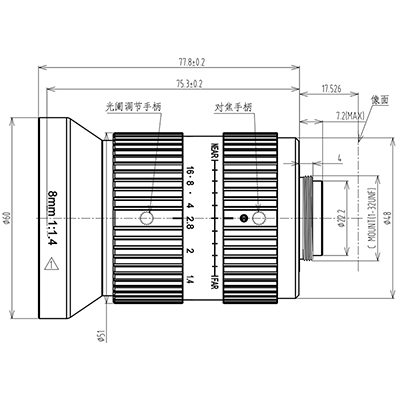
1.1″ C-Mount 8mm Low distortion Wide-angle lens
TOWIN Recommended Low Distortion Lenses for Industrial Use
Combined with TOWIN’s product categories and industrial application scenarios, we recommend the following hot-selling low distortion lenses to help you quickly select the right product:
1. M12 Low Distortion Board Lens (Miniature Series)
- Key specs: Distortion ≤0.3%, 5MP resolution, M12×0.5 mount, 1/2.5” sensor, F2.0, multi-coating;
- Advantages: Miniature size, board-mountable, easy to integrate into small industrial equipment, cost-effective;
- Typical application: PCB camera, small industrial inspection equipment, portable detection devices;
- Relevant product model reference: CCL12516MPR2 (1/2.5” 5MP F2.0).
2. C-Mount Ultra-Low Distortion Lens (Machine Vision Series)
- Key specs: Distortion ≤0.9%, 5MP+ resolution, C-mount (17.526mm flange distance), 2/3” sensor, F1.4, IR correction;
- Advantages: High precision, suitable for high-precision measurement, compatible with machine vision cameras (USB, GigE, 3D);
- Typical application: Machine vision measurement, 3D cameras, ITS traffic monitoring, precision assembly;
- Relevant product model reference: CCL231530MMPC (high-resolution industrial grade).
3. CS-Mount Low Distortion Lens (Surveillance Series)
- Key specs: Distortion ≤1.8%, 8MP resolution, CS-mount (12.526mm flange distance), 1/1.8” sensor, F1.5, day/night IR correction;
- Advantages: Multi-coating, anti-flare, suitable for day/night surveillance, compatible with CCTV, network, and IP cameras;
- Typical application: Factory security, traffic monitoring, indoor/outdoor surveillance;
- Relevant product model reference: CS371611815A8 (IR-corrected day/night lens).
4. Custom Low Distortion Lens
- Key specs: Distortion rate, resolution, mount type, and sensor format all customizable (minimum distortion ≤0.3%);
- Advantages: Tailored to special industrial scenarios, perfect matching with custom equipment;
- Typical application: Special industrial inspection, custom machine vision systems, unique equipment integration;
- Service: Contact our team for custom design and sampling.

12-50mm-P-Iris-CS-Mount Industrial lens
FAQs
Q1: What is considered low distortion for industrial lenses?
A: For general industrial use, a distortion rate ≤2% is considered low distortion; for high-precision scenarios (e.g., measurement, positioning), a distortion rate ≤1% is required, and ultra-low distortion lenses (≤0.5%) are suitable for advanced machine vision systems.
Q2: What’s the difference between M12, C, and CS mount for low distortion lenses?
A: The core difference is the flange focal distance and application scenario:
- M12/S-mount: Flange distance not fixed, M12×0.5 thread, miniature size, suitable for board cameras and small equipment;
- C-mount: Flange focal distance 17.526mm, suitable for industrial machine vision, 3D cameras, and ITS traffic monitoring;
- CS-mount: Flange focal distance 12.526mm (5mm shorter than C-mount), suitable for CCTV, network, and IP surveillance cameras.
Q3: Can TOWIN customize the distortion level of lenses?
A: Yes. TOWIN provides full customization services, including distortion rate (minimum ≤0.3%), focal length, size, sensor format, and mount type. Our R&D team will design a tailored solution according to your specific needs.
Q4: What resolution do I need for industrial measurement scenarios?
A: For general measurement, 5MP is sufficient; for high-precision measurement (e.g., small part size detection), 8MP+ resolution is recommended to ensure clear image details and accurate data.
Q5: What’s TOWIN’s lead time and MOQ?
A: Lead time: 3-7 days for standard products, 7-15 days for custom sampling, 15-30 days for custom mass production. MOQ: 1 piece for standard products, flexible MOQ for custom products (negotiable).
Q6: Does TOWIN support global shipping?
A: Yes. TOWIN has a global logistics network, supporting shipping to all overseas countries and regions. We can choose the most suitable logistics method (express, air, sea) according to your order quantity and delivery time requirements.
Conclusion
In industrial imaging, low distortion lenses are the foundation of accurate data and stable system performance, and choosing the Best Low Distortion Lens Manufacturer is the key to realizing the value of these lenses. TOWIN, as a professional optical lens supplier, integrates design, manufacturing, and service, providing high-precision, complete-series low distortion lenses (M12/C/CS-mount) for industrial users, with fast delivery, customization capabilities, and global technical support.
Whether you need standard low distortion lenses for general industrial inspection, high-precision lenses for machine vision measurement, or custom lenses for special scenarios, TOWIN can meet your needs. Contact us today to get a tailored solution:
Email: info@towin-elec.com
Choose TOWIN, the Best Low Distortion Lens Manufacturer for Industrial Use, and let high-quality optical lenses empower your industrial imaging system.