


Spherical vs Aspherical lens cost-benefit
04/05/2026
M12 wide angle 3.6mm CCTV lens with IR corrected
04/07/2026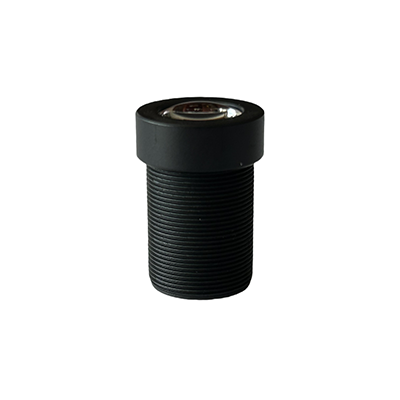
Table of Contents
Key Takeaways
- Industrial lens are the core of machine vision systems, directly impacting imaging resolution, distortion, and stability.
- Core selection factors: sensor size matching, mount type (M12/S-Mount, C-Mount, CS-Mount), resolution, focal length, and application scenarios.
- 2026 industrial lens trends: high megapixel, low distortion, IR-corrected, compact design, and custom optical solutions.
- TOWIN offers professional, fast-delivered industrial lenses (standard & custom) to meet all industrial imaging needs.
- Quick selection rule: Lens format ≥ sensor format, lens megapixel ≥ camera megapixel, mount compatibility with camera.
1. Introduction
In 2026, industrial imaging technologies (machine vision, intelligent traffic, robotics, and surveillance) are evolving rapidly, and the industrial lens – as the “eye” of these systems – directly determines the accuracy, efficiency, and cost-effectiveness of your operations. Choosing the wrong lens can lead to blurred images, measurement errors, and wasted investment.
This guide is designed for engineers, buyers, and decision-makers in the industrial sector. It breaks down the selection process step by step, explains key parameters in simple terms, and provides TOWIN’s professional lens recommendations – tailored to help you find the perfect optical solution quickly and easily.
2. Key Optical Definitions You Must Know
Before selecting an industrial lens, it’s critical to understand basic optical terms – this avoids confusion and ensures you make informed decisions.
2.1 Core Optical Terms Explained
- Resolution: The ability of a lens to capture fine details, measured in lp/mm (line pairs per millimeter). It must match the camera’s pixel size to avoid wasting camera performance.
- Distortion: A deviation from the real geometric shape of the imaged object. Low distortion (<0.5%) is essential for precision measurement and positioning applications.
- Focal Length: The distance from the lens center to the image sensor, which determines the field of view (FOV) and working distance. Shorter focal length = wider FOV; longer focal length = narrower FOV.
- Field of View (FOV): The actual area captured by the lens-camera system. It depends on focal length, working distance, and sensor size.
- Depth of Field (DOF): The range of distances where objects remain in focus. A larger DOF is ideal for inspecting objects of varying heights; a smaller DOF is better for focusing on specific details.
- Aperture (F-number): Controls the amount of light entering the lens. A lower F-number means more light (brighter image) but smaller DOF; a higher F-number means less light but larger DOF.
- Sensor Format: The size of the camera’s image sensor (e.g., 1/4″, 1/3″, 1/2″, 2/3″, 1″). The lens format must be equal to or larger than the sensor format to avoid vignetting (dark edges).
- Mount Interface: The physical connection between the lens and camera, with specific flange back distances (distance from lens mount to sensor). Incompatible mounts will cause focus failure.
3. 2026 Industrial Lens Core Selection Parameters
The right industrial lens depends on matching key parameters to your camera and application. Below are the most critical factors to consider in 2026.
3.1 Sensor Size Matching (Critical for Clear Imaging)
The most common mistake in lens selection is using a lens with a smaller format than the camera’s sensor. This causes vignetting, reduced resolution, and dark corners. Use the table below to match sensor size to recommended lens format:
Sensor Size | Horizontal Dimension (mm) | Vertical Dimension (mm) | Recommended Lens Format | Common Applications |
|---|---|---|---|---|
1/4″ | 3.6 | 2.7 | ≥1/4″ | Miniature cameras, drones, small vision modules |
1/3″ | 4.8 | 3.6 | ≥1/3″ | Basic surveillance, entry-level machine vision |
1/2″ | 6.4 | 4.8 | ≥1/2″ | Mid-range machine vision, traffic monitoring |
2/3″ | 8.8 | 6.6 | ≥2/3″ | High-precision inspection, industrial positioning |
1″ | 12.8 | 9.6 | ≥1″ | Semiconductor measurement, high-res imaging |
3.2 Mount Types: M12/S-Mount vs C-Mount vs CS-Mount
Mount type determines compatibility with your camera. TOWIN offers all three main mount types, each tailored to specific industrial scenarios:
Mount Type | Flange Back Distance | Key Features | TOWIN Lens Options | Common Applications |
|---|---|---|---|---|
M12/S-Mount (M12×0.5) | Variable (compact) | Miniature, lightweight, board-mounted, low cost | Low Distortion, Fisheye, Wide Angle, Low Light Sensitive, Pinhole, Automotive lenses | PCB cameras, mini vision modules, drones, automotive systems |
C-Mount | 17.526 mm | Stable, supports large formats, high resolution | 12MP–45MP FA/MV lenses, ITS traffic lenses | Machine vision, industrial cameras, traffic monitoring (Intelligent Traffic Systems) |
CS-Mount | 12.526 mm (5mm less than C-Mount) | IR-corrected, multi-coating, day/night compatible | Fixed/Vari-Focal, Manual/DC Auto/P-Iris megapixel lenses | CCTV, Network/IP cameras, video surveillance |
3.3 Resolution & Megapixel Matching
Lens resolution must match or exceed the camera’s megapixel count to ensure sharp images. In 2026, high-megapixel lenses are increasingly popular for precision applications:
- 1MP–5MP: Entry-level inspection, basic monitoring (cost-effective option)
- 8MP–12MP: Mid-range machine vision, product recognition, traffic monitoring
- 15MP–45MP: High-precision measurement, semiconductor inspection, medical imaging
Rule of thumb: Lens megapixel ≥ Camera megapixel – this avoids “soft” images and ensures you maximize your camera’s performance.
3.4 Focal Length & FOV Calculation
Focal length directly affects the field of view (FOV) and working distance. Use this simple formula to calculate the required focal length:
Focal Length = (Sensor Size × Working Distance) / FOV
- Short focal length (2mm–12mm): Wide FOV, close working distance (ideal for large-area inspection)
- Medium focal length (12mm–50mm): Balanced FOV and working distance (most common for general industrial use)
- Long focal length (50mm+): Narrow FOV, long working distance (ideal for remote inspection, e.g., traffic cameras)
3.5 Special Features for 2026 Applications
- IR Correction: Essential for day/night surveillance cameras – prevents focus shift between visible and infrared light (TOWIN’s CS-Mount lenses feature multi-coating for IR correction).
- Low Distortion: Critical for measurement and positioning (TOWIN offers low distortion lenses with <0.5% distortion).
- Telecentric Lenses: No perspective error, perfect for high-precision gauging (ideal for semiconductor and medical applications).
- Low Light Sensitivity: For industrial environments with poor lighting (e.g., factory interiors, night inspection).
4. Step-by-Step Industrial Lens Selection Process (2026 Updated)
Follow this 8-step workflow to select the right industrial lens – no guesswork, no wasted time:
- Confirm Camera Sensor Size: Check your camera’s sensor size (1/3″, 1/2″, etc.) – this is the first and most critical step.
- Choose Compatible Mount Type: Select M12, C, or CS-Mount based on your camera’s interface (refer to Section 3.2).
- Match Resolution/Megapixel: Ensure the lens megapixel is equal to or higher than the camera’s megapixel.
- Calculate Focal Length: Use the FOV and working distance of your application to calculate the required focal length (Section 3.4).
- Define Aperture & DOF Requirements: Determine if you need a large DOF (for multi-height objects) or small DOF (for focused details).
- Select Special Features: Choose IR correction, low distortion, or telecentric features based on your application (Section 3.5).
- Confirm Budget & Delivery: TOWIN offers both standard lenses (fast delivery) and custom solutions (tailored to your needs).
- Verify with TOWIN Technical Support: Contact our team to confirm compatibility and get personalized recommendations.

12-50mm-P-Iris-CS-Mount Industrial lens
5. TOWIN Industrial Lens Recommendations 2026
As a professional optical lens supplier, TOWIN offers a full range of industrial lenses – standard and custom – to meet all your 2026 needs. Our lenses are designed, manufactured, and shipped quickly from China, with strict quality control.
5.1 M12/S-Mount Lenses (Compact & Cost-Effective)
- CCL13035MPF: 1/3″ 5MP Low Distortion M12 lens – ideal for mini vision modules
- S02112810822F: 1/2.8″ 8MP Wide Angle M12 lens – perfect for drones and compact cameras
- CCL1212MPR: 1/2″ 5MP IR-Corrected M12 lens – for night vision applications
- Custom options: Pinhole, Fisheye, Automotive M12 lenses (tailored to your specs)
5.2 C-Mount Lenses (Industrial & High-Stable)
- C3511014M12IR: 2/3″ 12MP FA/Machine Vision C-Mount lens – for industrial inspection
- C5001428M45: 1.4″ 45MP High-Res C-Mount lens – for precision measurement
- ITS Traffic Lenses: C-Mount lenses optimized for intelligent traffic systems (license plate recognition, traffic flow monitoring)
5.3 CS-Mount Lenses (Surveillance & Day/Night)
- CCL23060MPCS: 2/3″ 5MP CS-Mount lens – IR-corrected for day/night CCTV
- CS105011814P8: 1/1.8″ 8MP CS-Mount lens – high resolution for IP cameras
- Vari-Focal CS-Mount lenses: Manual/DC Auto/P-Iris options for flexible surveillance
5.4 Custom Optical Solutions
TOWIN offers custom lens design and manufacturing – we can tailor lenses to your specific size, focal length, distortion, coating, and mounting requirements. Fast prototyping and mass production are available, with quick delivery to meet your project timeline.
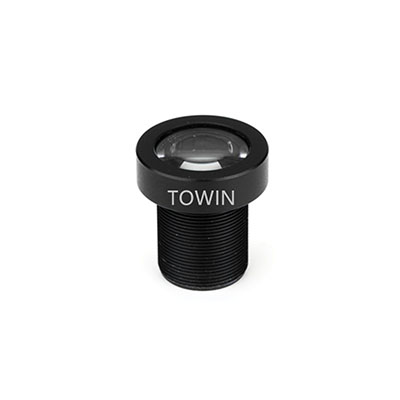
M12 fixed-focus CCTV industrial lens
6. Typical Industrial Lens Application Scenarios
Different applications require different lens specifications. Below are the most common 2026 industrial scenarios and TOWIN’s recommended lenses:
6.1 Machine Vision & Factory Automation
- Requirements: High resolution, low distortion, stable performance
- TOWIN Recommendations: C-Mount 8MP–45MP FA lenses, low distortion M12 lenses
- Use Cases: Electronics assembly, defect inspection, product positioning
6.2 Intelligent Traffic Systems (ITS)
- Requirements: Weather-resistant, IR-corrected, long working distance
- TOWIN Recommendations: C-Mount ITS traffic lenses, high-sensitivity CS-Mount lenses
- Use Cases: License plate recognition, traffic flow monitoring, road safety
6.3 Security & CCTV Surveillance
- Requirements: Day/night compatibility, compact design, wide FOV
- TOWIN Recommendations: IR-corrected CS-Mount lenses, wide-angle M12 lenses
- Use Cases: Building security, retail monitoring, perimeter protection
6.4 Robotics & UAVs
- Requirements: Lightweight, compact, shock-resistant
- TOWIN Recommendations: Miniature M12 lenses (Fisheye, Wide Angle)
- Use Cases: Drone vision, robotic arm inspection, narrow-space imaging
6.5 Precision Measurement & Semiconductor
- Requirements: Ultra-low distortion, high resolution, telecentric design
- TOWIN Recommendations: 15MP–45MP C-Mount lenses, telecentric lenses
- Use Cases: Semiconductor inspection, medical device measurement, micro-imaging
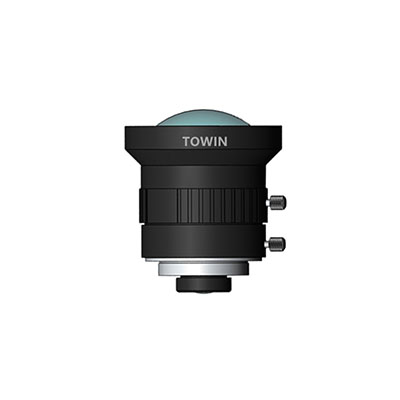
1/1.8″, 4.5mm low distortoin wide angle C mount industrial lens
7. FAQs
Q1: Can I use a C-Mount lens on a CS-Mount camera, or vice versa?
A: C-Mount lenses can be used on CS-Mount cameras with a 5mm adapter (to compensate for the 5mm difference in flange back distance). However, CS-Mount lenses cannot be used on C-Mount cameras – this will cause focus failure and blurred images.
Q2: What happens if the lens format is smaller than the sensor size?
A: You’ll experience vignetting (dark edges around the image), reduced effective resolution, and distorted colors. Always choose a lens with a format equal to or larger than your camera’s sensor (refer to Section 3.1).
Q3: Do I need an IR-corrected lens for my surveillance camera?
A: Yes, if your camera is used for day/night surveillance. IR-corrected lenses (like TOWIN’s CS-Mount lenses) prevent focus shift between visible light (day) and infrared light (night), ensuring clear images 24/7.
Q4: How long does TOWIN take to deliver custom industrial lenses?
A: TOWIN offers fast delivery – standard lenses are shipped within 3–5 business days. Custom lenses have a quick prototyping period (7–10 days) and mass production delivery within 2–4 weeks, depending on your order quantity.
Q5: Can TOWIN help me match a lens to my existing camera?
A: Yes! Contact our technical support team with your camera’s sensor size, mount type, and application details, and we’ll recommend the perfect lens – free of charge. Email us at info@towin-elec.com.
8. Quick Selection Flowchart (2026)
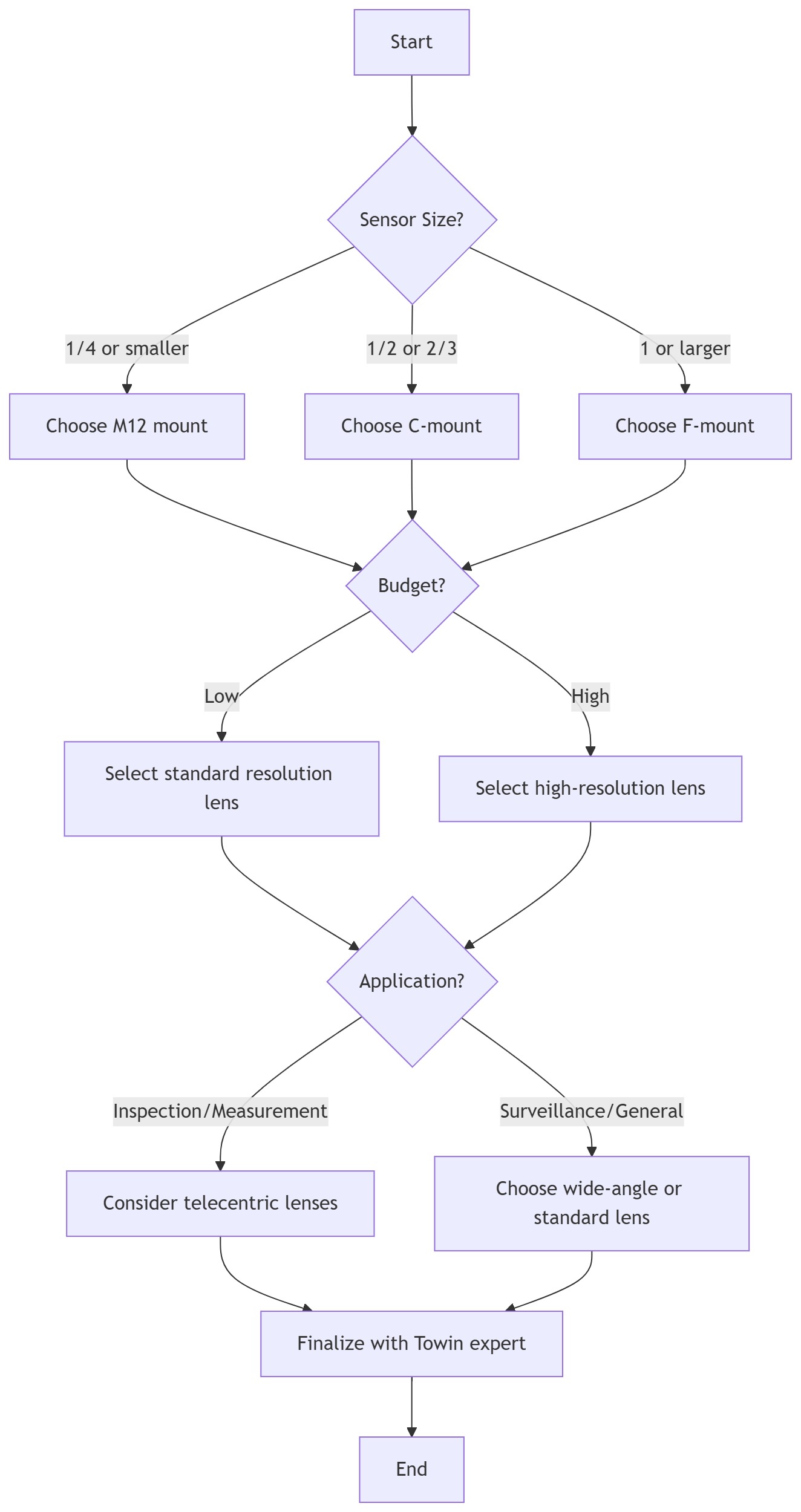
Quick Selection Flowchart
9. Conclusion
Selecting the right industrial lens in 2026 doesn’t have to be complicated – by focusing on sensor size, mount type, resolution, and application needs, you can choose a lens that improves your system’s accuracy, reduces costs, and ensures long-term stability.
TOWIN is your trusted partner for industrial lenses – we offer professional design, fast manufacturing, and reliable support to meet all your optical needs. Whether you need a standard lens or a custom solution, we’re here to help.
For more information, custom quotes, or technical support, contact TOWIN today: info@towin-elec.com
Related posts
08/11/2026
07/16/2026