


1/3″ 3.7mm M12 Pinhole CCTV lens
03/10/2026
Hidden pinhole camera lens
03/11/2026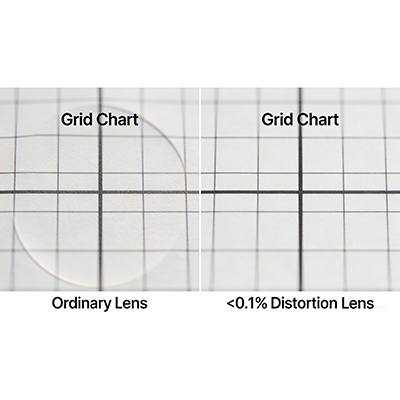
Table of Contents
Key Takeaways
- Lenses with <0.1% distortion (Low distortion lens) feature near-zero optical distortion, ensuring no edge deformation in images, which is critical for high-precision scenarios.
- Optical Distortion refers to the deviation of light from its ideal path, while TV Distortion describes the curvature of image edges; high-precision users prioritize Optical Distortion for sub-pixel measurement.
- Compared to standard lenses (1%-3% distortion), <0.1% low distortion lenses offer superior edge sharpness, require minimal software correction, and excel in precision measurement scenarios.
- When selecting a <0.1% distortion lens, focus on sensor size compatibility, working distance, and resolution matching (10MP/20MP high-pixel cameras are recommended).
- Towin achieves <0.1% distortion through precision optical design, providing customized solutions for industries like PCB inspection, automated alignment, and document digitization.
Introduction
In precision imaging applications—such as PCB inspection, dimensional measurement, and semiconductor quality control—even the smallest margin of error can lead to catastrophic results. A mere 1% distortion in a lens can cause fatal deviations in measurement data, resulting in defective products, production delays, and increased costs. For businesses that prioritize accuracy, <0.1% Distortion lens are not an option, but a necessity.
What Is a Lenses with <0.1% Distortion?
A Lenses with <0.1% Distortion, also known as a near-zero distortion lens, is an optical lens designed to minimize optical distortion to less than 0.1%. Optical distortion is the phenomenon where light rays deviate from their ideal path as they pass through the lens, causing image edges to stretch, compress, or bend. A lens with <0.1% distortion eliminates this issue almost entirely, ensuring that the captured image is a true, undistorted representation of the object—critical for applications that demand sub-pixel level precision.
Towin’ Commitment to Precision
At Towin, we specialize in designing and manufacturing high-performance optical lenses that meet the most stringent precision requirements. Our <0.1% low distortion lens series achieves this exceptional performance through advanced optical design, high-quality lens materials (such as low-birefringence optical glass), and rigorous quality control processes. We integrate aspherical lenses and complex optical structures to correct distortion at the source, delivering reliable, consistent imaging for even the most demanding industrial and scientific applications .
Deep Dive: TV Distortion vs. Optical Distortion
When evaluating lens distortion, two key standards are commonly used: TV Distortion and Optical Distortion. Understanding the difference between these two is essential for choosing the right lens for your precision application.
| Distortion Type | Definition | Key Focus | Relevance for <0.1% Distortion Users |
| Optical Distortion | The degree to which light rays deviate from their ideal path as they pass through the lens. | Accuracy of light propagation and geometric fidelity of the image. | Highly relevant—critical for sub-pixel precision measurement, as it directly affects data accuracy <superscript:3>. |
| TV Distortion | The degree to which the edges of an image appear curved on a display or sensor. | Visual appearance of the image edge. | Less critical for precision measurement, but still important for applications requiring visual clarity (e.g., document scanning). |
For users seeking <0.1% distortion performance, the primary concern is Optical Distortion. This is because precision applications like PCB line width measurement and automated robot alignment rely on the lens to capture the true geometric shape of the object—any deviation in light path (Optical Distortion) will directly impact measurement accuracy, even if the image edge appears visually straight (TV Distortion).
The 0.1% Difference: <0.1% Distortion Lenses vs. Standard Lenses
The gap between Lenses with <0.1% distortion and standard lenses is far more than just a numerical difference—it translates to a significant improvement in imaging accuracy, reliability, and efficiency. Below is a detailed comparison to highlight the key advantages of Towin’ <0.1% distortion lenses:
| Feature | Standard Lens | <0.1% Low Distortion Lens |
| Distortion Rate | 1% – 3% (or higher), leading to noticeable edge deformation. | <0.1% (near-zero distortion), ensuring true-to-life image geometry. |
| Edge Sharpness | Weak; edge blurring caused by stretching or compression. | Extremely high; maintains original spatial frequency for clear, detailed edges <superscript:6>. |
| Applicable Scenarios | General surveillance, basic object recognition, and non-precision imaging. | Precision measurement, AOI (Automated Optical Inspection), medical imaging, semiconductor inspection, and document digitization <superscript:3>. |
| Software Correction Requirement | Requires heavy algorithmic correction, which loses pixel information and reduces efficiency. | No or minimal software correction needed, preserving original image data and saving processing time. |
| Optical Structure | Simple design with fewer lenses; lower manufacturing precision. | Complex structure with aspherical lenses and high-precision alignment; uses high-quality optical materials <superscript:6>. |
Selection Guide: How to Choose the Right <0.1% Distortion Lens
Choosing the right <0.1% low distortion lens requires considering several key factors to ensure compatibility with your imaging system and application needs. Follow this guide to make an informed decision:
- Sensor Size Compatibility: Ensure the lens’ image circle fully covers your camera’s sensor. Common sensor sizes for precision applications include 1/1.8″, 2/3″, and 1″. A mismatched sensor size will result in vignetting or incomplete imaging. Towin offers <0.1% distortion lenses compatible with all major sensor sizes to meet diverse application needs.
- Working Distance: Most Lenses with <0.1% distortion perform optimally at a specific working distance (the distance between the lens and the object). Determine your application’s required working distance (e.g., short-distance PCB inspection vs. long-distance precision measurement) and select a lens that matches this range. Towin provides lenses with adjustable working distances for flexible use.
- Resolution Matching: <0.1% distortion lenses are designed to work with high-pixel cameras to maximize precision. We recommend pairing them with 10MP or 20MP high-resolution cameras to ensure that the lens’ near-zero distortion and high edge sharpness are fully utilized. Mismatching a low-resolution camera with a <0.1% distortion lens will waste the lens’ performance.
- Application-Specific Requirements: Consider additional needs such as depth of field, light transmission, and environmental resistance (e.g., industrial harsh environments). For example, semiconductor inspection may require lenses with high light transmission, while outdoor precision imaging may need dust-proof and waterproof designs.
Explore Towin’ Low Distortion Lens Series to find the perfect lens for your application, or contact our team for personalized recommendations.
Application Scenarios: Industries That Need <0.1% Distortion Lenses
Lenses with <0.1% distortion are indispensable in industries where precision is non-negotiable. Below are the key sectors that benefit most from Towin’ high-performance low distortion lenses:
- PCB & Semiconductor Inspection: In PCB manufacturing, measuring the width of circuit lines, the distance between pins, and detecting tiny defects requires absolute geometric accuracy. Towin’ <0.1% distortion lenses ensure that even the smallest details are captured correctly, reducing defective products and improving production efficiency .
- Automated Alignment & Robotics: Industrial robots and automated assembly lines rely on precise imaging to抓取 objects, align components, and complete assembly tasks. A <0.1% distortion lens provides the accurate spatial information needed for robot arms to perform precise movements, reducing errors and improving production speed.
- Document Digitization & Scanning: For libraries, archives, and businesses that need to digitize documents, blueprints, or historical records, edge distortion can cause text or graphics to appear skewed. Towin’ low distortion lenses ensure that scanned documents are true to the original, preserving every detail for long-term storage and retrieval.
- Medical Imaging: In medical applications such as microscopic imaging, endoscopy, and medical device inspection, precision is critical for accurate diagnosis and treatment. <0.1% distortion lenses capture clear, undistorted images of cells, tissues, or medical devices, supporting healthcare professionals in making informed decisions.
- Precision Metrology: In fields such as aerospace, automotive manufacturing, and precision engineering, measuring the dimensions of components (e.g., engine parts, aerospace components) requires sub-millimeter accuracy. Towin’ <0.1% distortion lenses work with metrology systems to deliver reliable measurement data.
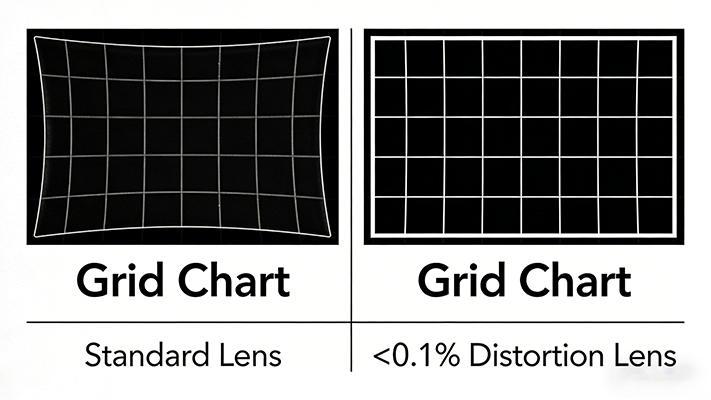
normal lens vs <0.1% ultra-low distortion industrial lens
FAQs
1. Why can’t I just use software to correct 2% distortion instead of buying a <0.1% distortion lens?
Software correction works by cropping or stretching pixels to compensate for distortion, which inevitably loses edge pixel information and reduces image resolution. This is unacceptable for precision measurement applications, where every pixel matters. A physical <0.1% distortion lenses captures the original, undistorted image, preserving all data and ensuring maximum accuracy .
2. Are <0.1% distortion lenses more expensive than standard lenses?
Yes, <0.1% distortion lenses are typically more expensive. This is because they require more complex optical design, high-quality materials (such as aspherical lenses and low-birefringence glass), and rigorous quality control to achieve near-zero distortion . However, the investment is worth it for applications where precision is critical—reducing errors, improving efficiency, and avoiding costly rework.
3. Are <0.1% distortion lenses suitable for wide-angle applications?
Achieving <0.1% distortion in a wide-angle lens is extremely challenging. Wide-angle lenses inherently have a larger field of view, which tends to cause significant distortion (barrel distortion or pincushion distortion). While it is possible to design wide-angle lenses with <0.1% distortion, it requires advanced optical engineering and is often more costly. Towin offers specialized wide-angle low distortion lenses for applications that require both a wide field of view and high precision.
4. Can Towin provide customized <0.1% distortion lenses for my specific application?
Yes! Towin has a team of experienced optical engineers who can design and manufacture customized <0.1% low distortion lenses tailored to your unique requirements, including sensor size, working distance, resolution, and environmental conditions. Contact our team to discuss your project needs.
Conclusion & Call to Action
In precision imaging systems, <0.1% distortion is not a luxury—it’s a necessity. Whether you’re in PCB manufacturing, automated robotics, medical imaging, or precision metrology, the accuracy of your lens directly impacts the quality of your products, the efficiency of your operations, and the success of your business. Towin’ Lenses with <0.1% distortion series delivers the exceptional optical performance you need, backed by rigorous quality control and personalized support.
Ready to elevate your precision imaging? Take the next step with Towin:
- Contact our optical experts: info@towin-elec.com
Discuss your specific application needs and get a customized imaging solution tailored to your business.
At Towin, we’re committed to helping you achieve the highest level of precision in every image. Let’s work together to bring your precision imaging projects to life.