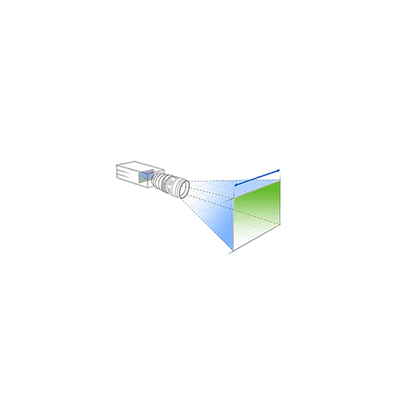



1/2.7″ 3.2mm M12 wide-angle lens
12/24/2025
8mm M12 CCTV lens IR corrected
12/25/2025Table of Contents
- Introduction
- Zoom Lens Basics
- Comprehensive Analysis of Zoom Lens Application Scenarios
- Recommendation of 5 Common TOWIN Zoom Lenses
- TOWIN Zoom Lens Application Scenarios and Recommended Models Table
- Optical Performance, Image Stabilization, and Focusing Technology Evaluation
- Maintenance and Care Tips
- FAQs
- Conclusion
Introduction
With the intelligence of security monitoring and the refinement of traffic management, Zoom Lenses have become core imaging equipment in fields such as security surveillance, intelligent transportation, and commercial security. Whether you are an engineering company focusing on long-distance traffic violation capture, a store operator needing to cover indoor panoramic views, a property manager responsible for community security deployment, or an operation and maintenance team pursuing high-definition forensics, you all aim to find a zoom lens that fits your specific scenarios and offers stable performance. This guide will comprehensively analyze the advantages and adaptation logic of the TOWIN Zoom Lens series from multiple dimensions including application scenarios, core performance, and key specifications, helping you accurately select the optimal model and avoid common pitfalls.
Zoom Lens Basics
1. What is a Zoom Lens?
A zoom lens is an optical lens that can continuously adjust the focal length without changing the shooting distance by adjusting the relative position of internal lens groups, thereby realizing flexible switching of viewing angle width and image size.
From a technical evolution perspective, early surveillance lenses were mostly fixed-focus designs with a fixed focal length (e.g., 8mm, 12mm). A single fixed-focus lens could only cover a fixed viewing angle; to monitor both near and far scenes, multiple fixed-focus lenses with different focal lengths had to be installed, which not only incurred higher costs but also led to cumbersome installation and monitoring blind spots. With the advancement of optical design and precision manufacturing technology, zoom lenses achieve continuous focal length adjustment through the coordinated movement of multiple movable lens groups. A single zoom lens can replace multiple fixed-focus lenses, fundamentally solving the limitation of “one lens, one viewing angle” of fixed-focus lenses.
For CCTV surveillance scenarios, the core value of a zoom lens lies in the ability to switch from wide-range panoramic monitoring (short focal length, wide angle) to long-distance detail capture (long focal length, telephoto) by manually or automatically adjusting the focal length—no need to disassemble or move the camera. This makes it suitable for diverse monitoring needs in complex environments.
2. Core Advantages of Zoom Lenses
Comprehensive Scene Coverage: A single lens can switch between multiple focal length ranges. For example, a 2.8-12mm focal length lens can cover large areas with a 100° wide angle (e.g., shopping mall lobbies, parking lots) and focus on close-range details with a 31° narrow angle (e.g., product shelves, door handles), eliminating the need to replace lenses to balance panoramic and close-up monitoring.
Efficient Installation and Debugging: Compared to a combination of multiple fixed-focus lenses, zoom lenses reduce the number of devices and installation procedures. They also allow real-time focal length adjustment based on on-site conditions, enabling quick optimization of monitoring angles and lowering post-installation debugging costs.
Strong Low-Light and Day-Night Adaptability: Mainstream surveillance zoom lenses are generally equipped with large apertures (e.g., F1.4, F1.5) and infrared (IR) correction technology. Combined with automatic iris adjustment, they can increase light intake in low-light environments such as nights or cloudy days, while avoiding image distortion under infrared illumination, achieving clear 24/7 monitoring.
Cost-Effectiveness: The procurement cost of a high-quality zoom lens is usually lower than the total cost of multiple fixed-focus lenses of the same specification. It also reduces labor and time costs during installation and maintenance, delivering higher long-term cost performance.
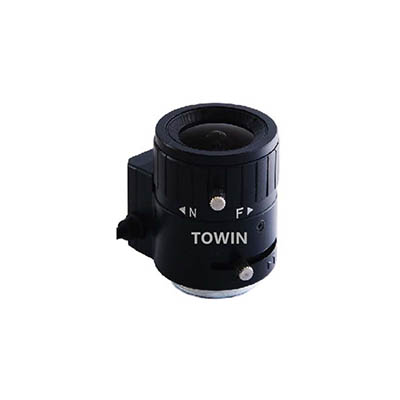
2.8-12mm F1.4 IR Corrected Lens , CCTV Zoom Lens
Comprehensive Analysis of Zoom Lens Application Scenarios
Based on the product characteristics of TOWIN’s 5 zoom lens models, their core application scenarios focus on two major fields: security surveillance and intelligent transportation. Detailed scenario breakdowns are as follows:
1. Traffic Monitoring (ITS Applications): Precise Matching of Telephoto and High Definition
The core requirements for lenses in traffic monitoring scenarios are “long-distance capture” and “high-definition recognition.” They need to clearly capture details such as license plates, vehicle models, and driver faces, while adapting to light changes in road environments (strong daylight, low-light nights).
- Recommended Lenses: Long focal length, high-resolution, large-aperture zoom lenses such as TOWIN C157511715A8 (15-75mm, 8-12MP, F1.5) and C167011714A8 (16-70mm, 8-12MP, F1.4).
- Core Requirements: A 15-75mm long focal length enables long-distance capture (e.g., cross-lane monitoring on highways and urban arterial roads); 8-12MP high resolution ensures clear recognition of license plate characters; F1.4-F1.5 large apertures enhance light intake in low-light environments; IR correction technology solves image blurriness under infrared supplementary lighting at night.
2. Security Surveillance: Scene Coverage of Short-Wide and Medium Focal Lengths
Security surveillance scenarios are diverse, and lenses with appropriate focal lengths should be selected based on the size of the monitoring range and distance:
- Close-Range Wide-Angle Monitoring (e.g., indoor lobbies, elevators, convenience stores): Suitable for short focal length, large viewing angle lenses such as TOWIN C281212M2 (2.8-12mm, 100°-31° viewing angle) and C06152314A3 (6-15mm, 77°-34° viewing angle). Short focal lengths enable large-area, blind-spot-free coverage, making them ideal for small spaces or scenarios requiring panoramic monitoring.
- Medium-Distance Monitoring (e.g., community walls, factory workshops, campus playgrounds): Suitable for medium focal length lenses such as TOWIN C084011814A5 (8-40mm, 47°-11° viewing angle). The 40mm telephoto end can cover detail monitoring at distances of 50-100 meters, while the 8mm wide-angle end balances large-range patrols, adapting to semi-open space monitoring needs.
3. Special Environment Monitoring: Low-Light and Day-Night Switching Requirements
Some monitoring scenarios (e.g., underground garages, tunnels, night roads) suffer from insufficient light, requiring lenses with strong low-light adaptability:
- Core Requirements: Large aperture (F1.4-F1.6) + automatic iris + IR correction. For example, TOWIN C06152314A3 (F1.4) and C084011814A5 (F1.4). The automatic iris can real-time adjust light intake based on light intensity, and IR correction technology ensures distortion-free and color-accurate images when infrared supplementary lights are turned on at night, achieving clear 24/7 imaging.
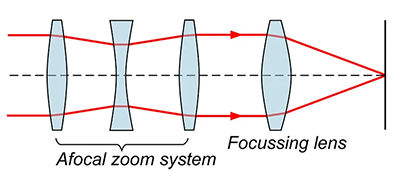
Zoom Lens
Recommendation of 5 Common TOWIN Zoom Lenses
The following 5 recommended zoom lenses focus on CCTV surveillance and ITS traffic applications, covering different focal length ranges, resolutions, and functional configurations to meet diverse monitoring needs:
1. Model: C06152314A3
Core Specifications:
- Focal Length Range: 6-15mm (medium-short focal length)
- Sensor Compatibility: 2/3″ (supports sensors such as CMV2000)
- Resolution: 3MP (high definition)
- Aperture: F1.4 (large aperture)
- Horizontal Field of View (H F.O.V.): 77°-34°
- Iris Type: DC Auto Iris
Special Features: IR Correction, Manual Focus/Zoom, Minimum Focus Distance 0.1m
Recommendation Reasons:
- The 6-15mm focal length is suitable for medium-short distance monitoring; the 77° wide angle covers large areas, and the 34° narrow angle focuses on details, making it ideal for communities, shopping malls, factories, etc.
- F1.4 large aperture + automatic iris ensures clear imaging in low-light environments; IR correction supports day-night monitoring.
- 3MP resolution meets high-definition surveillance needs, enabling clear recognition of human faces and object details with outstanding cost performance.
Application Scenarios: Community security, shopping mall monitoring, small and medium-sized factory workshops, ordinary road intersection monitoring.
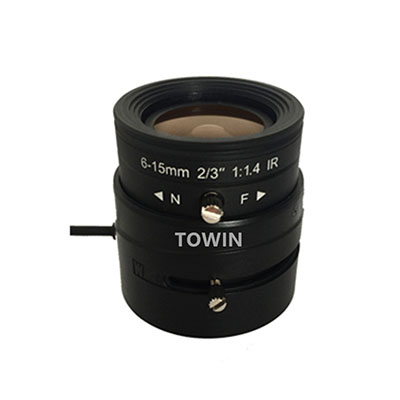
2/3″ 6-15mm Auto Iris F1.4 C mount IR corrected Zoom CCTV lens
2. Model: C084011814A5
Core Specifications:
- Focal Length Range: 8-40mm (medium-telephoto focal length)
- Sensor Compatibility: 1/1.8″ (supports sensors such as imx185, imx385, imx178)
- Resolution: 5MP (ultra-high definition)
- Aperture: F1.4 (large aperture)
- Horizontal Field of View (H F.O.V.): 47°-11°
- Iris Type: DC Auto Iris
Special Features: IR Correction, Manual Focus/Zoom, Minimum Focus Distance 0.1m, ITS Lens Compatible
Recommendation Reasons:
- The 8-40mm focal length covers medium-long distances; the 40mm telephoto end enables detail capture within 100 meters, suitable for roads, factory perimeters, and other scenarios requiring long-distance monitoring.
- 5MP ultra-high resolution combined with a 1/1.8″ large-size sensor delivers richer image details, enabling precise recognition of license plates and vehicle models.
- Marked as both “CCTV” and “ITS Lens,” it meets dual needs of security and traffic monitoring with strong compatibility.
Application Scenarios: Urban secondary road traffic monitoring, factory perimeter security, campus wall monitoring, parking lot entrance/exit capture.

8-40mm C mount IR corrected machine vision lenses
3. Model: C157511715A8
Core Specifications:
- Focal Length Range: 15-75mm (telephoto focal length)
- Sensor Compatibility: 1/1.7″ (supports sensors such as IMX324, IMX226)
- Resolution: 8-12MP (ultra-high definition)
- Aperture: F1.5 (large aperture)
- Horizontal Field of View (H F.O.V.): 26°-6°
- Iris Type: DC Auto Iris
Special Features: IR Correction, Manual Focus/Zoom, Minimum Focus Distance 1.5m, ITS Traffic-Specific
Recommendation Reasons:
- The 15-75mm telephoto focal length and 6° narrow angle enable precise long-distance capture within 200 meters, making it the first choice for highway and urban arterial road traffic monitoring.
- 8-12MP ultra-high resolution combined with a 1/1.7″ sensor clearly captures details such as license plates and driver faces, meeting traffic violation forensics needs.
- F1.5 large aperture enhances low-light adaptability; IR correction ensures distortion-free images under infrared supplementary lighting at night, suitable for 24/7 traffic monitoring.
Application Scenarios: Highway traffic monitoring, urban arterial road violation capture, bridge monitoring, long-distance key area monitoring (e.g., oil depots, power station perimeters).
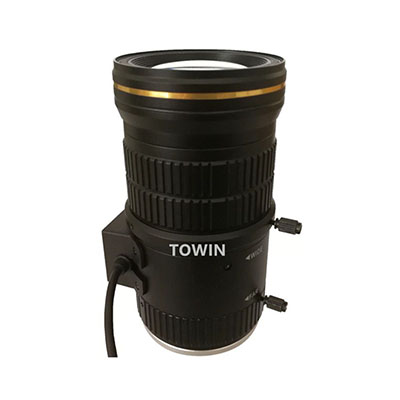
IR-corrected-ITS-traffic-C-mount-CCTV-lens
4. Model: C167011714A8
Core Specifications:
- Focal Length Range: 16-70mm (telephoto focal length)
- Sensor Compatibility: 1/1.7″ (supports sensors such as IMX324, IMX226)
- Resolution: 8-12MP (ultra-high definition)
- Aperture: F1.4 (extra-large aperture)
- Horizontal Field of View (H F.O.V.): 26°-6°
- Iris Type: DC Auto Iris
Special Features: IR Correction, Manual Focus/Zoom, Minimum Focus Distance 1.5m, ITS Traffic-Specific
Recommendation Reasons:
- Similar to the C157511715A8, the 16-70mm telephoto focal length is suitable for long-distance traffic monitoring with comparable viewing angle and telephoto performance.
- Its core advantage is the F1.4 extra-large aperture, which allows more light intake than F1.5, delivering better imaging results in low-light environments (e.g., tunnels, night roads without streetlights).
- 8-12MP ultra-high resolution + IR correction balances detail recognition and day-night adaptability, making it suitable for traffic monitoring scenarios with high low-light performance requirements.
Application Scenarios: Tunnel traffic monitoring, night key road capture, highway toll station monitoring, long-distance security forensics.
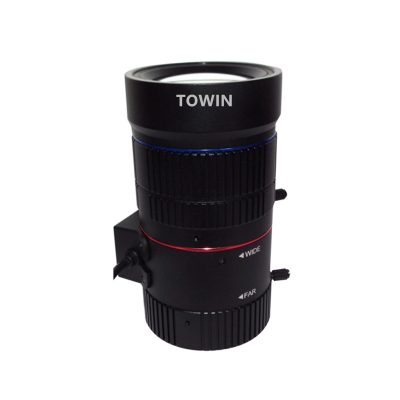
70mm C-mount ITS traffic road CCTV lens
5. Model: C281212M2
Core Specifications:
- Focal Length Range: 2.8-12mm (short-wide focal length)
- Sensor Compatibility: 1/2″
- Resolution: 2MP (high definition)
- Aperture: F1.6 (large aperture)
- Horizontal Field of View (H F.O.V.): 100°-31°
- Iris Type: Manual Iris
Special Features: IR Correction, Manual Focus/Zoom, Minimum Focus Distance 0.1m
Recommendation Reasons:
- The 2.8mm short focal length combined with a 100° ultra-wide angle is an ideal choice for indoor small-space monitoring, enabling blind-spot-free coverage.
- The manual iris design features a simple structure and low cost, suitable for scenarios with stable light (e.g., indoor lobbies, elevators, underground garages with fixed lighting).
- 2MP resolution meets basic high-definition surveillance needs; IR correction supports night infrared monitoring with high cost performance, suitable for small and medium-sized scenarios with limited budgets.
Application Scenarios: Elevator monitoring, convenience stores, offices, underground garages (stable light environments), small store security.
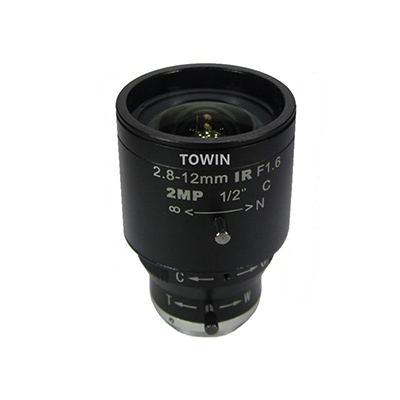
2.8-12mm IR corrected C mount Zoom lens
TOWIN Zoom Lens Application Scenarios and Recommended Models Table(999)
| Application Scenario | Core Requirements | Compatible TOWIN Zoom Lens Model | Focal Length Range | Recommendation Rationale (Based on Core Lens Parameters) |
| Indoor Close-Range Panoramic Surveillance | Wide-angle coverage, no blind spots, stable lighting, cost-effective | C281212M2 | 2.8-12mm | 2.8mm short focal length + 100° ultra-wide angle, compatible with 1/2″ sensors, ideal for small spaces like elevators or convenience stores; 2MP HD + IR correction for nighttime infrared surveillance. |
| Indoor/Outdoor Medium-Range Security Surveillance | Balanced panoramic and detail capture, low-light adaptability, high-definition recognition (faces/objects) | C06152314A3 | 6-15mm | 6-15mm medium-short focal length (77°-34° field of view), 3MP resolution; F1.4 large aperture + auto-iris, suitable for medium-range scenarios like residential areas, malls, or factories. |
| Outdoor Medium-Range Traffic/Security Surveillance | Medium-to-long focal length coverage, ultra-HD detail (license plates/vehicle types), day/night adaptability | C084011814A5 | 8-40mm | 8-40mm medium-to-long focal length (47°-11° field of view), 5MP ultra-HD; F1.4 large aperture + IR correction, supports long-distance capture on urban secondary roads or factory perimeters. |
| Outdoor Long-Range Traffic Capture/Evidence Collection | Long-focal precision capture, ultra-HD clarity (license plates/driver faces), strong low-light adaptability | C157511715A8, C167011714A8 | 15-75mm | 15-75mm/16-70mm long focal length (26°-6° field of view), 8-12MP ultra-high resolution; F1.4/F1.5 large aperture + IR correction, ideal for high-speed or main road violation evidence collection. |
| Special Low-Light Environment Surveillance (Tunnels/Underground Parking Lots) | High light intake, distortion-free imaging, clear day/night switching | C167011714A8, C084011814A5 | 8-70mm | F1.4 ultra-large aperture enhances low-light intake; IR correction ensures distortion-free imaging under infrared illumination, suitable for tunnels or roads without streetlights at night. |
| Small-to-Medium Business Security (Shops/Offices) | Cost-effective, easy installation, basic HD surveillance | C281212M2, C06152314A3 | 2.8-15mm | Manual/auto-iris options, simple structure for easy maintenance; focal length coverage of 2.8-15mm meets panoramic + detail surveillance needs for small-to-medium spaces. |
Key Notes:
- Focal Length Interpretation: Shorter focal lengths (e.g., 2.8mm) provide wider angles for panoramic views, while longer focal lengths (e.g., 75mm) enable precise detail capture.
- IR Correction: Ensures color accuracy and distortion-free imaging under infrared lighting, critical for nighttime surveillance.
- Aperture Size (F-number): Lower values (e.g., F1.4) indicate larger apertures, improving low-light performance.
- Resolution: Higher megapixel counts (e.g., 8MP) support finer detail recognition, such as license plate numbers or facial features.
Optical Performance, Image Stabilization, and Focusing Technology Evaluation
1. Sharpness and Resolution:
As a core indicator of lens image quality, sharpness directly determines the clarity of image details. Resolution is measured in pixels (MP), commonly 2MP (1080P), 3MP, 5MP, 8MP, and above. Higher resolution means stronger detail rendering capability (e.g., an 8MP lens has four times the pixels of a 2MP lens, clearly rendering fine details such as distant license plate edges and facial features).
- Suitable Scenarios: Basic surveillance (indoor panoramas, no detail recognition requirements) requires 2MP; general detail recognition (faces, objects) requires 3MP-5MP; high-precision evidence collection (license plates, driver faces, text markings) requires 8MP or higher ultra-high resolution lenses.
- Testing Techniques: When purchasing, request sample images from the manufacturer. Focus on observing the difference in sharpness between the edges and center of the image (high-quality lenses have similar edge and center sharpness) and the sharpness of details and contours (no blurring or ghosting). Avoid inferior products that are “sharp in the center but blurry at the edges.”
2. Chromatic Aberration Control:
Chromatic aberration (dispersion) is a common problem in optical lenses. It refers to the different angles at which different wavelengths of light refract, causing purple or green fringing at the edges of the image, affecting image sharpness and color accuracy. This is more noticeable in high-contrast environments (sunny days under trees, nighttime near lights), easily causing blurring of details such as license plates and faces.
- Selection Points: Prioritize lenses labeled “IR correction” or “chromatic aberration correction” (e.g., all TOWIN recommended lenses have IR correction, which reduces chromatic aberration under infrared light). Large-aperture lenses (F1.4, F1.5) should be paired with high-quality optical glass and multi-layer coating technology. Inquire about lens materials and coating processes during purchasing.
- Test Method: Shoot in high-contrast scenes such as the edge of a white wall and metal signs. Lenses without obvious purple or green fringing are more suitable for high-precision monitoring.
3. Optical Image Stabilization (OIS):
Most surveillance lenses are fixedly installed (wall-mounted, pole-mounted), eliminating handheld shake issues. Mainstream CCTV zoom lenses typically do not include OIS.
- Special Scenario Requirements: Only mobile monitoring scenarios (vehicle-mounted monitoring, drone monitoring) require OIS to counteract movement.
- Selection Recommendations: For fixed installation scenarios (roads, residential areas, indoors), OIS is not a primary concern; focus on lens installation stability (bracket load-bearing capacity, interface sturdiness). For mobile monitoring scenarios, choose a zoom lens specifically equipped with OIS to ensure clear images during movement.
4. Fast Focusing System:
Survey lenses primarily use manual focus, with some high-end models supporting autofocus. The core requirements are accurate and stable focusing, eliminating the need for frequent adjustments after initial setup.
- Manual Focusing Tips: After installation, first adjust the focal length to its longest setting (telephoto end), accurately focus on the target (license plate, face area), then adjust to a suitable focal length (after achieving accurate focus at the telephoto end, the short focal length usually doesn’t need to be refocused). It’s recommended to choose a lens with a “focus lock” function to avoid accidental focus shift later.
- Autofocus Adaptation: Only suitable for scenarios where the monitored target moves frequently (densely populated areas in shopping malls, dynamic security patrols). It can improve monitoring efficiency, but its response speed and accuracy should be monitored.
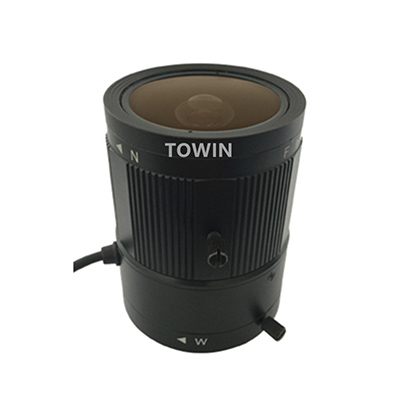
3.8-18mm C mount IR corrected Zoom CCTV lens
Maintenance and Care Tips
1. Daily Cleaning
- Lens surfaces are prone to dust and fingerprints. Clean them with a professional microfiber cloth—avoid rough materials such as paper towels or rags that may scratch the lens coating.
- For oil stains on the lens surface, apply 1-2 drops of professional lens cleaning fluid (alcohol-based) and gently wipe with a microfiber cloth. Do not spray cleaning fluid directly onto the lens.
2. Environmental Protection
- Ensure outdoor lenses are properly sealed during installation to prevent rainwater and dust from entering the interior.
- For high-temperature environments (e.g., poles exposed to direct sunlight in summer), select lenses made of high-temperature-resistant materials to avoid lens glue melting or lens deformation.
- For low-temperature environments (e.g., northern winters), pay attention to lens condensation. Choose lenses with anti-condensation function or reserve ventilation space during installation.
3. Operation and Storage
- When manually adjusting focus or zoom, use gentle force to avoid displacing the lens groups due to excessive pressure.
- When not in use, store the lens in a dry, well-ventilated box to prevent lens mold growth in humid environments.
- Regularly check the firmness of the lens interface and bracket to avoid lens loosening or focus shift caused by long-term vibration.
FAQs
Is the image quality of zoom lenses always inferior to fixed-focus lenses?
Early zoom lenses had inferior image quality to fixed-focus lenses due to design limitations. However, modern high-end zoom lenses (e.g., “holy trinity” series) have achieved image quality close to fixed-focus lenses—especially in center sharpness—through complex optical designs.
Can image-stabilized lenses completely replace tripods?
Image-stabilized lenses improve hand-held shooting stability, but tripods remain indispensable for long-exposure photography (e.g., night scenes) or ultra-telephoto shooting.
What is the difference between “constant aperture” and “variable aperture” in zoom lenses?
A constant aperture (e.g., 24-70mm f/2.8) maintains the same aperture throughout the focal length range, suitable for low-light conditions or shallow depth of field, but is larger and more expensive. A variable aperture (e.g., 18-135mm f/3.5-5.6) decreases as the focal length increases, having little impact on daytime shooting but requiring parameter adjustments in low light.
Is “zoom ring damping” important for zoom lenses?
How to judge its quality?Damping affects operational experience. High-quality lenses have moderate damping—neither too loose (which causes focal length slippage) nor too tight (which increases adjustment difficulty). To test, rotate the zoom ring evenly and check if the focal length changes linearly without jamming. Some lenses feature focal length locks to prevent accidental extension or retraction.
Conclusion
With flexible focal length adjustment, comprehensive scene coverage, and high cost-effectiveness, zoom lenses have become core equipment in modern security surveillance and intelligent transportation. The key to selecting the right zoom lens lies in accurately matching the three core factors: “monitoring distance, scene light conditions, and detail requirements.” When making a purchase, be sure to choose based on your specific needs and application scenarios. If you want to experience optical quality, enjoy stable imaging with low chromatic aberration interference and strong low-light adaptability, TOWIN Zoom Lens is definitely worth looking forward to!