


940nm TOF Lens Guide: Why 940nm Is Preferred for Modern Depth Sensing
06/09/2026
Industrial Lens Environmental Design: Ensuring Stable Performance in Harsh Conditions
06/09/2026
Relative illumination is one of the most important optical parameters in lens design. It describes how evenly light is distributed from the center of the image sensor to the corners.
For applications such as TOF depth sensing cameras, machine vision systems, and industrial inspection equipment, maintaining high relative illumination is essential for image consistency and measurement accuracy.
What Is Relative Illumination?
Relative illumination refers to the brightness ratio between the image center and the image edge.
If the center of an image receives significantly more light than the corners, the lens exhibits low relative illumination.
This phenomenon is commonly associated with image vignetting.
Understanding relative illumination is just as important as understanding lens distortion and sensor compatibility when selecting an industrial lens.
Why Matters
Improved Image Uniformity
Machine vision algorithms perform best when image brightness remains consistent across the entire field of view.
Uneven illumination can reduce edge detection accuracy and create processing inconsistencies.
Better Measurement Accuracy
Industrial inspection systems often require precise dimensional measurement.
Brightness variation can affect image processing reliability and measurement repeatability.
Enhanced TOF Depth Accuracy
In a TOF camera system, relative illumination directly impacts the quality of reflected infrared signals.
Poor edge illumination can reduce depth accuracy and introduce noise into 3D reconstruction.
This is one reason why modern 940nm TOF lenses place significant emphasis on optical uniformity.
Factors Affecting
Lens Design
Optical architecture determines how effectively light reaches the corners of the image sensor.
Sensor Size
Larger sensors require larger image circles and often demand better illumination control.
Before selecting a lens, engineers should review sensor size specifications.
Chief Ray Angle (CRA)
Chief ray angle strongly influences pixel acceptance efficiency.
Modern image sensors often require low CRA lenses to maintain edge brightness.
Image Circle Coverage
Insufficient image circle coverage can significantly reduce edge illumination.
Relative Illumination in TOF Applications
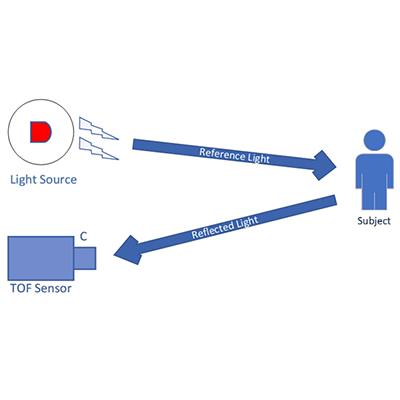
TOF cameras use infrared light to calculate distance information.
Because depth calculation relies on reflected signal strength, uniform illumination becomes critical.
Many high-performance TOF lenses are specifically optimized to improve relative illumination across the entire sensor.
Combined with low distortion and high infrared transmission, high relative illumination helps produce more accurate depth maps.
How to Improve
- Optimize lens optical design
- Reduce chief ray angle
- Increase image circle coverage
- Improve infrared coating efficiency
- Match lens design to sensor specifications
These design strategies are commonly used in modern M12 lenses and industrial machine vision optics.
Relative Illumination vs Vignetting
Relative illumination and vignetting are closely related concepts.
Low relative illumination often appears as visible corner darkening, which is known as vignetting.
However, relative illumination is typically measured quantitatively, while vignetting is usually observed visually.
Conclusion
Relative illumination is a critical optical parameter that affects image quality, machine vision performance, and TOF depth sensing accuracy.
When evaluating a lens, engineers should consider relative illumination alongside distortion, sensor compatibility, and infrared transmission performance.
Explore our TOF Lens Solutions and M12 Lens Solutions to learn more about high-performance industrial optics.