


Top 7 Global M12 Lens Manufacturers in 2026
04/16/2026
Edmund Optics vs. Kowa vs. Towin: Which is Best for You?
04/18/2026
Table of Contents
- Introduction
- Why Consistency Matters in High-Volume Lens Manufacturing
- Key Factors Affecting Quality & Consistency in High-Volume Production
- Parameter Consistency Comparison Table
- Towin High-Volume Lens Product Line Specifications
- High-Volume Lens Selection Guide
- FAQs
- Towin’s High-Volume Manufacturing Quality Assurance System
- Conclusion
Key Takeaways
- High-volume lens manufacturing core challenge is balancing scale, consistency, and yield—Towin solves this with standardized processes and strict quality control.
- Key factors affecting lens consistency: design standardization, material stability, automated production, and full-process testing.
- Towin’s high-volume production maintains tighter tolerances (≤±0.5% focal length) and better consistency than industry averages.
- Choose lenses by interface (M12/C/CS-Mount), resolution, and application—Towin offers one-stop customization and fast delivery.
- Towin supports OEM/ODM, small-batch trial production, and batch traceability for high-volume orders.
Introduction
In the optical lens industry, high-volume manufacturing is a double-edged sword. On one hand, it meets the massive demand from sectors like security, machine vision, and automotive; on the other hand, it often faces the risk of inconsistent parameters, low yield, and delayed delivery. For buyers and project engineers, even tiny deviations in focal length, distortion, or coating uniformity can lead to poor terminal product performance, increased rework costs, and project delays.
As a professional optical lens supplier, Towin has long focused on solving these pain points. With our core advantages of PROFESSIONAL-ALL-EASY-FAST, we integrate design, manufacturing, testing, and delivery to ensure that every batch of lenses maintains stable quality and consistency. This article will detail how to achieve reliable quality control in high-volume lens manufacturing, from key influencing factors to selection guides, helping you make informed decisions for your projects.
Why Consistency Matters in High-Volume Lens Manufacturing
Consistency is the cornerstone of high-volume lens production—it directly affects your business efficiency, product reliability, and brand reputation. Here’s why it matters:
- Terminal Product Stability: For security cameras, machine vision systems, and automotive lenses, inconsistent lens parameters (e.g., focal length drift, distortion) will cause blurry imaging, inaccurate recognition, and mismatched assembly with other components.
- Cost Control: Poor consistency leads to high rework and scrap rates, increasing material and labor costs. It also raises after-sales risks, such as product returns and replacements.
- Delivery Reliability: Unstable yield often results in delivery delays, which may cause your project to fall behind schedule and affect cooperation with your clients.
- Industry Compliance: Most industries (e.g., industrial automation, intelligent traffic) require lenses to meet ISO 9001 standards, with strict requirements for parameter consistency and coating uniformity.
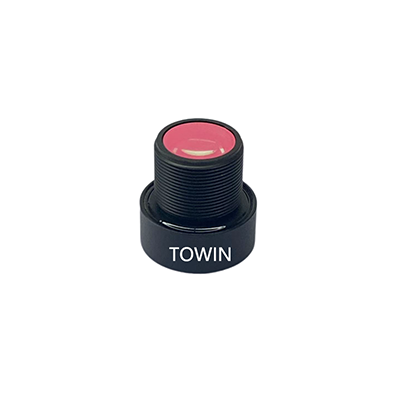
M12 Lens with IR Cut Filter
Key Factors Affecting Quality & Consistency in High-Volume Production
Achieving consistent quality in high-volume lens manufacturing requires strict control over every link—from design to delivery. Here are the core influencing factors:
- Design Stage: DFM (Design for Manufacturability)
- Optimize tolerance chains to avoid cumulative errors in mass production.
- Standardize lens structures to ensure compatibility with automated assembly lines.
- Towin’s professional design team integrates DFM into every custom project, reducing production risks.
- Material Stage: Stability & Uniformity
- Select high-quality glass/plastic raw materials with consistent refractive index and thermal stability.
- Use stable coating materials to ensure uniform film thickness across batches.
- Production Stage: Automated & Precise Processes
- Automated grinding, cleaning, coating, and assembly reduce human errors.
- Strict control of production environment (cleanroom, temperature, humidity) to avoid dust and moisture affecting lens performance.
- Testing Stage: Full-Process Inspection
- First article inspection (FAI) to confirm parameters before mass production.
- In-process inspection: regular sampling to monitor focal length, distortion, and coating uniformity.
- Outgoing inspection: 100% testing of key parameters (MTF, resolution, IR correction) to ensure qualified products.
Parameter Consistency Comparison Table (Industry vs Towin)
Key Parameters | Industry Average (High-Volume Production) | Towin High-Volume Control Standard | Impact on Product Performance |
|---|---|---|---|
Focal Length Tolerance | ±1% ~ ±3% | ≤±0.5% | Ensures stable imaging distance and field of view (FOV) for terminal devices. |
Distortion Control | >2% | ≤0.8% ~ 1.5% (by model) | Avoids edge stretching or distortion in images, suitable for high-precision scenarios. |
Coating Uniformity | Large batch differences | Film thickness/refractive index consistency <1% | Stable light transmittance and anti-glare performance, ideal for day/night security cameras. |
MTF Consistency | Obvious fluctuations | High consistency across batches | Ensures clear image resolution and sharpness for machine vision and surveillance. |
Assembly Coaxiality | General | Micron-level coaxial control | Eliminates defocus and vignetting, improving overall imaging quality. |
Towin High-Volume Lens Product Line Specifications
Lens Type | Interface/Thread | Key Specifications (High-Volume Available) | Typical Applications |
|---|---|---|---|
M12X0.5 Thread | 5MP/8MP resolution, fixed focal length, IR corrected, low distortion/fisheye/wide angle options | PCB cameras, miniature devices, automotive, small surveillance cameras | |
C-Mount (17.526mm flange focal distance) | High resolution, suitable for machine vision, USB/GigE/3D cameras | Industrial automation, intelligent traffic systems (ITS), traffic monitoring | |
CS-Mount (12.526mm flange focal distance) | Megapixel, fixed/vari-focal, manual/DC auto/P-Iris, multi-coating | CCTV cameras, network/IP cameras, day/night security surveillance |
High-Volume Lens Selection Guide
Choosing the right lens for high-volume production requires combining your project needs with lens performance. Here’s a step-by-step guide from Towin:
- Choose by Interface
- M12/S-Mount: Ideal for small, compact devices (e.g., PCB cameras, miniature surveillance) due to its tiny size and direct PCB mounting.
- C-Mount: Suitable for industrial applications (machine vision, ITS) that require high stability and compatibility with industrial cameras.
- CS-Mount: Perfect for security cameras (CCTV, IP cameras) with its shorter flange focal distance and IR correction feature.
- Choose by Resolution
- 5MP/8MP: Suitable for most surveillance and general industrial scenarios.
- 12MP+: For high-precision machine vision and professional imaging needs.
- Choose by Application Scenario
- Day/Night Surveillance: Select IR-corrected lenses with multi-coating (Towin’s CS-Mount lenses are optimized for this).
- Industrial Automation: Choose low-distortion, high-MTF lenses (C-Mount) for accurate recognition.
- Automotive: Opt for M12 lenses with high temperature resistance and vibration stability.
- Communicate Your Production Needs
- Provide Towin with your target surface, resolution, focal length, FOV, interface, and working environment.
- We will quickly match the most suitable lens model and provide a customized production plan.
ISO 9001
FAQs
- Q1: How does Towin ensure parameter consistency across large batches?
- A: We implement full-process quality control: standardized design (DFM), stable raw material selection, automated production lines, and 100% outgoing inspection. Additionally, we establish batch traceability systems to track every production link.
- Q2: What is the minimum order quantity (MOQ) for high-volume production, and what is the delivery time?
- A: Towin supports flexible MOQs, including small-batch trial production (to test product compatibility) and large-batch mass production. Delivery time is fast—we prioritize efficient selection and shipping, and specific lead times can be confirmed based on your order quantity and product model.
- Q3: Does Towin support OEM/ODM customization for high-volume orders?
- A: Yes. We offer one-stop customization services, including lens design, mold opening, coating, calibration, and assembly. Our professional team will work with you to meet your specific project requirements.
- Q4: How does Towin conduct reliability testing for high-volume lenses?
- A: We perform strict reliability tests, including high-low temperature testing, humidity testing, vibration testing, aging testing, and salt spray testing, to ensure lenses can adapt to various harsh working environments.
Towin’s High-Volume Manufacturing Quality Assurance System
At Towin, we integrate our PROFESSIONAL-ALL-EASY-FAST advantages into every link of high-volume production to provide reliable lens solutions:
- Professional Design: DFM optimization to ensure manufacturability and parameter stability in mass production.
- All-Category Coverage: Comprehensive product line, including M12/S-Mount, C-Mount, CS-Mount, and various functional lenses (low distortion, fisheye, wide angle, IR corrected) to meet diverse high-volume needs.
- Easy Cooperation: Simple selection process—provide your requirements, and we will quickly match models and provide quotes; professional after-sales support to solve your production problems.
- Fast Delivery: Optimized production and logistics processes to ensure on-time delivery, even for large-volume orders.
- Strict Quality Control: Automated production lines, super clean workshops, and full-process testing to ensure consistent quality across batches.
Conclusion
High-volume lens manufacturing is not just about scale—it’s about balancing consistency, quality, and efficiency. The core of achieving this lies in standardized design, stable production processes, and strict quality control. As a professional optical lens supplier, Towin has rich experience in high-volume manufacturing, helping countless clients solve pain points such as inconsistent parameters and delayed delivery.
If you are looking for a reliable partner for high-volume lens production, Towin is your best choice. We offer one-stop solutions from design, customization, production to delivery, ensuring your projects run smoothly.
- Contact us via email: info@towin-elec.com to get a free selection plan.
- Visit our product pages to learn more about M12/S-Mount, C-Mount, and CS-Mount lenses.
- Request specifications and test reports to verify our quality standards.
Towin—Your Trusted Partner for High-Quality, Consistent High-Volume Optical Lenses.
Related posts
08/11/2026

07/16/2026