


Low distortion wide angle 4.2mm M8 mount lens
03/09/2026
1/3″ 3.7mm M12 Pinhole CCTV lens
03/10/2026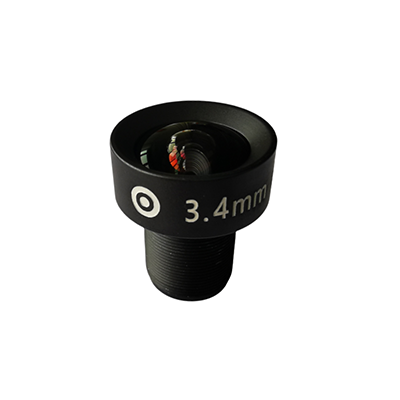
Table of Contents
Key Takeaways
- Lens Distortion is the optical aberration that warps the true shape of objects in an image, measured as a percentage of deviation from the ideal rectilinear projection.
- Low Distortion lenses have a distortion value of <0.2% (typically <0.05% for high-precision industrial models), balancing performance and cost for most professional vision applications.
- Zero Distortion (nearly zero distortion) lenses offer distortion as low as <0.02%, engineered for ultra-precise imaging where even minimal warping invalidates results (e.g., OCR, QR code recognition).
- The choice between low and zero distortion depends on application precision requirements, sensor size, focal length, and budget—zero distortion lenses deliver maximum accuracy at a premium cost.
- TOWIN offers a full range of low/zero distortion lenses across M7, M12/S-mount, and C-mount, optimized for 1/2″ to 1.1″ sensors and 4.2mm to 50mm focal lengths.
Introduction
In the world of machine vision, industrial inspection, and precision imaging, the accuracy of your optical system is only as good as your lens. A critical factor that defines this accuracy is distortion—a common optical aberration that distorts the geometry of captured images. When sourcing lenses for your vision system, the choice between Low Distortion vs. Zero Distortion is one of the most impactful decisions you’ll make.
This guide breaks down the core differences between low distortion and zero distortion lenses, their ideal applications, and how to select the right TOWIN lens for your specific vision system needs—with a clear decision flowchart to simplify your choice.
What Is Lens Distortion?
Lens distortion is the deviation of an optical lens from rectilinear projection—the ideal where straight lines in the real world remain straight in the captured image. It occurs when light rays bend unevenly across the lens’s field of view (FOV).
Types of Lens Distortion
Barrel Distortion
- Appearance: Straight lines bend outward, resembling the shape of a barrel.
- Common in: Wide-angle lenses, especially at shorter focal lengths.
- Cause: The magnification decreases as you move away from the center of the lens, causing the outer edges of the image to appear compressed.
- Example: When photographing a rectangular building with a wide-angle lens, the sides may appear to bulge outward.
Pincushion Distortion
- Appearance: Straight lines bend inward, resembling the shape of a pincushion.
- Common in: Telephoto lenses or zoom lenses at longer focal lengths.
- Cause: The magnification increases as you move away from the center of the lens, causing the outer edges of the image to appear stretched.
- Example: When photographing a grid pattern with a telephoto lens, the lines may appear to converge inward.
Mustache Distortion
- Appearance: A combination of barrel and pincushion distortion, resulting in a wavy or “mustache-like” distortion.
- Common in: Some zoom lenses or lenses with complex optical designs.
- Cause: A combination of uneven magnification across the lens surface.
- Example: Straight lines may appear to wave or curve in an irregular pattern.
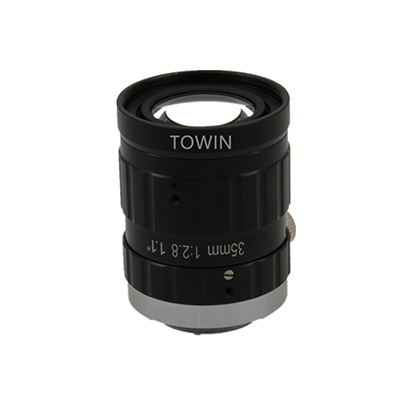
20-35mm-20MP-C-mount-low distortion FA lens-lens
Causes of Lens Distortion
- Optical Design: The physical construction of the lens, including the number of elements, their shape, and their arrangement, can contribute to distortion.
- Focal Length: Shorter focal lengths (wide-angle) are more prone to barrel distortion, while longer focal lengths (telephoto) are more prone to pincushion distortion.
- Zoom Lenses: Zoom lenses often exhibit varying degrees of distortion at different focal lengths due to their complex optical designs.
- Perspective Distortion: While not a true lens distortion, perspective distortion occurs when the camera is not parallel to the subject, causing parallel lines to converge or diverge. This is often confused with lens distortion but is a separate phenomenon.
Effects of Lens Distortion
- Architectural Photography: Distortion can make buildings appear tilted or curved, affecting the overall composition.
- Portrait Photography: Wide-angle lenses can distort facial features, making them appear unnatural or exaggerated.
- Product Photography: Distortion can make straight edges or lines appear curved, affecting the accuracy of the product representation.
- Creative Effects: Some photographers intentionally use distortion for artistic purposes, such as creating a sense of depth or exaggerating perspective.
Low Distortion vs. Zero Distortion: Core Differences
The terms “low distortion” and “zero distortion” are not universal industry standards, but TOWIN defines them based on precision thresholds that align with machine vision and industrial imaging best practices. The core differences lie in distortion tolerance, engineering complexity, cost, and use case suitability.
Critical Distinction Metrics
| Feature | Low Distortion Lenses | Zero Distortion (Nearly Zero) Lenses |
| Typical Distortion Value | <0.2% (high-precision models: <0.05%) | <0.04% (ultra-precise models: <0.02%) |
| Engineering Focus | Balance of precision, cost, and versatility | Maximum geometric accuracy; minimal optical aberration |
| Cost Point | Mid-range; cost-effective for most professional applications | Premium; engineered for ultra-high-precision use cases |
| Image Fidelity | Sufficient for standard inspection/imaging; negligible warping for most users | Perfect geometric fidelity; no measurable warping for critical tasks |
| Lens Mount Variety | Wide (M7, M12/S-mount, C-mount, CS-mount) | Focused on industrial mounts (C-mount) + high-precision small mounts (M12) |
Key Traits of Each Lens Type
Low Distortion Lenses
- Distortion values range from -0.2% to <0.05%
- Optimized for versatility—works across a wide range of focal lengths (4.2mm wide-angle to 50mm long-focal)
- Available in compact mounts (M7, M12/S-mount) for embedded/security vision + industrial mounts (C-mount)
- Ideal for applications where minor distortion is imperceptible or irrelevant to the end goal
- Cost-efficient without sacrificing professional-grade performance
Zero Distortion Lenses
- Distortion values as low as 0.02% (near-perfect rectilinear projection)
- Engineered exclusively for ultra-precise industrial imaging
- Almost exclusively available in industrial mounts (C-mount) for machine vision cameras
- Built with advanced optical glass and multi-coating to eliminate even minimal warping
- Designed for applications where any distortion invalidates data/results (e.g., OCR, QR code scanning, dimensional measurement)
Application Scenarios: Low Distortion vs. Zero Distortion
The right lens type depends entirely on what your vision system is designed to do. Below is a breakdown of ideal use cases for each, with clear examples to guide your choice.
Low Distortion Lenses: Ideal For
- Security & surveillance imaging: M12/S-mount low distortion lenses for HD security cameras (no need for ultra-precision)
- Video conferencing & motion capture: Wide-angle low distortion lenses (4.2mm) for panoramic/360° cameras
- Basic industrial inspection: Surface scanning for general defects (no dimensional measurement)
- Biometric recognition & document reading: Standard passport/ID scanners (minimal precision required)
- Embedded vision: Compact M7 mount lenses for small imaging modules (space constraints > ultra-precision)
Zero Distortion Lenses: Ideal For
- Optical Character Recognition (OCR): Text scanning/verification where warped characters cause misreading
- QR code/barcode identification: Industrial code scanning where distortion leads to unreadable codes
- High-precision dimensional measurement: Machine vision systems for part inspection/quality control
- Advanced surface inspection: Micro-defect detection where geometric accuracy is critical
- FA (Factory Automation): Robotic vision systems that rely on precise spatial data
TOWIN Application Matchup (Low/Zero Distortion)
| Model | Distortion Value | Lens Type | Ideal Application |
| M71801200245 (M7 mount) | <-0.05% | Low Distortion | Embedded vision, small module imaging |
| CCL123042MPF (M12/S-mount) | <-0.2% | Low Distortion | Video conferencing, motion capture, panoramic cameras |
| CCL1250MP (M12/S-mount) | <-0.03% | Low Distortion (High-Precision) | Security imaging, HD board lens applications |
| C5011028M20 (C-mount) | <0.04% | Zero Distortion | QR code identification, industrial surface inspection |
| C3511028M20 (C-mount) | <0.02% | Zero Distortion (Ultra-Precise) | OCR, factory automation, high-precision dimensional measurement |
TOWIN Low Distortion & Zero Distortion Lenses: Engineered for Vision Systems
TOWIN is a leading supplier of industrial and machine vision lenses, with a curated range of low distortion and zero distortion lenses optimized for 1/2″ to 1.1″ sensors, and focal lengths from 4.2mm (wide-angle) to 50mm (long-focal). All TOWIN low/zero distortion lenses feature:
- High-resolution performance (up to 20MP for industrial C-mount models)
- Multiple mount options (M7x0.35, M12x0.5 S-mount, C-mount) for seamless integration
- Manual/fixed iris/focus (per model) for tailored control
- Compact, durable design for industrial/embedded use cases
- IR correction/IR cut filter options for day/night imaging (select models)
Standout Low Distortion TOWIN Lenses
- M71801200245: 18mm focal length, M7x0.35 mount, 1/2″ sensor, <-0.05% distortion, 50mm M.O.D.—perfect for compact embedded vision.
- CCL123042MPF: 4.2mm wide-angle, M12/S-mount, 1/2.3″ sensor, <-0.2% distortion, 12MP resolution—ideal for panoramic/motion capture cameras.
- CCL1250MP: 50mm long-focal, M12/S-mount, 1/2″/2/3″ sensor, <-0.03% distortion, F2.5 aperture—high-precision low distortion for security/HD imaging.
Standout Zero Distortion TOWIN Lenses
- C3511028M20: 35mm focal length, C-mount, 1.1″ sensor, <0.02% distortion, 20MP resolution—the ultra-precise choice for OCR and factory automation.
- C5011028M20: 50mm focal length, C-mount, 1.1″ sensor, <0.04% distortion, 20MP resolution—optimized for QR code recognition and industrial surface inspection.
- All TOWIN low/zero distortion lenses are marked as HOT LENSES—our designation for top-performing, customer-favorite optical solutions for vision systems.
Quick Selection Flowchart
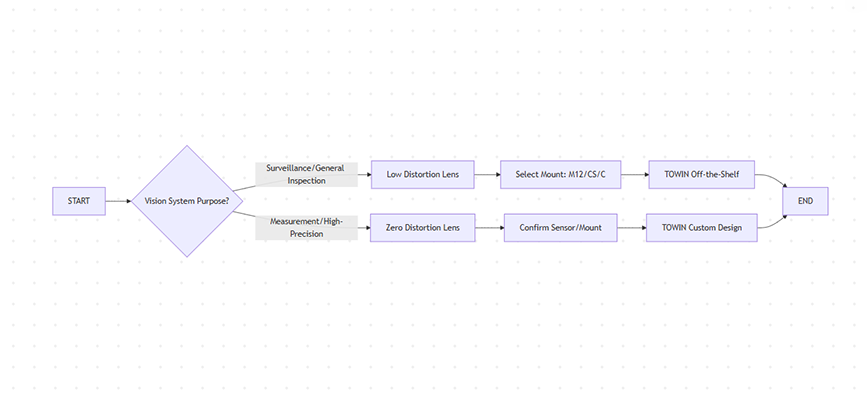
Quick Selection Flowchart
FAQs
Q1: Can a low distortion lens be used for OCR/QR code scanning?
A: Only high-precision low distortion lenses (<-0.03%) with 20MP resolution can be used for basic code scanning—zero distortion lenses are recommended for industrial-grade OCR/QR code recognition to eliminate misreads.
Q2: What sensor size is best for zero distortion lenses?
A: TOWIN’s zero distortion lenses are optimized for 1.1″ sensors (20MP resolution)—the gold standard for industrial machine vision and FA applications.
Q3: Are zero distortion lenses only available in C-mount?
A: TOWIN’s ultra-precise zero distortion lenses (<0.04%) are exclusively C-mount (industrial FA/machine vision). We offer high-precision low distortion lenses (<-0.03%) in M12/S-mount for compact systems that need near-zero distortion.
Q4: How does focal length impact distortion?
A: Long-focal-length lenses (35mm/50mm) are more prone to pincushion distortion—TOWIN’s zero distortion lenses are engineered to eliminate this, while our low distortion lenses balance focal length and aberration for versatility.
Q5: What is the minimum object distance (M.O.D.) for TOWIN’s low/zero distortion lenses?
A: M.O.D. ranges from 0.2m (200mm) (C3511028M20, CCL123042MPF) to 0.4m (400mm) (CCL1250MP), with 50mm M.O.D. for the compact M71801200245—ideal for both close-up and medium-range imaging.
Conclusion
The choice between Low Distortion vs. Zero Distortion lenses boils down to one key question: Does my vision system require ultra-precise geometric accuracy (0.02%-0.04% distortion) or is professional-grade precision (<0.2% distortion) sufficient?
Zero distortion lenses are the gold standard for factory automation, OCR, and QR code recognition—where even minimal warping ruins results. Low distortion lenses (including our high-precision <0.05% models) are the cost-effective, versatile choice for security, surveillance, motion capture, and basic industrial inspection—delivering excellent performance without the premium price tag.
TOWIN’s full range of low and zero distortion lenses is engineered to meet the unique needs of every vision system—from compact embedded M7 mount modules to high-performance 20MP C-mount industrial FA lenses. With multiple sensor sizes, focal lengths, and mounts, we have the perfect lens to optimize your imaging accuracy.
📩 Get a Custom Quote or Request a Sample
Get a custom quote for bulk orders or tailored optical lens solutions
Contact our optical experts: info@towin-elec.com
TOWIN Optical Lenses: Professional, All-Range, Easy to Source, Fast to Ship—Your Trusted Partner for Machine Vision and Industrial Optical Solutions.