


C-Mount vs CS-Mount: Understanding the 5mm difference and adapter usage
04/04/2026
Industrial Lens Selection Guide 2026
04/06/2026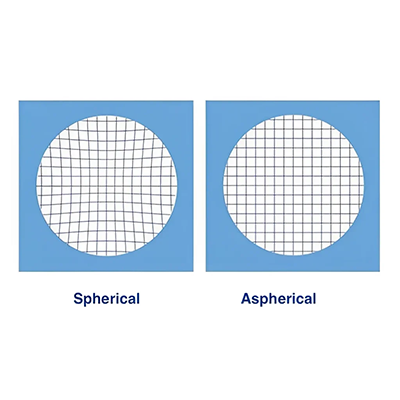
Table of Contents
Key Takeaways
- When choosing between a Spherical vs Aspherical lens, the biggest tradeoffs boil down to cost, image quality, and design flexibility.
- Spherical lenses offer low cost, fast tooling, and simple manufacturing, making them ideal for cost‑sensitive applications with low‑to‑medium resolution requirements.
- Aspherical lenses effectively eliminate spherical aberration, produce sharper imaging, and reduce the number of lens elements needed, making them superior for high‑resolution and miniaturized optical systems.
- Cost difference: Aspherical lenses involve higher mold and precision processing costs, while spherical lenses hold a clear unit‑price advantage in mass production.
- Best use cases: Spherical lenses for basic imaging; aspherical lenses for megapixel cameras, low‑distortion systems, and compact designs.
- ROI tip: Use aspherical lenses where image quality is critical; rely on spherical lenses to lower overall BOM cost.
What Are spherical vs aspherical lens?
Spherical Lens
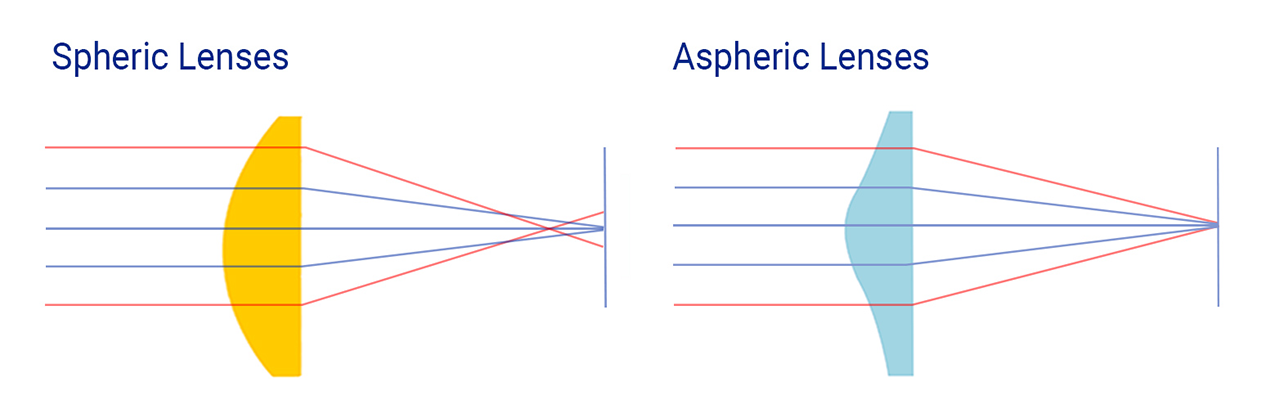
- A spherical lens has a consistent surface curvature across its entire clear aperture.
- Using a standard spherical profile, it is easy to produce through conventional grinding and polishing.
- Its natural optical limitation is spherical aberration, meaning light rays focus at different points rather than a single sharp spot.
- Typical applications include board lenses, standard CCTV cameras, and low‑cost industrial optical assemblies.
Aspherical Lens
- An aspherical lens features a surface curvature that gradually changes from the center to the edge.
- This optimized design is specifically engineered to correct spherical aberration and distortion.
- It achieves crisp, uniform focus with fewer components, enabling smaller, lighter, and more compact optical systems.
- Typical applications include megapixel surveillance cameras, machine vision, automotive optics, and high‑end security systems.
Spherical vs Aspherical Lens: Performance Comparison
| Parameter | Spherical Lens | Aspherical Lens |
|---|---|---|
| Spherical aberration | Obvious; needs multiple lenses to compensate | Greatly reduced or eliminated |
| Image sharpness | Good for low‑resolution; soft at edges | High clarity, consistent across FOV |
| Distortion | Higher; noticeable at wide angle | Much lower; ideal for precision imaging |
| System size & weight | Larger assembly; more elements | Compact; fewer lenses, lighter |
| Light transmission | Good; can be improved with coating | Higher; fewer surfaces = less loss |
| Complexity | Simple design & assembly | Complex design; tight tolerances |
Cost Breakdown: Spherical vs Aspherical Lens
Manufacturing Cost
- Spherical lenses
- Mature, standardized grinding & polishing.
- Low mold cost; short development cycle.
- High yield, stable mass production.
- Aspherical lenses
- Precision molding / ultra‑precision grinding required.
- Higher mold & R&D cost; longer validation.
- Tighter tolerances lower yield slightly.
- Total Cost of Ownership (TCO)
- Unit cost: Spherical ≈ 30%–70% lower than aspherical at same volume.
- System cost: Aspherical reduces total lens count; lowers assembly cost.
- Tooling/NRE: Spherical very low; Aspherical moderate to high.
- Volume effect: Aspherical cost per unit drops sharply at high volume.
Cost‑Benefit Scenarios & Application Selection
- When to Choose Spherical Lenses
- Budget is top priority; basic imaging sufficient.
- Low‑resolution analog cameras, simple sensors.
- Large‑volume, cost‑sensitive consumer devices.
- Prototyping with fast lead time & low NRE.
- Best for:
- Basic board lenses
- Low‑end CCTV
- Simple optical assemblies
- Cost‑driven mass products
- When to Choose Aspherical Lenses
- Need high sharpness, low distortion, high contrast.
- Megapixel / 4K imaging, day/night IR correction.
- Miniaturized design (space limited).
- Reduce total lens elements in assembly.
- Best for:
- 5MP+ industrial & network cameras
- Machine vision (FA/MV lenses)
- Automotive & ITS traffic lenses
- High‑end surveillance & low‑light modules
Quick Selection Table
| Application Type | Recommended Lens | Key Reason |
|---|---|---|
| Low‑res analog CCTV | Spherical | Low cost, sufficient quality |
| 1MP–5MP IP camera | Aspherical | Sharpness, compact size |
| Machine vision inspection | Aspherical | Precision, low distortion |
| High‑volume consumer | Spherical | Best unit cost |
| Automotive/ADAS | Aspherical | Stability & high performance |
Comprehensive Cost‑Benefit Analysis
Advantages of Spherical Lenses
- Ultra‑low unit cost at scale
- Fast production & short lead time
- High yield, low failure rate
- Easy replacement & standardization
Advantages of Aspherical Lenses
- Eliminates spherical aberration
- Fewer lenses = smaller, lighter assembly
- Better edge-to-edge sharpness
- Higher contrast & transmittance
- Ideal for high‑megapixel sensors
Which One Gives Better ROI?
- Short term, low budget: Spherical wins.
- Long term, high performance: Aspherical reduces system cost & improves product value.
- Mixed design: Use spherical for simple groups; aspherical for critical surfaces—balance cost & quality.
Spherical vs Aspherical Lenses
FAQs
Q: Are aspherical lenses always worth the extra cost?
A: No. Use them only when image quality, size, or distortion is critical. For basic use, spherical is more economical.
Q: Can aspherical lenses reduce the total number of lenses in a system?
A: Yes. One aspherical often replaces 2–3 spherical elements, cutting size, weight, and assembly cost.
Q: Which is more durable: spherical or aspherical?
A: Similar durability when using same material & coating. Difference is optical performance, not strength.
Q: Does TOWIN provide both spherical & aspherical lenses?
A: Yes. TOWIN supplies M12/CS/C‑mount spherical & aspherical lenses for surveillance, machine vision, automotive, and industrial applications.
Conclusion
Spherical and aspherical lenses serve different goals. Spherical lenses deliver unbeatable cost and speed for standard applications. Aspherical lenses provide superior imaging with fewer components for high‑end systems.
Choose spherical for cost efficiency; choose aspherical for performance and miniaturization. For custom optical solutions, contact TOWIN to optimize your lens design and cost structure.
Need help selecting spherical or aspherical lenses for your project? Contact TOWIN for a free cost‑performance evaluation and lens recommendation.
📧: info@towin-elec.com