


3.6mm HD M12 IR corrected CCTV lens
12/17/2025
6mm 3-Megapixel M12 CCTV lens
12/18/2025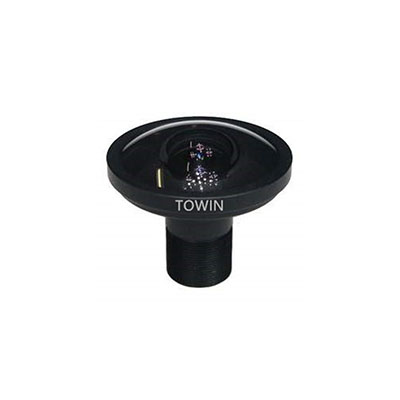
Table of Contents
- Introduction: The Secret to the Popularity of Fisheye Lenses
- Basic Structure and Principles of Fisheye Lenses
- These 5 fisheye lenses are irresistible!
- Applications of Fisheye Lenses in Different Fields
- Fisheye Lens Usage Tips and Precautions
- The Development History and Future Trends of Fisheye Lenses
- FAQs
- Conclusion
Introduction: The Secret to the Popularity of Fisheye Lenses
A fisheye lens is essentially an optical lens with an ultra-wide field of view of 180°+. It breaks through the limitations of conventional perspectives and presents a unique barrel distortion effect. Whether capturing expansive natural panoramas, narrow indoor spaces, fleeting moments of high-speed motion, VR panoramic capture, or even creative visual effects, a single lens can handle it all. This characteristic makes fisheye lenses a darling of the image recording field. Because it doesn’t require stitching together multiple photos to cover a wide scene, nor does it require frequent lens changes to adapt to different shooting needs, it significantly improves shooting efficiency and allows for the creation of distinctive works through its impactful distortion effect.
Basic Structure and Principles of Fisheye Lenses
A fisheye lens is a special optical lens capable of achieving an ultra-wide field of view of 180°+. Its core value lies in its unique optical design, which breaks through the field of view limitations of conventional lenses while simultaneously creating a distinctive barrel distortion effect. Its construction and principles revolve around “maximizing the light-gathering range” and “balancing image quality and field of view expansion”:
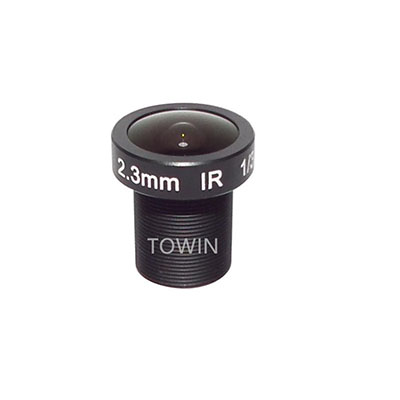
4 megapixel CCTV lens Fisheye Lens
I. Basic Construction of a Fisheye Lens
The construction of a fisheye lens is fundamental to achieving an ultra-wide field of view. Its core consists of three parts: a special optical lens group, an optimized optical structure, and auxiliary functional components. Each component is custom-designed to meet the needs of an “ultra-wide field of view”:
1. Core Optical Lens Group (Determines Field of View and Image Quality)
Aspherical Lens + Apochromatic Lens Combination:
This is the most crucial lens configuration for a fisheye lens. Ordinary lenses often use spherical lenses, but fisheye lenses need to receive large-angle edge light, and spherical lenses are prone to serious aberrations (such as spherical aberration and coma) and distortion. Aspherical lenses, through the non-linear design of their surface curvature, can simultaneously correct multiple aberrations, reducing edge blurring; apochromatic lenses can eliminate the dispersion (chromatic aberration) of different wavelengths of light, making color reproduction more consistent between the center and edges of the image (TOWIN fisheye lenses, based on this, use high-refractive-index optical glass to further improve light transmittance and anti-reflection capabilities).
Multi-element stacked design:
Fisheye lenses typically have 10 or more elements (some professional-grade lenses can have 15+), divided into front, middle, and rear groups. The front group elements are mostly large-diameter convex mirrors, responsible for “capturing ultra-wide-angle light”; the middle group elements use alternating combinations of convex and concave mirrors to correct light refraction deviations; the rear group elements precisely focus the corrected light onto the sensor, avoiding excessive edge image distortion.
2. Core optical structure: Retrofocus structure
This is the key structure for fisheye lenses to achieve “short focal length + ultra-wide field of view”. If the focal length of a conventional wide-angle lens is too short, the back focal length (the distance from the last element of the lens to the sensor) will be too short, making it unsuitable for the focal plane of the camera/equipment (such as the reflex mirror structure of an SLR camera). The reverse telephoto structure, through a design with a large convexity in the front lens element and a large concaveness in the rear lens element, significantly increases the back focal length while shortening the overall lens length. This solves equipment compatibility issues and allows light to enter the sensor edge at a wider angle (close to 90°), thus achieving a field of view coverage of 180°+.
3. Auxiliary Function Components
- Aperture Component: Mostly fixed aperture or small-range adjustable aperture (e.g., f/2.8-f/16). The core function of the aperture in a fisheye lens is to control the amount of light entering, not the depth of field (the depth of field is naturally very deep at ultra-wide angles). Some professional-grade fisheye lenses (such as TOWIN industrial-grade products) use blade-type apertures to reduce glare and light spots, improving image quality in low-light environments.
- Focusing Mechanism: Primarily manual focus (some consumer-grade products support autofocus). By adjusting the spacing between lens elements, objects at different distances are focused onto the sensor. Fisheye lenses typically have a focusing range from a few centimeters (macro mode) to infinity, suitable for close-up and panoramic shooting.
- Optical Coating: The lens surface is coated with multiple layers of anti-reflective coating (such as TOWIN’s AR anti-reflective coating) to reduce light reflection loss, reduce flare and ghosting in backlit conditions, and improve the lens’s durability and resistance to smudges.
- Filter Socket/Lens Hood: Some fisheye lenses are equipped with a dedicated filter socket (to accommodate ultra-wide angles and prevent filters from obstructing the image) or have a built-in lens hood to prevent stray light from interfering with image formation.
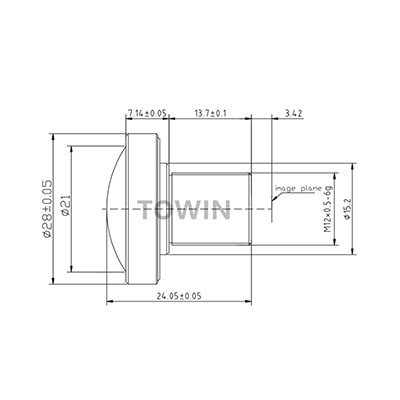
8MP Fisheye CCTV HD lens IR corrected
II. Working Principle of Fisheye Lenses
Core Principle: Through special optical design, fisheye lenses maximize the angle of light incidence, precisely focusing light from objects within a 180°+ range onto a finite-sized image sensor, while balancing image quality and unique visual effects.
1. The Core Logic of Expanded Field of View
Ordinary lenses typically have a field of view between 10° and 120°, and their lens design “limits large-angle light incidence” (to avoid excessive aberrations). Fisheye lenses overcome these limitations through the following two points:
- ① Short Focal Length Design: The shorter the focal length, the larger the field of view (formula: Field of View = 2 × arctan (sensor size / 2 ÷ focal length)). Fisheye lenses typically have a focal length of 8mm-16mm (full-frame equivalent). The short focal length significantly increases the angle of light refraction, thus covering a wider scene.
- ② Extreme Refraction of Light: The large-diameter convex lens in the front group can capture edge light rays (even those exceeding 90°) that are almost parallel to the lens axis. These rays, after correction by the middle lens group, are incident on the sensor at a suitable angle, achieving a panoramic effect of “seeing the whole picture at a glance.”
2. Causes and Value of Barrel Distortion
The characteristic “barrel distortion” of fisheye lenses is not a design flaw, but rather an “optical trade-off made to achieve an ultra-wide angle of view”:
- Causes: When light rays at angles greater than 180° enter the lens, the refraction angle of the edge rays is much greater than that of the center rays. Forcibly correcting to “straight-line perspective” (like in ordinary wide-angle lenses) would result in severely stretched and blurred edge images. Therefore, fisheye lenses employ a “non-orthogonal projection” design, allowing objects in the center of the image to appear relatively normal, while objects at the edges shrink towards the center, forming a barrel effect, thus ensuring the sharpness and integrity of the edge images.
- Value: This distortion not only creates a unique visual style (such as in creative photography and VR panoramas), but also enables “blind-spot-free coverage” in industry applications (such as security monitoring and vehicle imaging), preventing information loss at the edges of the image.
3. Principles of Image Quality Optimization
Fisheye lenses balance ultra-wide field of view and image quality through a dual approach of “optical correction + algorithm optimization”:
- Optical Level: The combination of aspherical lenses and apochromatic lenses reduces aberrations and chromatic aberration; multi-layer anti-reflective coatings improve light transmittance and reduce stray light interference;
- Algorithm Level: Modern fisheye lenses (especially professional brands like TOWIN) are equipped with built-in correction algorithms that can switch between “preserving distortion (creative effects)” and “moderate correction (practical scenarios)” as needed, satisfying both artistic creation and the precision imaging requirements of industrial applications.
2.4mm 3-Megapixel Fisheye lens IR corrected
III. TOWIN Fisheye Lens Construction and Principle Upgrades
Based on the core optical logic of fisheye lenses, TOWIN has optimized its technology for professional scenarios and consumer needs, achieving both “ultra-wide field of view” and “high-quality imaging”:
- Customized Optical Lens Group: Utilizing SCHOTT high-refractive-index optical glass, combined with an aspherical apochromatic lens design, it achieves a 190° ultra-wide field of view while reducing edge aberrations by 30%, resulting in image clarity and color reproduction far exceeding the industry average;
- Enhanced Reverse Telephoto Structure: Optimizing the curvature ratio of the front convex lens and the rear concave lens, shortening the lens length (thinner than similar products). (15%), suitable for installation in various scenarios such as drones, action cameras, and security equipment;
- Intelligent optical correction system: Combining hardware coating technology and software algorithms, it automatically recognizes the shooting scene (such as panoramic recording, creative photography, and security monitoring) and dynamically adjusts the degree of distortion, preserving the unique style of the fisheye lens while avoiding visual discomfort in practical scenarios;
- Industrial-grade protective design: The lens shell is made of unibody aluminum alloy, and the lens surface is covered with a hydrophobic and scratch-resistant coating, coupled with an IP67 dust and water resistance rating, making it suitable for stable use in harsh environments such as outdoor adventure and industrial monitoring.
Through precise control and optimization of the core structure, the TOWIN fisheye lens not only continues the core advantages of fisheye lenses—”ultra-wide angle of view and convenient recording”—but also solves the pain points of traditional fisheye lenses—”blurred edges and excessive distortion”—with professional-grade optical technology, becoming a high-performance, cost-effective choice that balances creative creation and industry applications.
5-Megapixel Fisheye CCTV HD lens
These 5 fisheye lenses are irresistible!
In the field of fisheye lenses, TOWIN’s 5 products have become popular choices in security monitoring, industrial applications, and other fields due to their core advantages of “ultra-wide coverage without blind spots, uncompromising high-definition image quality, and highly flexible scene adaptation.” From 200° to 230° field of view coverage, a resolution gradient from 3MP to 8MP, IP69K waterproofing to practical functions like IR correction, each model precisely addresses user needs, making them indispensable once used.
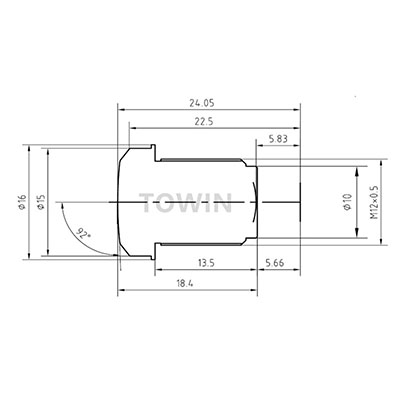
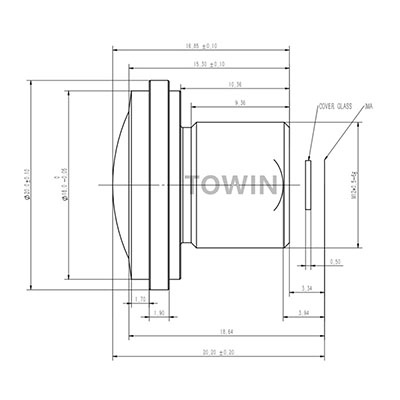
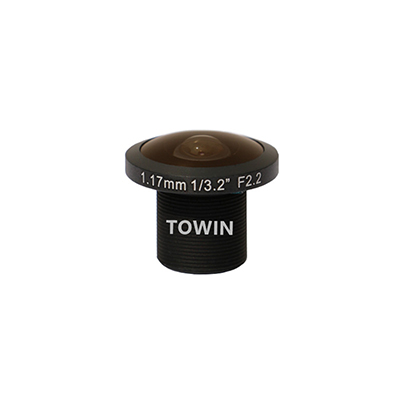
1. CCL1320117MP: 220° Omnidirectional Coverage, a Reliable Partner for Day and Night Monitoring
Key Parameter Highlights:
- Field of View: 220° (D/H/V three-way full 220°), near-“no blind spots” coverage; a single lens can replace the monitoring range of multiple ordinary lenses.
- Resolution: 8MP high definition, paired with a 1.17mm focal length, strong detail capture (e.g., clearly identifying faces and object outlines in monitored scenes).
- Exclusive Advantages: IR correction technology + Φ3.2mm image circle, designed specifically for day and night IP cameras; no color cast or blur in nighttime infrared mode, and accurate color reproduction during the day.
Suitable Scenarios:
Community security, shop monitoring, indoor panoramic monitoring (e.g., offices, warehouses), especially suitable for scenarios requiring 24-hour monitoring and demanding full coverage with a single lens, eliminating the need for frequent switching of monitoring angles, offering peace of mind and high efficiency.
IR corrected 1.17mm M12 Fisheye CCTV lens
2. S00903021024F: 8MP High Definition + Ultra-Low Distortion, an “All-Round Performer” Adaptable to Multiple Scenarios
Key Parameter Highlights:
- Field of View: 210° wide-angle, balancing “coverage range” and “image usability”;
- Resolution: 8MP top-tier high definition, paired with an ultra-short 0.09mm focal length, capturing both panoramic views and preserving local details;
- Exclusive Advantages: F-theta distortion <-4.5%, one of the best distortion control models among the five, with no exaggerated barrel distortion, facilitating target recognition; 6G+IRCF structure, sufficient lens quantity, more thorough aberration correction, and clear edge image quality.
Suitable Scenarios:
Shopping mall surveillance, factory workshop monitoring, vehicle panoramic imaging, especially suitable for scenarios that “require ultra-wide coverage but are concerned about distortion affecting recognition”—such as in shopping mall surveillance, where both overall crowd flow and clear identification of individual customer behavior can be seen.
4-Megapixel F2.4 M12 mount fisheye lens
3. S00903423020F: 230° Ultra-Wide Angle, the “Ceiling” of High-Definition with No Blind Spots
Key Parameter Highlights:
- Field of View: 230°, the largest field of view among the five models, a single lens can cover the entire “front, back, left, and right” range, truly achieving “a panoramic view”;
- Resolution: 8MP high-definition, paired with a large F2.0 aperture (one of the largest apertures among the five models), resulting in superior performance in low-light environments, with sufficient brightness and low noise in nighttime images;
- Exclusive Advantages: F-theta distortion <3%, distortion control reaches an excellent level in the industry, maintaining “undistorted and recognizable” images even with a 230° ultra-wide angle of view; 7G+IRCF structure, one more glass lens than the previous model, resulting in more precise optical correction.
Suitable Scenarios:
Large warehouses, parking lots, open-air plazas, and other scenarios requiring “extremely large area coverage.” For example, a single lens can monitor the entire area’s vehicle entry and exit in a parking lot, eliminating the need for multi-lens stitching and reducing installation and maintenance costs.
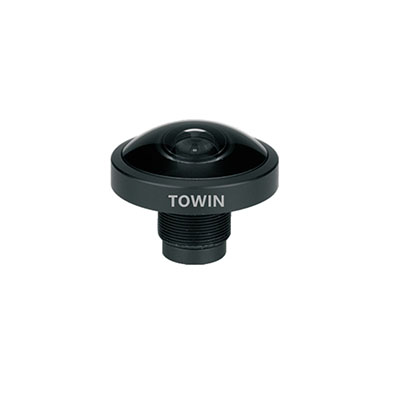
8-Megapixel F2.0 M12 mount Fisheye Lens
4. S01412420020F69: IP69K waterproof + industrial-grade stability, a “hardcore performer” in harsh environments
Key Parameter Highlights:
- Field of View: 200°, suitable for “medium-range coverage” needs, with balanced image proportions;
- Exclusive Advantages: IP69K waterproof rating (the highest level of waterproof and dustproof standard), able to withstand high-pressure water jets and high-temperature washing, suitable for harsh outdoor environments (such as heavy rain, dust, and industrial oil stains); built-in IR filter + 2G4P + IRCF structure, strong industrial-grade stability, suitable for long-term outdoor monitoring;
- Resolution: 3MP, meeting basic monitoring needs, outstanding cost-effectiveness.
Suitable Scenarios:
Outdoor security, industrial production line monitoring, harsh environments such as mines/docks, etc. For example, in mine monitoring, the lens can still work stably even in heavy rain or dust, without affecting the monitoring image.
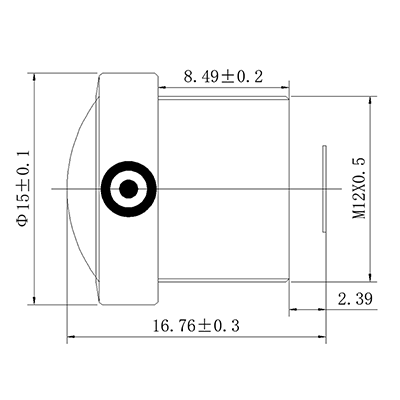
Fisheye M12-mount F2.0 CCTV Lens
5. S4121020F-1: 209° wide-angle + 5MP balanced, a high-performance security “preferred choice”
Key Parameter Highlights:
- Field of view: 209°, between 200°-210°, moderate coverage, suitable for small to medium-sized scenes;
- Resolution: 5MP, at the “golden balance” of 3MP-8MP, ensuring clear image quality while controlling costs;
- Exclusive Advantages: Φ4.2mm image circle, adaptable to larger sensor sizes, providing a wider field of view; F-theta distortion <-5.8%, excellent performance in its price range, coupled with a 0.2m minimum focusing distance, capturing close-up details (e.g., clearly identifying express packages in doorway monitoring).
Suitable scenarios:
Home security, small shops, office building corridors and other “small and medium-sized scenarios”, the first choice for users who pursue “sufficient picture quality and affordable price” – no need to pay for extra features, but can meet the core monitoring needs.
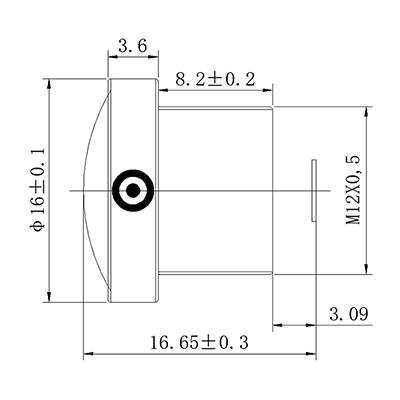
1.6mm 5-Megapixel Fisheye CCTV lens
Applications of Fisheye Lenses in Different Fields
| Application Fields | Specific Application Scenarios | Core Requirements | Core Advantages of Fisheye Lenses (TOWIN Adaptation) |
| Security Surveillance | Community/Shop/Warehouse/Parking Lot Surveillance | Wide coverage, clear day and night, stability | 200°-230° ultra-wide field of view, IR correction/IRCF filter, fixed aperture for long-term operation |
| Industrial Applications | Production Line/Mine/Dock Monitoring | Resistance to harsh environments, high compatibility | IP69K waterproof (S01412420020F69), 3MP-8MP resolution, M12 universal interface |
| Automotive Imaging | 360° Panorama/Blind Spot Monitoring/In-vehicle Recording | Compact size, low distortion, blind spot coverage | Compact structure (TTL=13mm), 210°-220° field of view, low F-theta distortion (<-4.5%) |
| VR/Panoramic Photography | VR Collection/Panoramic House Viewing/Event Live Streaming | Wide angle, high-definition & accurate color | 220°-230° field of view, 8MP high definition, low distortion (<3%) |
| Indoor Space Recording | Office/Classroom/Hotel Panoramic Collection | Easy installation, clear in low light | 209°-220° field of view, M12 compact size, F2.0-F2.4 large aperture |
| Special Scene Monitoring | Elevator/Tunnel/Equipment Room Monitoring | Narrow space coverage, clear close-up shooting | Short focal length (0.09mm-1.6mm), 0.1m-0.2m close-up distance, multi-piece lens anti-interference |
Fisheye Lens Usage Tips and Precautions
Combining the ultra-wide angle of view, low distortion, and strong scene adaptability of fisheye lenses, the following tips can maximize their performance, and the precautions can help avoid usage mistakes and extend their lifespan:
Usage Tips
1. Composition:
- Center Composition: Fisheye lenses produce obvious distortion at the edges of the image, so placing the subject in the center of the frame usually yields better results.
- Foreground Elements: Use foreground elements to enhance the sense of depth; for example, bring some objects closer to the lens when shooting.
2. Adjusting Angles:
- Low-Angle Shooting: Try shooting from a low angle to exaggerate the foreground and enhance the tension of the image.
- High-Angle Shooting: Shooting from a high angle can showcase a vast scene, especially suitable for shooting city panoramas.
3. Utilizing Light:
- Backlighting: Can create unique light and shadow effects, enhancing the sense of depth in the image.
- Golden Hour: Shooting at sunrise or sunset, the soft light can make the image more captivating.
4. Dynamic Photography:
- Fisheye lenses are suitable for shooting dynamic scenes, such as sports and performances, capturing more environmental information.
5. Post-Processing:
- Photos taken with a fisheye lens can be moderately corrected using post-processing software to reduce distortion and achieve the desired visual effect.
Precautions:
- 1. Distortion Control: Distortion is a characteristic of fisheye lenses, but excessive distortion can affect the overall aesthetics of the photo; this should be considered when shooting.
- 2. Avoid Edge Defocus: While fisheye lenses offer an ultra-wide-angle view, sharpness in edge areas may be lower. Ensure important elements are centered in the frame when shooting.
- 3. Avoid Overuse: The fisheye effect is novel, but overuse can cause visual fatigue. Moderate use enhances the effect.
- 4. Appropriate Shooting Distance: Fisheye lenses typically have a short focusing distance; pay attention to the distance from the subject to avoid losing detail.
- 5. Clean the lens: The front lens of a fisheye lens is usually quite protruding and easily attracts dust and fingerprints. Keeping the lens clean is crucial for image quality.

Fisheye CCTV Lens
The Development History and Future Trends of Fisheye Lenses
From its early days as a research tool, the fisheye lens has evolved into a core optical device covering multiple fields such as security, automotive, and VR/AR. Its development has revolved around “expanded field of view, improved image quality, and scene adaptation,” and will see further breakthroughs in technological innovation and scene penetration in the future.
Development History
- Early Stage (1940s): The concept of the fisheye lens first appeared in the 1940s. American optical engineer Edwin H. Land and his colleagues developed the first successful fisheye lens. These early lenses were mainly used for scientific research and weather observation, as their wide field of view allowed them to capture large-scale scenes.
- Commercialization and Photographic Applications (1950s-1970s): Entering the consumer market in the 1950s, fisheye lenses gradually became widely used by photographers. Many camera manufacturers, such as Nikon, Canon, and Zeiss, launched their own fisheye lenses, providing photographers with more choices.
- Technological Advancements and Specialization (1980s-2000s): With the development of optical technology, fisheye lens designs became more complex, significantly improving image quality and distortion control.
- The Rise of the Digital Age (2000s-Present): The development of digital image processing technology has made post-processing with fisheye lenses possible. Photographers can perform distortion correction in software while preserving the creativity of the fisheye effect.
Future Trends
Based on industry reports and technological breakthroughs, fisheye lenses will develop in three main directions: “approaching the limits of hardware, software-defined performance, and cross-industry penetration,” while accelerating the localization of the industry chain and global expansion.
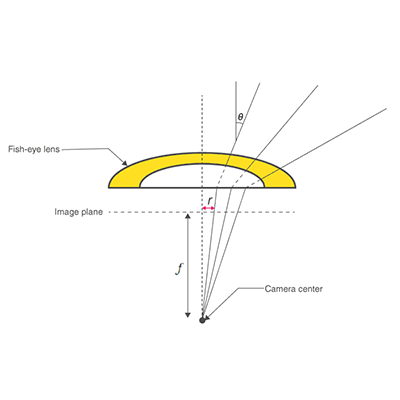
Full Frame Fisheye Lens
FAQs
How to choose the appropriate field of view?
Choose according to coverage needs: 200°-210° is suitable for small to medium-sized scenes such as shops and offices; 220°-230° is suitable for “no blind spots” coverage scenes such as parking lots and large warehouses; for narrow spaces (such as elevators), prioritize 220°+ models, as a single lens can cover the entire range.
Do fisheye lenses require frequent refocusing?
No. Fisheye lenses naturally offer deep depth of field. The TOWIN series has a close-up distance of 0.1m-0.2m. In surveillance scenes, focusing to “infinity” is sufficient to cover both near and far distances. For close-up shots (such as equipment details), a single manual focus adjustment is enough for stable image formation.
Can barrel distortion be eliminated?
It can be optimized in two ways: ① Enable the fisheye distortion correction algorithm on the device. Using a TOWIN low-distortion model (such as S00903423020F, distortion < 3%) will result in a more natural image, suitable for surveillance and indoor displays; ② Center the subject during shooting to reduce edge distortion.
Do all fisheye lenses support the M12 mount?
All TOWIN fisheye lenses come standard with an M12×0.5 universal mount, compatible with security, industrial, and automotive equipment. Some professional photography fisheye lenses may use camera-specific mounts (such as EF, E-mount), requiring selection based on the device’s mount.
Conclusion
The greatest appeal of fisheye lenses in video recording lies in their ultra-wide field of view, covering any scene with a single lens. Their core value is seamless single-lens coverage with no blind spots, resulting in cost-effectiveness. No stitching, multi-lens deployment, or complex adjustments are needed; panoramic images are obtained with minimal operation. In the future, fisheye lenses will only become more popular, becoming the standard for all-scenario video recording. If you’re looking for a panoramic recording tool with wide coverage, simple operation, and high cost-performance, a fisheye lens is undoubtedly your best choice!