


Wide Angle IP67 automotive M12 lens
01/06/2026
IR Correction Impact on Night Vision Performance
01/07/2026
Table of Contents
- Introduction
- What is an M12 Lens? Core Definitions & Features
- Technological Breakthroughs of 1/1.8-Inch Sensors
- Five Core Advantages of 1/1.8-Inch M12 Lenses
- Lens Selection Logic for Industrial Surveillance Scenarios
- In-Depth Review of 5 Top-Tier 1/1.8-Inch M12 Lenses
- Application Scenario Segmentation for 1/1.8-Inch M12 Lenses
- Lens Performance Comparison: Key Parameters Horizontal Evaluation
- FAQs
- Conclusion
Introduction
In fields such as security surveillance, industrial vision, and smart devices, the core competitiveness of visual systems is increasingly focusing on “precision perception” and “scene adaptability.” The 1/1.8-inch sensor strikes a golden balance between small-size (e.g., 1/2.7-inch) and large-size (e.g., 1-inch) options, ensuring compact installation space while delivering the light intake and resolution required for high-definition imaging. As an industrial standard threaded interface, the M12 connector has become the mainstream choice for linking lenses and sensors, thanks to its strong versatility, easy installation, and cost-effectiveness. The combination of these two technologies endows 1/1.8-inch M12 lenses with three core advantages: “high-definition performance,” “standardized compatibility,” and “multi-scene adaptability.” Perfectly aligning with the future development trend of visual systems—”miniaturization, high image quality, and low cost”—these lenses have emerged as core components in security surveillance, industrial inspection, smart terminals, and other fields.
What is an M12 Lens? Core Definitions & Features
What is an M12 Lens?
An M12 lens specifically refers to a small optical lens adopting the M12×0.5 threaded interface. Its interface standard originates from the standardization needs of industrial manufacturing—featuring uniform thread specifications and controllable installation precision, it can quickly adapt to mainstream small sensors such as 1/1.8-inch and 1/2-inch models. From an optical design perspective, the “industrial genes” of M12 lenses are reflected in three dimensions:
- Modular Structure: Lens groups (e.g., 8G+IRCF, 2G2P+IRCF) adopt standardized modular design, supporting mass production while balancing cost and consistency.
- Lightweight Adaptation: With a compact size (e.g., Φ14×11.30mm) and light weight, M12 lenses meet the installation requirements of embedded devices and confined spaces.
- Integrated Functions: Most M12 lenses integrate practical features such as IRCF (Infrared Cut Filter), fixed aperture, and manual focus, enabling adaptation to complex environments without additional accessories.
Its core features can be summarized as: standardized interface, miniaturized size, large-scale production, and practical functions—key factors driving the widespread adoption of M12 lenses in civilian security and industrial vision fields.
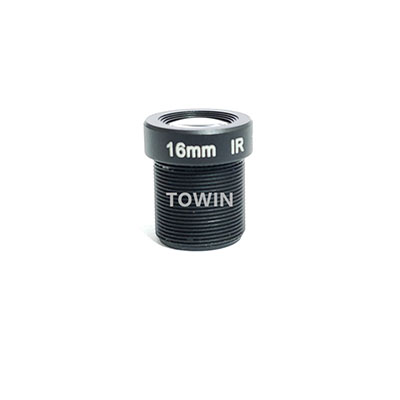
IR-corrected-Low-distortion-CCTV-16mm-M12-lens
Technological Breakthroughs of 1/1.8-Inch Sensors
In recent years, 1/1.8-inch sensors have achieved significant breakthroughs in multiple technical dimensions, enhancing imaging quality and expanding their application boundaries in industries, security, consumer electronics, and beyond.
1. Optimization of Pixel Structure & Light Sensitivity
- Popularization of Backside Illuminated (BSI) and Stacked CMOS technologies improves light utilization and reduces signal interference, boosting noise reduction capability by over 40% in low-light environments.
- Balanced large pixel size and high pixel density—optimized pixel arrangement achieves high resolution and low noise, meeting the detail-capturing needs of industrial inspection scenarios.
2. Enhancement of Low-Light Performance & Dynamic Range
- Starlight-level imaging technology improves quantum efficiency through Near-Infrared (NIR) enhancement, enabling full-color imaging without supplementary lighting for covert night surveillance.
- Multi-frame synthesis and HDR technology realize high dynamic range imaging, suppressing overexposure in highlights and noise in shadows for scenes with strong light-dark contrast or backlighting.
3. Innovation in Optical Image Stabilization & System Integration
- Miniaturized anti-shake components achieve ±3° mechanical compensation range by reducing gyroscope size and optimizing voice coil motors, enhancing imaging stability in moving scenarios.
- Modular and lightweight design optimizes packaging processes, reducing sensor size and weight to drive miniaturization of consumer electronics and industrial equipment.
4. Intelligence & Scene Adaptability
- Built-in NPU and AI algorithms support real-time target detection and classification, improving the automation level of surveillance systems for rapid response in traffic violation detection and other scenarios.
- Scene-adaptive anti-shake strategies dynamically adjust parameters based on shooting conditions, balancing video fluency and static photography exposure time to meet diverse needs.
5. Localization & Cost Optimization
- Full-process domestic production breakthroughs realize independent control from chip design to packaging and testing, reducing design and manufacturing costs for equipment solution providers and accelerating mass production of starlight-level products.
- Power consumption and high-temperature stability optimization improves sensor performance in high-temperature environments, reducing maintenance costs for long-term operation and outdoor applications.
Fisheye CCTV lens IR corrected 1/1.8″ M12 lens
Five Core Advantages of 1/1.8-Inch M12 Lenses
1. High Resolution & Low Distortion
The large sensor size design of 1/1.8-inch combined with multi-layer coating technology enables 5MP-class high-resolution imaging, while controlling the distortion rate within 0.1%. For example, Hikvision’s MVL-HF1228-05S lens can clearly capture micron-level defects in industrial inspection, with edge brightness attenuation of less than 10% to ensure image consistency.
2. Compact & Lightweight Design
The M12 standard interface (12mm diameter) and threaded mounting method reduce the lens size to Φ15.4×19.46mm and weight to only 7 grams. This design facilitates integration into space-constrained devices such as drones and action cameras. For instance, Zhisai’s MTV12MP5C lens maintains a 12mm focal length while being 60% lighter than traditional lenses.
3. Large Depth of Field & Wide-Angle Coverage
By optimizing the optical structure, 1/1.8-inch M12 lenses can achieve a depth of field ranging from 0.1m to infinity at f/2.8 aperture. For example, United Optics’ 25mm focal length lens in industrial positioning scenarios can clearly capture nearby components while fully covering distant production lines, with a field of view of 40.7°×33°.
4. Multi-Scene Adaptability
Optimized designs for different application scenarios:
- Industrial Vision: Hikvision’s MVL-HF1628-05S lens achieves 0.01mm-level measurement accuracy in machine vision inspection by optimizing the working distance (100-850mm).
- Security Surveillance: Zhisai’s MTV12MP5C lens supports a wide operating temperature range of -20℃ to +60℃, meeting outdoor environment requirements.
- Consumer Electronics: M12 fisheye lenses realize single-camera panoramic surveillance with a 180° ultra-wide angle, reducing the number of devices.
5. High Cost-Effectiveness & Easy Integration
M12 lenses adopt a standardized interface design, enabling quick adaptation to camera modules of different brands. For example, Zhonglian Kechuang’s MTV-MP5C series lenses are 40% more cost-effective than telecentric lenses while maintaining S-Mount interface compatibility, shortening equipment development cycles. Their modular nature reduces system integration costs by over 30%, accelerating the large-scale application of starlight-level products.
Lens Selection Logic for Industrial Surveillance Scenarios
| Selection Factor | Scenario Classification | Recommended Lens Specifications |
| Surveillance Distance | Short-range (<5m) | Wide-angle lens (e.g., 2.8mm focal length) |
| Medium-range (5-20m) | Standard focal length (6-12mm) | |
| Long-range (>20m) | Telephoto lens (16mm+) | |
| Lighting Conditions | Low-light environments | Large aperture lens (e.g., F1.4) |
| Strong light environments | Lens with ND filter or small aperture (F2.8+) | |
| Installation Space | Compact space | Ultra-thin lens |
| Wide dynamic range scenes | Low-distortion lens |
In-Depth Review of 5 Top-Tier 1/1.8-Inch M12 Lenses
1. Fisheye Panorama King: CCL118032MPF
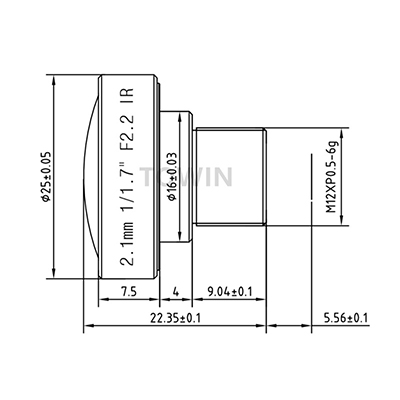
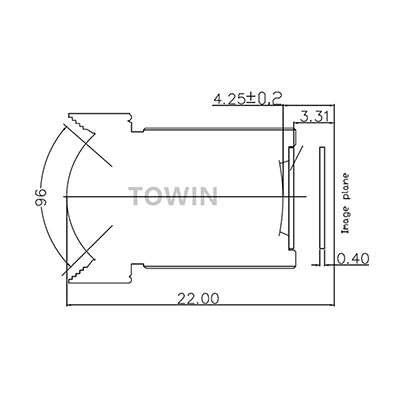
Core Parameters: Focal length 3.2mm, diagonal FOV 154° (H:130°/V:90°), 12MP resolution, F2.0 aperture, distortion rate < -58%, structure 8G+IRCF, TTL=6.2mm
Core Advantages:
- 12MP ultra-high resolution—rare in fisheye lenses, delivering sharp details in panoramic images.
- 154° extra-large FOV enables 360° panoramic coverage with a single lens, eliminating the need for multi-lens stitching.
- F2.0 large aperture ensures clear panoramic images in low-light environments, ideal for night panoramic surveillance.
Application Scenarios: Indoor panoramic surveillance (e.g., shopping malls, meeting rooms, underground parking lots), VR visual collection, non-blind spot security deployment.
3.2mm F2.0 M12 Fisheye lens
2. Low-Distortion Precision Imaging: CCL118040MPFR
Core Parameters: Focal length 4.0mm, diagonal FOV 98° (H:85°/V:70°), 6MP resolution, F2.8 aperture, distortion rate < -0.4%, structure 2G2P+IRCF, TTL=21.8mm, minimum focusing distance 0.4m
Core Advantages:
- Ultra-low distortion rate of -0.4%—top-tier among low-distortion M12 lenses, ensuring undistorted imaging for precision detection.
- Built-in IRCF ensures accurate color reproduction day and night without color deviation.
- 6MP high resolution combined with low-distortion design meets the needs of license plate, face, and other key information recognition.
Application Scenarios: Industrial vision inspection (e.g., part size measurement), precision security surveillance (e.g., road intersections, community entrances), scenarios requiring undistorted imaging.
Low distortion wide angle 4mm 85° M12 lens
3. Long-Range Observation Expert: CCL11812MPR4
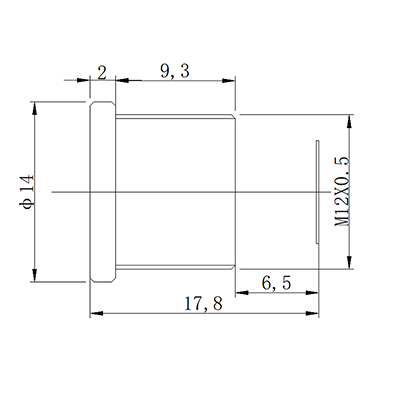
Core Parameters: Focal length 12mm, diagonal FOV 41° (H:33°/V:25°), 5MP resolution, F4.0 aperture, distortion rate < -1.5%, structure 6G, TTL=17.79mm, size Φ14×11.30mm
Core Advantages:
- 12mm long focal length enables precise magnification of long-range targets over 20m with clear details.
- Compact size (Φ14×11.30mm) suitable for embedded installation inside equipment without occupying additional space.
- Low distortion (-1.5%) + high transmittance (R.I.>83%) ensures undistorted, true-color imaging at long distances.
Application Scenarios: Remote equipment monitoring in industrial workshops, outdoor long-range observation (e.g., perimeter security), embedded vision systems for small devices.
1/1.8″ 12mm Achromatic low-distortion M12 lens
4. All-Rounder for Security: S06011806028F
Core Parameters: Focal length 6mm, diagonal FOV 77° (H:60°/V:41°), 6MP resolution, F2.8 aperture, distortion rate < 0.5%, structure 3G2P+IRCF, TTL=23.2mm, minimum focusing distance 0.1m
Core Advantages:
- 0.1m ultra-close focusing distance meets both “close-range detail inspection” and “medium-range coverage” needs.
- Low distortion (<0.5%) + IR correction ensures stable imaging indoors/outdoors, day/night without color deviation or distortion.
- 6MP high resolution optimized for CCTV—an “all-rounder” for security surveillance.
Application Scenarios: Shop surveillance (close-range products + medium-range customers), close-range industrial part inspection, semi-enclosed space surveillance (e.g., community corridors, elevators).
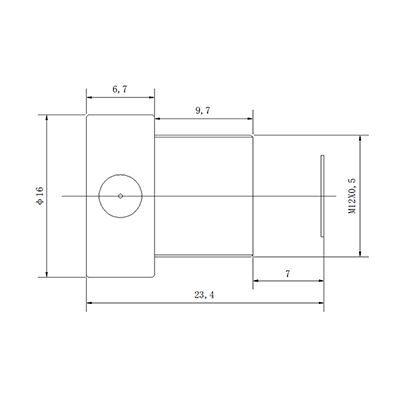
1/1.8″ M12 F2.8 CCTV lens
5. Low-Light Wide-Angle Weapon: CCL11804018MPF
Core Parameters: Focal length 4.0mm, diagonal FOV 135° (H:110°/V:73°), 6MP resolution, F1.8 large aperture, distortion rate < -35%, structure 6G+IRCF, TTL=23mm
Core Advantages:
- F1.8 extra-large aperture—2x more light intake than F2.8 lenses, delivering bright, low-noise images in low-light environments.
- 135° wide-angle coverage enables non-blind spot monitoring of large scenes while maintaining detail clarity.
- 6MP high resolution + IRCF IR correction ensures consistent day/night imaging without additional supplementary lighting.
Application Scenarios: Night security surveillance (e.g., community perimeters, parking lots), low-light environments (e.g., underground parking lots, tunnels), wide-angle coverage of large spaces (e.g., factories, warehouses).
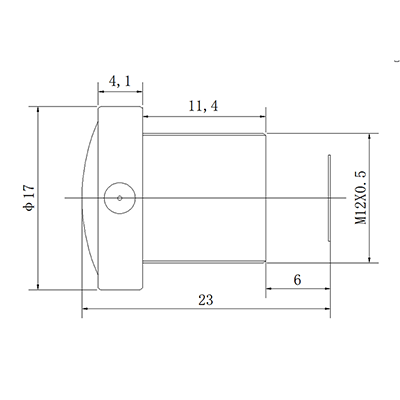
135° wide-angle CCTV lens
Application Scenario Segmentation for 1/1.8-Inch M12 Lenses
Based on the characteristics of the 5 lenses, their application scenarios can be precisely divided into five categories:
- Panoramic Coverage Scenarios: Shopping malls, meeting rooms, large exhibition halls, and other spaces requiring non-blind spot monitoring—prefer CCL118032MPF fisheye lens.
- Precision Imaging Scenarios: Industrial inspection, road intersection license plate recognition, face capture, and other scenarios requiring undistorted, high-detail imaging—prefer CCL118040MPFR (low distortion) or S06011806028F (close-range precision).
- Long-Range Surveillance Scenarios: Remote equipment monitoring in industrial workshops, outdoor long-range security, and other scenarios—prefer CCL11812MPR4 telephoto lens.
- Low-Light Scenarios: Underground parking lots, tunnels, night security, and other low-light environments—prefer CCL11804018MPF (F1.8 large aperture).
- General Security Scenarios: Communities, shops, office buildings, and other general security needs—choose S06011806028F (all-rounder) or CCL118040MPFR (low distortion) for balanced coverage and detail.
Lens Performance Comparison: Key Parameters Horizontal Evaluation
| Lens Model | Focal Length | Resolution | Aperture | Distortion Rate | FOV (Diagonal) | Structure | TTL | Core Strengths |
| CCL118032MPF | 3.2mm | 12MP | F2.0 | < -58% | 154° | 8G+IRCF | 6.2mm | Ultra-wide panoramic coverage |
| CCL118040MPFR | 4.0mm | 6MP | F2.8 | < -0.4% | 98° | 2G2P+IRCF | 21.8mm | Ultra-low distortion precision |
| CCL11812MPR4 | 12mm | 5MP | F4.0 | < -1.5% | 41° | 6G | 17.79mm | Long-range observation |
| S06011806028F | 6mm | 6MP | F2.8 | < 0.5% | 77° | 3G2P+IRCF | 23.2mm | All-round security performance |
| CCL11804018MPF | 4.0mm | 6MP | F1.8 | < -35% | 135° | 6G+IRCF | 23mm | Low-light wide-angle imaging |
FAQs
Is the M12×0.5 interface of M12 lenses universal?
Yes, M12×0.5 is an industry-unified standard thread. All 5 lenses can be directly adapted to all 1/1.8-inch M12 interface sensor modules without additional adapters.
Is higher distortion rate always worse?
Not necessarily. Distortion rate is a “trade-off” in optical design: fisheye lenses (e.g., CCL118032MPF) achieve extra-large FOV through high distortion, suitable for panoramic coverage; low-distortion lenses (e.g., CCL118040MPFR) are ideal for precision imaging scenarios. The choice depends on specific application needs.
What is the function of the IRCF (Infrared Cut Filter)?
It is mainly used to correct the impact of infrared light on imaging, avoiding color deviation in daytime images while ensuring clear images during night infrared supplementary lighting. All 5 lenses integrate this function, eliminating the need for additional installation.
Will fixed aperture and manual focus affect usability?
Fixed aperture lenses are optimized for light intake based on scenarios, requiring no manual adjustment; manual focus only needs one-time debugging during installation, with no subsequent maintenance—making them more suitable for mass-installed security and industrial scenarios.
Can 1/1.8-inch lenses be adapted to other sensor sizes?
Some lenses (e.g., CCL11812MPR4) are compatible with 1/2-inch and 2/3-inch sensors, but the best imaging effect is achieved with 1/1.8-inch sensors to avoid issues such as edge blurriness and FOV reduction.
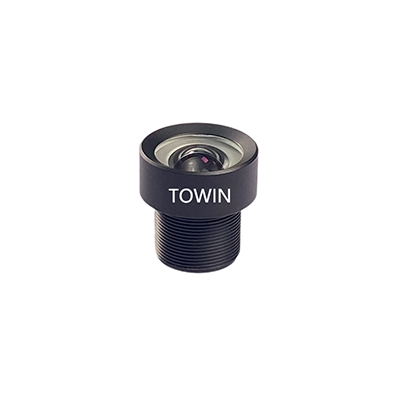
1/1.8″ Low distortion 5-Megapixel lens
Conclusion
1/1.8-inch M12 lenses, with their core advantages of “standardized interface + high-definition performance + multi-scene adaptability,” are becoming the “standard core” in industrial vision, smart security, and other fields. The 5 lenses reviewed in this article cover core scenarios including panoramic coverage, precision imaging, long-range surveillance, low-light environments, and general security. From 12MP fisheye lenses to ultra-low distortion precision lenses, from F1.8 large apertures to 12mm telephoto lenses, users can select the most suitable lens based on specific needs to unlock more efficient and precise visual solutions.
For customized lens solutions or further technical consultations, please contact TOWIN’s professional team—we are committed to providing high-quality optical components tailored to your business needs.