


Low distortion 35mm M12 S-mount board lens
02/26/2026
1/2.8″ M12 S-mount wide angle 2.8mm HD lens
02/27/2026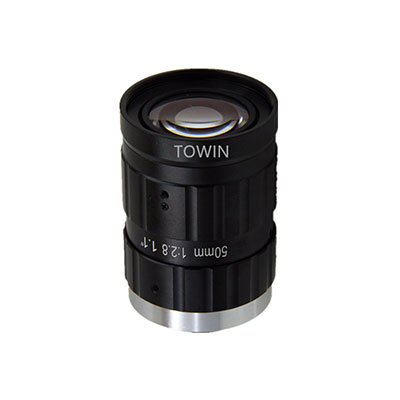
Introduction
In machine vision systems, image accuracy is the foundation of reliable industrial automation—even 1% of optical distortion can lead to misjudgment in measurement, inspection, and recognition tasks. A Low Distortion Lens for Machine Vision is engineered to reduce geometric image deformation, ensuring the captured image perfectly matches the actual size and shape of the object. As a professional optical lens manufacturer, TOWIN has developed a series of high-performance low distortion lenses for industrial scenarios, meeting the strict requirements of 20MP high resolution and ultra-low distortion for FA (Factory Automation) applications. This guide will cover the optical principles, key parameters, selection methods, and practical applications of low distortion lenses, and detail TOWIN’s mature product solutions.
Core Optical Principles of Low Distortion Lenses
The core goal of a Low Distortion Lens for Machine Vision is to eliminate parallax error and magnification error—two key issues that cause image deformation and unreliable data in automated systems. Unlike standard lenses, low distortion lenses rely on telecentric optical technology to address deformation at its root, ensuring consistent, accurate imaging for industrial precision.
1. Telecentric Optical Path Design
A telecentric optical path is the foundation of high-performance low distortion lenses. Unlike traditional lenses (with aperture stops near lens elements), low distortion lenses place the aperture stop at the optical system’s focal plane—this key design choice eliminates magnification errors and parallax.
With the aperture stop at the focal plane, main light rays become parallel to the optical axis, delivering two critical benefits:
- Constant Magnification: Traditional lenses suffer from magnification error when objects shift off the focal plane. Telecentric paths keep image size consistent, essential for assembly line inspections and precise measurement.
- Parallax Elimination: Non-parallel light in standard lenses causes object position shifts (parallax), leading to false defects. Telecentric design ensures light hits the sensor head-on, keeping object position consistent across the FOV.
Telecentric design varies by use case: Double telecentric lenses (aperture stops on both sides) offer near-zero distortion for ultra-precise tasks (e.g., semiconductor inspection). Object-side telecentric lenses are cost-effective for general FA inspection.
2. Lens Element Calibration
Even the best telecentric design needs high-precision lens elements. Low distortion lenses use 8–12 calibrated elements (in 5–7 groups) to minimize refraction-induced distortion, via three key steps:
- High-Precision Grinding: Elements are ground to ±0.1-micron tolerances to ensure uniform curvature, preventing radial/tangential distortion from uneven light refraction.
- AR Coating: Multi-layer anti-reflective coatings reduce glare and ghosting. TOWIN’s proprietary AR coating cuts reflection to <0.5% per surface, ensuring clear imaging in bright industrial settings.
- Strict Assembly: Cleanroom assembly with precision jigs ensures perfect element alignment. This control lets TOWIN’s 35mm lens (C3511028M20) achieve a 0.02% distortion rate—well below industry standards.
3. Elimination of Perspective Distortion
Perspective distortion (“near-large, far-small”) plagues traditional lenses, ruining accuracy for size comparison and edge detection—critical for machine vision. This effect is unacceptable in precision-focused applications.
Low distortion lenses eliminate this by combining telecentric design and optimized element geometry, keeping proportions consistent across the FOV. A straight edge, for example, stays straight—unlike the curve/taper from standard lenses.
- Edge Detection: Curved edges from distortion may be mistaken for defects, causing false rejects.
- Dimensional Measurement: Distortion leads to inconsistent part sizing, ruining measurement accuracy.
- OCR/QR Code ID: Stretched edges distort characters/codes, causing traceability errors.
Practical Performance Metrics: Distortion Rates in Real-World Applications
Distortion rate (TV Distortion) measures performance—industry standard for machine vision is <0.5%, sufficient for general FA tasks like burr or gap detection.
Ultra-precise applications require ≤0.1% distortion. TOWIN’s 35mm model (C3511028M20) achieves 0.02%, ideal for OCR, semiconductor inspection, and micron-level measurement—made possible by telecentric design, precision calibration, and strict assembly.
25mm Low Distortion Machine Vision Lens
Technology and Classification of Low Distortion Lenses for Machine Vision
Low distortion lenses are mainly classified according to optical design type and mount type, with clear application boundaries for each type, suitable for different machine vision system configurations:
By Optical Design Type
- Telecentric low distortion lenses: Divided into object-side, image-side, and double telecentric types. Double telecentric lenses have the best distortion control performance, with distortion close to 0, suitable for high-precision industrial measurement (e.g., precision part size detection).
- Fixed focal length low distortion lenses: The most widely used type in industrial scenarios, with fixed focal length and optimized distortion performance for specific FOV. TOWIN’s 16mm-50mm series belongs to this category, balancing cost and performance.
Distortion Level
- Ultra-low distortion: ≤0.01% (bi-telecentric, high-end metrology).
- High-precision: 0.01–0.1% (telecentric and premium fixed-focus).
- General low distortion: 0.1–0.5% (standard industrial fixed-focus).
By Mount Type
Mount type determines the compatibility with machine vision cameras, and C-mount is the mainstream for low distortion lenses:
- C-mount low distortion lenses: Flange focal distance of 17.526mm, compatible with most industrial GigE/USB 3.0 cameras, suitable for FA inspection, OCR, and QR code identification—the core product line of TOWIN’s low distortion lenses.
- CS-mount low distortion lenses: Shorter flange distance (12.526mm), mostly for small sensor format cameras, with lower resolution requirements.
- M12/S-mount low distortion lenses: Miniature design, for compact machine vision systems (e.g., portable inspection equipment), with limited resolution and distortion performance.
Key Parameters & Selection Priority
Selecting a Low Distortion Lens for Machine Vision needs to follow the principle of matching system requirements first, then pursuing extreme performance. The following parameters are sorted by priority, and each parameter directly affects the lens’s adaptability to the application scenario:
1. Distortion Rate (TV Distortion)
- Definition: The percentage of the difference between the actual imaging size and the ideal size, the core indicator of low distortion lenses.
- Selection standard: FA inspection ≥0.5%, industrial measurement ≤0.1%, OCR/QR code identification ≤0.05%.
- Key note: Avoid blind pursuit of ultra-low distortion—higher precision means higher cost, and it is only necessary to match the system’s measurement accuracy requirements.
2. Sensor Format & Resolution
- Sensor format: The lens’s image format must be greater than or equal to the camera’s sensor format (e.g., 1.1” lens for 1.1” sensor) to avoid vignetting and partial imaging.
- Resolution: Match the camera’s pixel count (e.g., 20MP lens for 20MP camera) to ensure clear imaging of fine features (e.g., tiny surface defects, small characters in OCR).
3. Focal Length & Field of View (FOV)
- Inverse correlation: Longer focal length = smaller FOV = higher distortion control performance.
- Practical selection:
- 16mm-25mm: Wide FOV for large object inspection (e.g., panel surface detection).
- 35mm-50mm: Narrow FOV for fine detection (e.g., OCR character recognition, QR code identification).
4. Minimum Object Distance (M.O.D)
- The closest distance that the lens can focus clearly, determine the installation space between the lens and the measured object (e.g., 0.1m M.O.D for narrow space assembly line inspection).
5. Aperture (FNo.)
- Manual aperture (F2.8~22) is the mainstream for industrial lenses, adjustable according to ambient light to balance imaging brightness and depth of field.
6. Mount Type
- Prioritize C-mount for industrial machine vision systems, with the best compatibility and performance; select M12/CS-mount only for compact/lightweight requirements.
Quick Selection Checklist
- Distortion rate matches inspection/measurement accuracy
- Sensor format ≥ camera sensor size
- Resolution ≥ camera pixel count
- Focal length covers the required FOV
- M.O.D adapts to on-site installation space
- Mount type is compatible with the camera
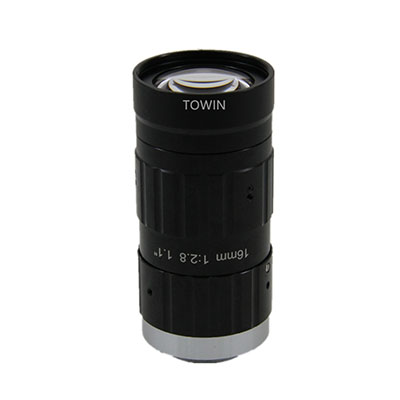
C-mount Machine Vision lens
Application Scenarios of Low Distortion Lens for Machine Vision
1. High-Precision Dimensional Measurement & Metrology
Low distortion (typically ≤0.1%, down to 0.01% for ultra-precise models) ensures that pixel-to-world coordinate mapping is linear and accurate, eliminating “barrel” or “pincushion” errors that skew measurements.
- Key Use Cases: PCB trace width/spacing, battery electrode alignment, connector pin pitch, medical device component dimensions, automotive part tolerancing.
- Why It Matters: A 0.1% distortion error can lead to a 0.5 mm positioning deviation in SMT; ultra-low distortion (0.01–0.04%) reduces this to ≤0.02 mm, directly cutting scrap and rework.
- Ideal Specs: Telecentric or near-telecentric low-distortion lenses, high resolution (5–25 MP), distortion ≤0.1%.
2. Robotic Guidance & Automation (Pick-and-Place, Bin Picking)
Robots rely on undistorted images for accurate workpiece localization, especially in tight workcells or high-speed lines.
- Key Use Cases: SMT component placement, automotive assembly (welding, part fitting), logistics parcel sorting, semiconductor wafer handling.
- Why It Matters: Eliminates blind spots in close-focus, wide-FoV setups; enables real-time tracking without latency from software dewarping, boosting cycle times.
- Ideal Specs: C-mount low-distortion lenses (flange focal distance 17.526 mm), wide angle for coverage, fast autofocus.
3. Surface Defect Inspection & Quality Control
Distortion-free imaging preserves edge definition and surface details, critical for identifying subtle defects that signal quality issues.
- Key Use Cases: Flat-panel display (FPD) pixel defects, solar cell micro-cracks, glass edge chips, metal surface scratches, pharmaceutical blister pack integrity.
- Why It Matters: Consistent geometry across the entire FoV ensures uniform defect detection—no missed errors at the image periphery. A photovoltaic manufacturer reduced NG rates by 37% after switching to low-distortion lenses.
- Ideal Specs: Low distortion + high MTF (≥0.4 at 120 lp/mm), uniform illumination compatibility.
4. Barcode/QR Code & OCR Reading for Traceability
Distortion warps 1D/2D codes, making them unreadable by scanners—low-distortion lenses keep code geometry intact, even at high speeds.
- Key Use Cases: Production line traceability, warehouse inventory management, pharmaceutical serialization, automotive part labeling.
- Why It Matters: Ensures reliable code recognition at any position in the FoV, reducing downtime from misreads.
- Ideal Specs: Fixed-focal low-distortion lenses, high contrast, compatibility with high-speed shutter cameras.
5. Autonomous Mobile Robots (AMRs) & Navigation
AMRs need accurate spatial awareness for obstacle avoidance and path planning—wide-angle, low-distortion lenses provide true-to-life environmental mapping.
- Key Use Cases: Factory floor navigation, warehouse order fulfillment, hospital supply delivery, outdoor uncrewed vehicles (UVs).
- Why It Matters: Eliminates position-calculation errors from fisheye distortion, enabling safer, more efficient navigation with fewer cameras (thanks to wide FoV).
- Ideal Specs: Rectilinear wide-angle low-distortion lenses, low light sensitivity, ruggedized design.
6. Stereo Vision & 3D Reconstruction
Stereo systems depend on precise epipolar geometry—distortion mismatches between left/right lenses break 3D point cloud accuracy.
- Key Use Cases: 3D scanning of complex parts, bin picking with depth perception, human motion analysis, reverse engineering.
- Why It Matters: Simplifies calibration (no need for extensive dewarping) and ensures consistent depth measurements across the FoV.
- Ideal Specs: Matched pairs of low-distortion lenses (distortion ≤0.05% per lens), identical focal length/MTF.
7. Specialized Industrial Monitoring
From remote infrastructure to cleanrooms, low-distortion lenses deliver reliable, undistorted data for continuous monitoring.
- Key Use Cases: Pipeline integrity monitoring (remote, high-res wide FoV), cleanroom particle counting, agricultural field monitoring (crop health, yield mapping).
- Why It Matters: Reduces the number of cameras needed for full coverage; provides accurate spatial data for trend analysis.
- Ideal Specs: Telephoto or wide-angle low-distortion lenses, weatherproof/IP67 housing, high resolution.
Key Selection Criteria by Scenario
| Scenario | Distortion Tolerance | Focal Length | Resolution | Special Features |
| Metrology | ≤0.01–0.1% | Telecentric/Normal | 10–25 MP | High MTF, low chromatic aberration |
| Robotic Pick-and-Place | ≤0.1–0.2% | Wide Angle | 5–12 MP | Close focus, fast autofocus |
| Defect Inspection | ≤0.1–0.2% | Normal/Telephoto | 8–20 MP | Uniform illumination, high contrast |
| Barcode/OCR | ≤0.2–0.3% | Normal | 3–8 MP | High sharpness at medium distances |
| AMR Navigation | ≤0.2% | Wide Angle (Rectilinear) | 5–12 MP | Rugged, low light, wide FoV |
| Stereo 3D | ≤0.05% (matched) | Normal | 8–16 MP | Matched pairs, identical optics |
TOWIN Low Distortion Lenses for Machine Vision
TOWIN’s 1.1” 20MP C-mount low distortion lens series is specially optimized for industrial machine vision scenarios, covering 16mm, 25mm, 35mm, and 50mm focal lengths, with distortion rates from <0.5% to <0.02%. All lenses adopt manual focus/iris/zoom design, easy to adjust on site, and meet the high-resolution imaging requirements of 20MP cameras. Below is a detailed introduction to each model, followed by a comparative summary table for quick selection.
1: C1611028M20 (16mm Focal Length)
- Core parameters: 1.1” sensor format, 20MP resolution, distortion <0.5%, FOV 55°(D)/46°(H)/36°(V), M.O.D 0.1m, T.T.L 95.5mm.
- Optical performance: Wide FOV design, suitable for large-area object inspection, with low distortion to ensure the accuracy of defect detection in the whole field of view.
- Key applications: FA inspection, flat panel display surface detection, large part assembly gap detection.
- Advantage: 0.1m ultra-short M.O.D, suitable for narrow installation space on assembly lines.
2: C2511028M20 (25mm Focal Length)
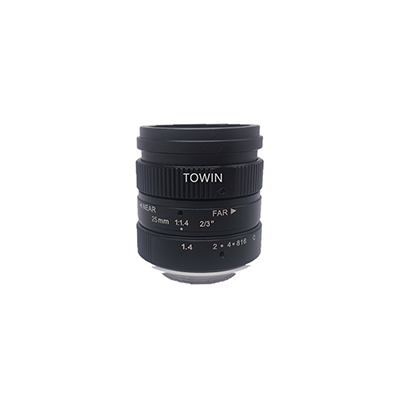
- Core parameters: 1.1” sensor format, 20MP resolution, distortion <0.1%, FOV 38°(D)/30°(H)/23°(V), M.O.D 0.1m, T.T.L 99.5mm.
- Optical performance: Balanced FOV and distortion performance, 0.1% low distortion meets the basic requirements of industrial measurement.
- Key applications: Industrial measurement of medium-sized parts, electronic component surface defect detection, automotive parts assembly inspection.
- Advantage: Same ultra-short M.O.D as 16mm model, compatible with assembly line scenarios with limited space.
3: C3511028M20 (35mm Focal Length)
- Core parameters: 1.1” sensor format, 20MP resolution, distortion <0.02% (ultra-low), FOV 28°(D)/23°(H)/17°(V), M.O.D 0.2m, T.T.L 65.1mm.
- Optical performance: The best distortion performance in the series, close to zero distortion, with high resolution to capture fine features.
- Key applications: OCR character recognition, precision part dimensional measurement, semiconductor wafer defect detection.
- Advantage: Compact design (T.T.L only 65.1mm), easy to integrate into small machine vision systems.
4: C5011028M20 (50mm Focal Length)
- Core parameters: 1.1” sensor format, 20MP resolution, distortion <0.04%, FOV 20°(D)/16°(H)/12°(V), M.O.D 0.3m, T.T.L 71.4mm.
- Optical performance: Narrow FOV design for fine detection, 0.04% ultra-low distortion ensures the accuracy of QR code/barcode imaging.
- Key applications: QR code/barcode identification, tiny part surface defect detection, high-precision electronic component measurement.
- Advantage: High resolution matching 20MP camera, clear imaging of high-density codes and tiny features.
TOWIN Low Distortion Lens for Machine Vision Comparative Table
| Model No. | Focal Length | Distortion Rate | Sensor Format | Resolution | Diagonal FOV | M.O.D | T.T.L (mm) | Core Applications |
| C1611028M20 | 16mm | <0.5% | 1.1” | 20MP | 55° | 0.1m | 95.5 | FA inspection, large area surface detection |
| C2511028M20 | 25mm | <0.1% | 1.1” | 20MP | 38° | 0.1m | 99.5 | Industrial measurement, electronic component inspection |
| C3511028M20 | 35mm | <0.02% | 1.1” | 20MP | 28° | 0.2m | 65.1 | OCR, precision part measurement, semiconductor inspection |
| C5011028M20 | 50mm | <0.04% | 1.1” | 20MP | 20° | 0.3m | 71.4 | QR code identification, tiny part defect detection |
Common features of the series: C-mount, F2.8~22 manual aperture, manual focus/zoom, 20MP high resolution, 1.1” large sensor format—all meet the technical requirements of industrial machine vision systems, and are marked as TOWIN’s HOT LENSES for their high cost performance and wide applicability.
FAQs
Q1: Why is C-mount the mainstream for Low Distortion Lens for Machine Vision?
A1: C-mount has a standard flange focal distance of 17.526mm, compatible with 90% of industrial machine vision cameras (GigE/USB 3.0/3D cameras). It supports large sensor formats (e.g., 1.1”) and high resolution (20MP+), and has better mechanical stability than M12/CS-mount, suitable for long-term industrial on-site use.
Q2: How to match the low distortion lens with the camera sensor?
A2: The image format of the lens must be ≥ the sensor format of the camera (e.g., 1.1” lens for 1.1” sensor). If the lens format is smaller, vignetting (dark corners) and partial imaging will occur, resulting in incomplete object capture and reduced distortion performance.
Q3: What is the relationship between focal length and distortion rate?
A3: For fixed focal length low distortion lenses, longer focal length usually means lower distortion rate. Because longer focal length lenses adopt more optimized optical path design and more lens elements, which can better correct light refraction deformation. TOWIN’s series fully reflects this rule: 16mm (<0.5%) → 25mm (<0.1%) → 35mm (<0.02%) → 50mm (<0.04%).
Q4: Can low distortion lenses be used in outdoor machine vision scenarios?
A4: TOWIN’s C-mount low distortion lenses are mainly designed for indoor industrial scenarios (FA/measurement/OCR). If used outdoors, additional protective measures (e.g., dustproof/waterproof casing) are required, and the aperture needs to be adjusted according to outdoor light changes to ensure imaging stability.
Conclusion
A Low Distortion Lens for Machine Vision is the “eye” of high-precision industrial automation, and its distortion control performance directly determines the reliability of machine vision systems in inspection, measurement, and recognition tasks. When selecting, it is crucial to match the actual application requirements—from distortion rate and resolution to focal length and mount type, each parameter needs to be calibrated with the camera and on-site scenarios.
TOWIN, as a professional optical lens supplier, has launched the 1.1” 20MP C-mount low distortion lens series (16mm-50mm) for machine vision scenarios, with distortion rates ranging from <0.5% to <0.02%, covering all medium and high-end industrial application requirements from large-area inspection to ultra-precise measurement. All products adopt industrial-grade design, with stable performance and easy on-site adjustment, and can be quickly integrated into various machine vision systems.
If you need to customize or select low distortion lenses for your machine vision project, contact TOWIN via info@towin-elec.com—we provide professional one-stop optical solutions, adhering to the service concept of PROFESSIONAL-ALL-EASY-FAST, to deliver high-quality lenses to you efficiently.