


Large aperture F1.0 lens for low-light imaging
02/19/2026
Understanding Chief Ray Angle (CRA) in Optical Lens Design
02/21/2026Introduction
Fisheye lens imaging, known for their ultra-wide 180°+ field of view, are widely used in surveillance systems, VR/AR devices, automotive cameras, and creative photography. However, their extreme wide-angle design often leads to a common pain point: edge-to-edge sharpness inconsistency—edges may appear blurry, distorted, or low in contrast. For professionals relying on high-quality imaging (e.g., security monitoring, industrial machine vision), consistent edge sharpness is non-negotiable.
As a professional optical lens supplier, TOWIN specializes in designing and manufacturing M12/S-Mount fisheye lenses (part of our M12/S-Mount product line) with advanced optical solutions to address edge sharpness challenges. This blog dives deep into the principles, influencing factors, optimization techniques, and purchasing guides for fisheye lens edge-to-edge sharpness—helping you make informed decisions and maximize your lens performance.
Fisheye Lens Imaging Principle & Edge Sharpness Challenges
How Fisheye Lenses Work
Fisheye lenses achieve ultra-wide coverage through a short focal length (typically 8mm or less) and extreme lens curvature. Unlike standard lenses that project scenes onto a flat sensor linearly, fisheye lenses use a hemispherical projection model to fit a 180°+ field of view onto a rectangular sensor.
Core Challenges for Edge Sharpness
- Distortion: Radial distortion (barrel distortion) is inherent—edges stretch outward, causing geometric deformation and perceived blurriness.
- Resolution Degradation: Light rays at the edge of the lens have a steeper incident angle, leading to lower pixel sampling efficiency and reduced detail.
- Contrast Loss: Edge rays are more prone to reflection, refraction, and vignetting (darkening at edges), weakening contrast.
- Chromatic Aberration: Different wavelengths of light focus at different points, resulting in color fringing at edges.
TOWIN’s M12/S-Mount fisheye lenses address these challenges via optimized optical design (e.g., aspherical lenses) and multi-coating technology—ensuring minimal distortion and consistent sharpness from center to edge.
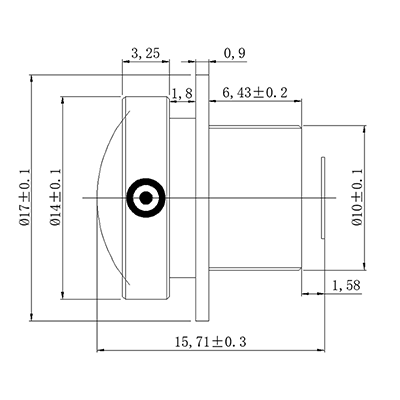
Fisheye 3-Megapixel CCTV lens
10 Key Optical Factors Affecting Fisheye Lens Edge Sharpness
Edge-to-edge sharpness is determined by a combination of optical design, material quality, and manufacturing precision. Here are the top 10 critical factors:
- Field of View (FOV): Wider FOV (e.g., 220°) increases edge sharpness pressure; 180°-200° FOV balances coverage and sharpness (TOWIN’s M12 fisheye lenses offer 180°+ FOV options).
- Lens Curvature Design: Overly curved lenses exacerbate distortion—TOWIN uses computer-aided optimization (CAO) to refine curvature for edge ray control.
- Glass Material Purity: High-purity optical glass (e.g., low-dispersion glass) reduces light scattering and chromatic aberration.
- Coating Technology: Multi-coating (Muti-Coating) minimizes reflection and glare—TOWIN’s IR-corrected coatings enhance edge contrast for day/night use.
- Aperture Size: Smaller apertures (e.g., f/2.0-f/4.0) improve depth of field and edge sharpness; TOWIN’s 1/2″ 5MP F2 fisheye lens balances light intake and sharpness.
- Focusing Precision: Misalignment between the lens and sensor degrades edge clarity—TOWIN’s M12 threaded mount ensures precise installation.
- Lens Group Count: Rational lens group (3-5 groups) balances aberration correction and light transmission (too many lenses cause light loss).
- Distortion Correction: Optical (aspherical lenses) or digital (software) correction—TOWIN prioritizes optical correction for natural image quality.
- Temperature Stability: High-quality glass and lens housing resist thermal expansion/contraction—critical for automotive and outdoor use (TOWIN’s automotive fisheye lenses meet industrial temperature standards).
- Installation Precision: Secure mounting (e.g., M12X0.5 thread) prevents lens shift—TOWIN’s board lens design (direct PCB mounting) reduces vibration impact.
Optical Structure Innovation: The Breakthrough of Aspherical Lenses
Traditional spherical lenses cause “spherical aberration”—light rays from the edge fail to focus at the same point as center rays, leading to blurriness. Aspherical lenses (a key innovation in TOWIN’s fisheye lenses) solve this problem with their non-uniform curvature:
Advantages of Aspherical Lenses for Edge Sharpness
- Reduces barrel distortion by 30-50% compared to spherical lenses.
- Improves edge resolution by concentrating light rays on the sensor’s edge pixels.
- Simplifies lens structure (fewer lenses needed), reducing light loss and weight.
- Enhances contrast at edges by minimizing scattered light.
TOWIN integrates aspherical lenses into its M12/S-Mount fisheye lens lineup—ideal for applications requiring both wide coverage and precise edge detail (e.g., 360° surveillance cameras, VR headsets).
Deep Dive: Lens Group Structure & Edge Sharpness
The number and arrangement of lens groups directly impact edge-to-edge performance. Here’s how TOWIN optimizes lens group design:
- Lens Group Count: 3-5 groups are optimal for fisheye lenses. For example:
- 1st group: Aspherical lens to correct distortion.
- Middle groups: Cemented lenses (two lenses bonded) to reduce chromatic aberration.
- Last group: Flat lens to ensure parallel light rays reach the sensor.
- Arrangement Type:
- Symmetrical design: Balances aberration correction for center and edge.
- Asymmetrical design: Prioritizes edge sharpness for ultra-wide FOV lenses.
- Cemented Lenses: Reduces internal reflection between lenses, improving edge contrast and resolution.
TOWIN’s engineering team uses optical simulation software to test thousands of lens group configurations—ensuring each M12 fisheye lens delivers consistent sharpness from center to edge.
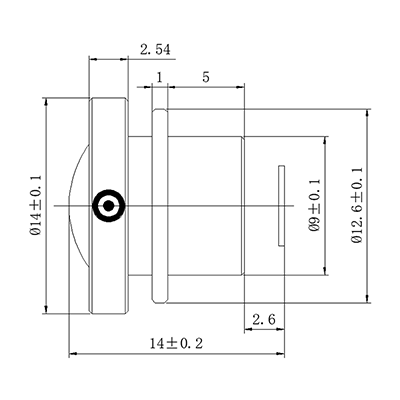
1.9mm 8-Megapixel M12 Fisheye CCTV lens
Glass Material & Coating Technology: Invisible Guardians of Edge Sharpness
Glass Material Selection
TOWIN uses high-grade optical glass for fisheye lenses, with key properties:
- Low dispersion: Minimizes chromatic aberration (color fringing) at edges.
- High transmittance: >95% light transmission to preserve edge detail.
- Thermal stability: Resists warping in extreme temperatures (-40°C to +85°C) for outdoor/automotive use.
Coating Technology: Muti-Coating + IR Correction
TOWIN’s fisheye lenses feature multi-coating (Muti-Coating) and IR-corrected technology—directly from our CS-Mount lens expertise, adapted for fisheye applications:
- Multi-coating: 5-7 layers of anti-reflective coating reduce surface reflection from 4% to <0.5%.
- IR correction: Aligns visible and infrared light focus points, ensuring sharp edges in both day and night (critical for security cameras).
- Benefits for edge sharpness:
- Reduces glare and ghosting at edges.
- Enhances contrast in high-contrast scenes (e.g., bright sky + dark buildings).
- Improves light utilization, preserving detail in low-light conditions.
Circular vs. Diagonal Fisheye Lenses: Edge Sharpness Differences
Fisheye lenses are categorized into two types—each with unique edge sharpness characteristics. Use the table below to choose the right type for your needs:
| Feature | Circular Fisheye Lens | Diagonal Fisheye Lens | TOWIN Recommendation |
| Field of View | 180°+ (circular image on sensor) | 180° (fills entire rectangular sensor) | Circular: 360° surveillance |
| Diagonal: VR/AR, automotive | |||
| Edge Distortion | Lower (circular projection reduces stretch) | Higher (fills sensor edges, more stretch) | Choose circular for minimal distortion |
| Edge Resolution | Consistent (circular edge avoids sensor corners) | Lower at sensor corners | Diagonal: Pair with TOWIN’s aspherical lenses for correction |
| Application | 360° panoramic monitoring, drone photography | VR headsets, automotive surround-view systems | TOWIN offers both types in M12/S-Mount |
Hyperfocal Focusing: A Key Tip to Boost Edge Sharpness
Hyperfocal focusing is a technique to maximize depth of field—ensuring both near and far edges are sharp without changing hardware. Here’s how to apply it:
What is Hyperfocal Distance?
The closest distance at which focusing keeps everything from half that distance to infinity sharp. For fisheye lenses:
- Formula: Hyperfocal distance (H) = (f²) / (N × c), where:
- f = focal length (e.g., 8mm)
- N = aperture (e.g., f/2.8)
- c = circle of confusion (typically 0.01mm for sensors)
Step-by-Step Guide for Fisheye Lenses
- Calculate hyperfocal distance using the formula (or use online calculators).
- Focus the lens at H (e.g., 1.5m for an 8mm f/2.8 lens).
- Ensure aperture is set to f/2.8-f/4.0 (balances sharpness and light intake).
TOWIN Lens Advantage
TOWIN’s M12 fisheye lenses feature precise manual focusing rings with clear markings—making hyperfocal setup quick and easy for surveillance or photography applications.
Scene-Specific Edge Sharpness Optimization Solutions
Different applications require tailored approaches to maximize edge sharpness. Below are TOWIN’s recommended optimizations:
1. Security & Surveillance
- Challenges: Low light, wide coverage, 24/7 use.
- Optimizations:
- Choose IR-corrected fisheye lenses (TOWIN’s IRB series) for day/night sharpness.
- Set aperture to f/2.0-f/2.8 (balances light and depth of field).
- Use hyperfocal focusing to cover 1m to infinity.
- TOWIN Product: M12/S-Mount Fisheye Lens (S01714012013IRB9) with IR correction.
2. VR/AR Devices
- Challenges: Low distortion, high resolution (4K+), eye comfort.
- Optimizations:
- Select diagonal fisheye lenses with aspherical design (TOWIN’s A5120020F69).
- Prioritize edge resolution >100 LP/mm (line pairs per millimeter).
- Use multi-coating to reduce glare (critical for close-up viewing).
3. Automotive Surround-View Systems
- Challenges: Temperature extremes, vibration, fast-moving scenes.
- Optimizations:
- Choose TOWIN’s automotive-grade fisheye lenses (part of M12 Automotive lens line).
- Ensure temperature stability (-40°C to +85°C) and shock resistance.
- Opt for f/2.4 aperture (sharpness + low-light performance).
4. Outdoor Photography/Cinematography
- Challenges: Bright light, high contrast, creative distortion control.
- Optimizations:
- Use circular fisheye lenses with low distortion (TOWIN’s CCL12014MP).
- Set aperture to f/4.0 for maximum edge sharpness.
- Pair with UV filters to reduce haze and protect the lens.
Mainstream Fisheye Lens Brand Edge Sharpness Comparison (with TOWIN Selection Guide)
Choose the right brand based on edge performance, application, and budget. The table below compares top options:
| Brand | Lens Type | Edge Resolution (LP/mm) | Distortion Control | Coating Technology | Application | Price Range | TOWIN Advantage |
| TOWIN | M12/S-Mount Fisheye | ≥90 | Excellent (aspherical + IR) | Multi-coating + IR | Surveillance, Automotive | $30-$80 | High cost-performance, PCB-mount compatible |
| Tamron | C-Mount Fisheye | ≥100 | Good | BBAR Coating | Industrial Machine Vision | $150-$300 | TOWIN offers smaller size (M12) for compact devices |
| Sigma | Full-Frame Fisheye | ≥110 | Excellent | Super Multi-Layer Coating | Photography | $400-$800 | TOWIN’s M12 lenses are more affordable for mass production |
| Sony | CS-Mount Fisheye | ≥95 | Good | Nano AR Coating | VR/AR | $100-$200 | TOWIN supports custom design (focal length, FOV) |
TOWIN Selection Recommendations
1. For Industrial/Surveillance: M12/S-Mount Lens (CCL12014MP)
- Core Parameters:
- Focal Length (E.F.L.): 1.4mm (short focal length for wide coverage)
- Sensor Compatibility: 1/2″ with image circle Φ4.7mm (fits mainstream industrial PCB camera sensors)
- Horizontal Field of View (H.F.O.V.): 185° (ultra-wide angle covers large areas, reducing the need for multiple lenses)
- Resolution: 5MP (high-definition imaging captures fine details like human faces or object features)
- Distortion Control (Max Dist.): 3.7% (extremely low distortion avoids image stretching, ensuring geometric accuracy for event traceability)
- Aperture (FNo.): F2.0 (large aperture boosts light intake in low-light environments, maintaining clear edge imaging at night or in dim workshops)
- Interface & Structure: M12x0.5 S-Mount (standard board-mount thread for direct installation on PCB cameras), TTL 16.65mm (compact design for embedded surveillance modules)
- Special Features: IR correction compatibility (adapts to TOWIN M12 lens’ universal infrared optimization, supporting 24/7 day-night surveillance)
- Applicable Scenarios:
- Industrial workshop panoramic monitoring: 185° wide angle covers the entire workshop without multi-lens stitching; low distortion ensures accurate positioning of equipment and personnel.
- Outdoor campus security: F2.0 aperture handles low-light conditions at night; IR correction maintains consistent day-night imaging; M12 board-mount fits the compact structure of outdoor surveillance boxes.
- Warehouse large-area monitoring: 5MP resolution clearly identifies cargo storage status; 3.7% low distortion prevents misjudgment of shelf and cargo positions.
Fisheye CCTV HD lens
2. For VR/AR: M12/S-Mount Lens (A5120020F69)
- Core Parameters:
- Focal Length (E.F.L.): 1.9mm (short focal length matches the natural visual range of human eyes)
- Sensor Compatibility: 1/2.9″ with maximum image circle Φ5.19mm (precisely fits small-size high-definition sensors in VR/AR devices, avoiding edge cropping)
- Horizontal Field of View (H.F.O.V.): 200° (ultra-wide coverage meets the binocular field of view for VR headsets, reducing image stitching traces)
- Resolution: 8MP (ultra-high resolution adapts to 4K+ screens in VR/AR devices, eliminating graininess for an immersive experience)
- Distortion Control (Max Dist.): 19% (F-θ distortion optimization, far lower than ordinary fisheye lenses, effectively reducing visual vertigo for users)
- Aperture (FNo.): F2.0 (balanced light intake ensures uniform image brightness, avoiding local over-darkening or over-brightening in VR/AR scenarios)
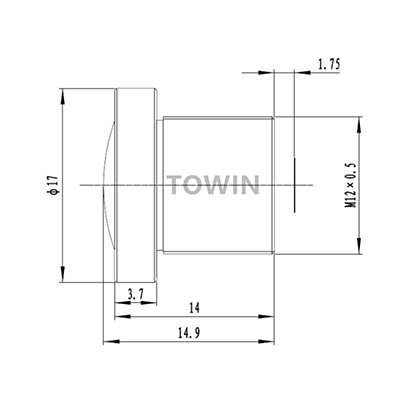
- Interface & Structure: M12x0.5 S-Mount (miniaturized interface fits the compact body of VR/AR devices), TTL 14mm (ultra-thin structure reduces space occupied by the lens module, improving wearing comfort)
- Special Features: Active Alignment (A-A) technology (ensures precise alignment between the lens optical center and sensor center, guaranteeing parameter consistency for left/right eye lenses to avoid binocular parallax); built-in IRCF infrared filter (supports day-night use, expanding application scope); IP69K waterproof rating (resists sweat and water stains in daily use, enhancing device durability)
- Applicable Scenarios:
- VR headsets: 200° ultra-wide angle covers binocular vision; 8MP high resolution restores detailed virtual scenes; 19% low distortion reduces vertigo during long-term wear; 14mm thin design improves wearing comfort.
- AR smart glasses: Active Alignment technology ensures accurate overlay of virtual images with real scenes; IP69K waterproofing adapts to outdoor daily use; M12 miniaturized interface facilitates integration into eyeglass frames.
- Virtual training devices (e.g., industrial VR training, medical VR simulation): High resolution ensures clear recognition of virtual equipment details; low distortion guarantees consistent operating perspectives with real scenes, improving training accuracy.
1.9mm 8-Megapixel M12 Fisheye CCTV lens
3. For Automotive: M12/S-Mount Lens (A5520220F69)
- Core Parameters:
- Focal Length (E.F.L.): 1.7mm (short focal length covers blind spots around the vehicle)
- Sensor Compatibility: 1/2.4″ with image circle Φ5.51mm (fits sensors commonly used in automotive surround-view systems, ensuring complete images without cropping)
- Horizontal Field of View (H.F.O.V.): 205° (ultra-wide angle covers large areas in front of/behind the vehicle, supporting 360° surround-view stitching)
- Resolution: 3MP (meets automotive imaging requirements, clearly displaying key information like obstacles and lane lines)
- Distortion Control (Max Dist.): 3.8% (extremely low distortion ensures realistic object size ratios in reverse images and surround views, avoiding driver misjudgment of distances)
- Aperture (FNo.): F2.0 (large aperture enhances imaging clarity in low-light environments such as night driving or tunnels, ensuring driving safety)
- Interface & Structure: M12x0.5 S-Mount (standard automotive camera interface for easy integration with vehicle electronic modules), TTL 15.71mm (compact design fits limited installation spaces like bumpers or rearview mirrors)
- Special Features: Automotive-grade temperature stability (-40°C~+85°C, adapting to extreme environments like severe cold in winter and intense sun in summer); anti-vibration performance (meets automotive vibration standards to handle driving bumps and maintain stable lens parameters); anti-fog coating (prevents lens fogging caused by temperature differences inside/outside the vehicle, ensuring clear imaging in all weather conditions)
- Applicable Scenarios:
- Automotive 360° surround-view systems: 205° ultra-wide angle covers blind spots around the vehicle; 3.8% low distortion ensures smooth stitching of multi-lens images without obvious deformation.
- Reverse image systems: 3MP high resolution clearly displays rear obstacles (e.g., pedestrians, curbs); F2.0 large aperture ensures bright images during night reversing.
- Automotive forward collision warning systems: Ultra-wide angle captures front lane lines, pedestrians, and obstacles; temperature stability and anti-vibration performance ensure stable lens performance during long-term driving, reducing false alarms/missed detections.
Fisheye 3-Megapixel CCTV lens
Purchasing Guide: 5 Core Parameters for Edge Sharpness
When buying a fisheye lens, focus on these 5 parameters to ensure optimal edge-to-edge sharpness:
| Core Parameter | Definition | How It Affects Edge Sharpness | TOWIN Specification |
| Field of View (FOV) | Angle of coverage (180°-220°) | Wider FOV = more edge distortion; 180°-200° is optimal | 180°+ (customizable up to 220°) |
| Edge Resolution | LP/mm (line pairs per millimeter) at lens edges | Higher LP/mm = sharper edge detail | ≥90 LP/mm (for 5MP sensors) |
| Distortion Rate | Percentage of barrel distortion | Lower rate = more natural edge shapes | ≤5% (aspherical lens correction) |
| Coating Technology | Anti-reflective and IR correction | Multi-coating + IR = better edge contrast | Muti-Coating + IR-corrected |
| Mounting Interface | Lens-sensor connection (M12/C/CS) | Precise mount = no edge misalignment | M12X0.5 (S-Mount) – PCB/board-mount compatible |
FAQs
Q1: Is edge blurriness normal for fisheye lenses?
A: Mild blurriness is common, but high-quality lenses (like TOWIN’s) minimize it via aspherical design and coating. Severe blurriness indicates poor optical design or misinstallation.
Q2: How to test a fisheye lens’s edge sharpness?
A: Use a resolution chart (e.g., ISO 12233), photograph it at 180° FOV, and check edge line clarity with image analysis software.
Q3: Can software fix fisheye edge blurriness?
A: Digital correction can reduce distortion but may degrade detail. Optical correction (TOWIN’s approach) is better for true sharpness.
Q4: Does aperture affect edge sharpness?
A: Yes—smaller apertures (f/2.8-f/4.0) improve edge sharpness; larger apertures (f/1.4-f/2.0) prioritize light intake over edge detail.
Q5: Are TOWIN’s fisheye lenses compatible with my PCB camera?
A: Yes—TOWIN’s M12/S-Mount fisheye lenses have a standard M12X0.5 thread, directly compatible with PCB/board cameras.
Conclusion
Edge-to-edge sharpness is a critical metric for Fisheye lens imaging, and it depends on optical design, material quality, and application-specific optimization. TOWIN, as a professional optical lens supplier, addresses these challenges with aspherical lenses, multi-coating technology, and precision M12/S-Mount design—delivering fisheye lenses that balance wide coverage and sharp edges for surveillance, automotive, VR/AR, and industrial use.
Whether you need a standard 180° fisheye lens or a custom solution, TOWIN’s engineering team is ready to support you. Contact us today at info@towin-elec.com to discuss your project requirements!