


CCTV lens manufacturers
06/25/2025
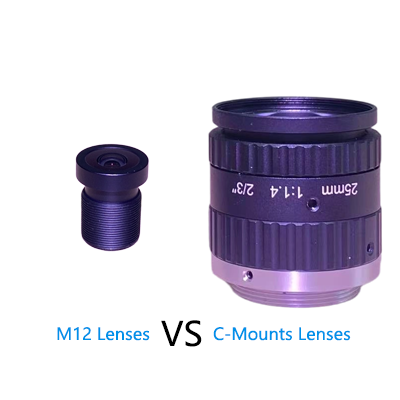
What is an M12 lens?
06/25/2025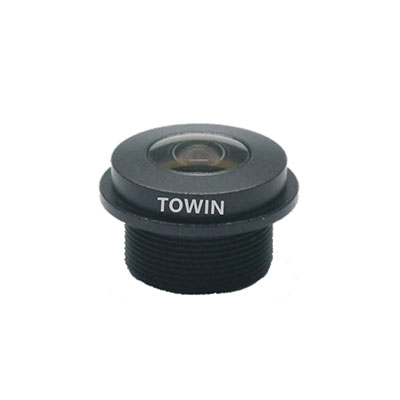
In the era of smart driving, automotive lenses serve as the “eyes” of vehicles, enabling advanced driver assistance systems (ADAS) and autonomous driving technologies. Among global suppliers, Towin stands out for its innovative lens solutions tailored for automotive applications.
1. Ultra-Wide Field of View (FOV) for 360° Perception
Automotive lenses must balance FOV range and image distortion to ensure comprehensive environmental monitoring. Towin’s lenses adopt multi-lens fusion technology, combining wide-angle (≥190°) and telephoto lenses to eliminate blind spots. For example, its fisheye lenses for surround-view systems achieve a 210° horizontal FOV while maintaining TV distortion below 21%, ensuring accurate object recognition in parking scenarios.
In contrast, consumer-grade lenses often struggle with barrel distortion, which distorts straight lines into curves. Towin’s optical calibration algorithms compensate for this, enabling its lenses to meet ISO 16505 standards for automotive imaging systems.
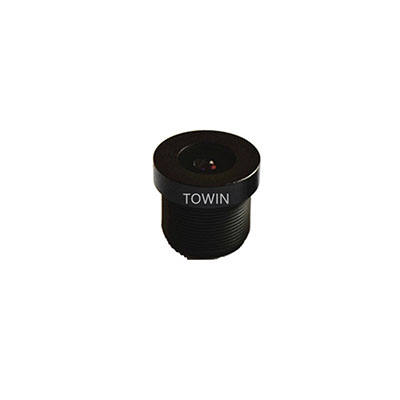
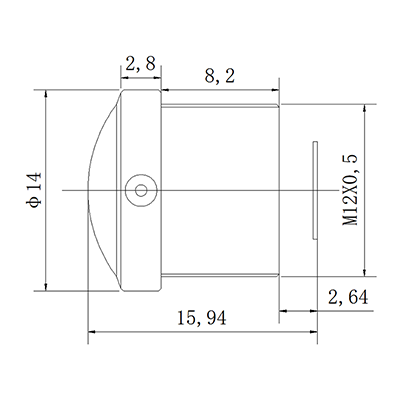
3.7mm wide angle lens automotive lens
2. Extreme Temperature Resistance: -40°C to 105°C Operation
Automotive environments demand lenses that withstand thermal shocks and vibrations. Towin’s lenses use all-glass optical elements with low thermal expansion coefficients, ensuring stability across -40°C to 105°C. For instance, its front-view lenses maintain ≤0.05mm focal length drift in temperature cycling tests, outperforming plastic lenses that may deform under extreme conditions.
Additionally, Towin’s lenses pass IPX9K waterproof tests and salt spray resistance (720h), making them ideal for exterior installations like rearview cameras.
3. High Dynamic Range (HDR) for Low-Light and High-Contrast Scenarios
Automotive lenses must adapt to rapidly changing lighting conditions, such as tunnels or night driving. Towin’s lenses integrate multi-layer anti-reflection coatings and aperture control mechanisms to achieve 120dB HDR, ensuring clear imaging in 0.1 lux (starlight-level) environments.
For example, its night-vision lenses feature F1.4 apertures and near-infrared (NIR) sensitivity enhancements, improving pedestrian detection accuracy by 30% compared to standard lenses.
4. Compact Design for Seamless Integration
Modern vehicles prioritize aerodynamics and space efficiency. Towin’s lenses adopt miniaturized optical structures, with some models measuring ≤22.7mm in length while maintaining 8MP resolution. For instance, its coaxial lens modules reduce Z-height by 40%, enabling integration into slim dashboard designs.
5. Advanced Manufacturing for Automotive-Grade Reliability
Automotive lenses must meet stringent quality standards, including 10-year lifespan requirements. Towin’s lenses undergo 1,000h thermal aging tests and 10g vibration resistance, ensuring 0.1% failure rates over 1 million kilometers.(See more about Waterproof Automotive lens)
For example, its aspherical lens elements reduce spherical aberration by 50%, improving MTF (Modulation Transfer Function) to ≥0.6 at 100lp/mm. This precision is critical for high-resolution ADAS cameras (e.g., 8MP front-view lenses).
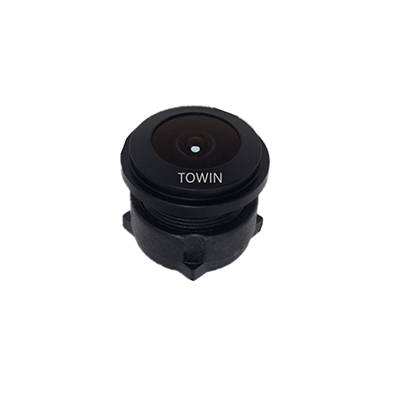
S-Mount Automotive lens
Towin’s Competitive Edge in Automotive Lenses
- Patented optical designs: 150+ patents in lens distortion correction and multi-sensor calibration.
- Automated production lines: Achieving ±0.01mm assembly accuracy for mass production.
- Customization capabilities: Offering FOV tuning (30°–210°) and wavelength optimization (400–940nm).
Conclusion
As autonomous driving evolves, automotive lenses must balance performance, reliability, and cost. Towin’s lenses excel in extreme environment adaptability, high-resolution imaging, and seamless system integration, making them a preferred choice for L2+ to L4 autonomous vehicles.
For automotive engineers and suppliers seeking cutting-edge lens solutions, Towin’s portfolio represents a benchmark for innovation and quality.