


Pinhole vs. Conventional Lenses
09/17/2025
Wide Angle Lens with Advanced Coating Technology
09/17/2025
For photographers seeking to push boundaries, few tools are as bold—or as polarizing—as the fisheye lens. Known for its extreme wide-angle perspective and dramatic barrel distortion, this lens transforms ordinary scenes into surreal, panoramic masterpieces.
What Is a Fisheye Lens?
Fisheye Lens Explained: Its defining trait is a 180-degree view that curves straight lines into dramatic, sweeping arcs. Unlike standard wide-angle lenses, which aim for natural perspective, fisheyes embrace distortion for artistic effect. This “bulging” look mimics the view from a fish’s underwater perspective, hence the name. Originally designed for meteorology in the 1920s, fisheyes later became a staple in photography and filmmaking for their ability to capture immersive, dynamic scenes.
Types of Fisheye Lenses
- Circular Fisheye: Creates a circular image with black borders, covering the full 180-degree view in all directions. Ideal for abstract art or capturing the entire sky in astrophotography.
- Full-Frame Fisheye: Produces a rectangular image with less distortion, filling the frame while maintaining a 180-degree diagonal angle. Better suited for traditional photography genres like architecture or sports.
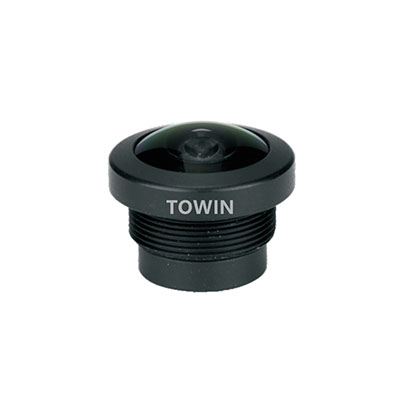
4-Megapixel F2.4 M12 mount fisheye lens
5 Creative Uses of Fisheye Lenses
- Landscape Photography: Emphasize vastness by placing the horizon at the center, stretching foreground elements like rocks or trees into sweeping curves.
- Action Sports: Capture athletes in motion from unique angles, such as low-angle shots that exaggerate speed and energy.
- Interior Design: Showcase small rooms by stretching walls outward, creating a sense of openness.
- Underwater Exploration: The lens’s water-friendly design and wide view make it perfect for documenting marine life up close.
- Experimental Art: Use distortion to warp portraits or cityscapes into psychedelic compositions, challenging viewers’ perceptions.
Tips for Mastering Fisheye Photography
- Get Close: Distortion is most pronounced near the edges, so position subjects near the center for a balanced look.
- Mind the Horizon: Keep it level to avoid unintended tilting effects.
- Post-Processing: Correct minor distortions or enhance creativity with software like Adobe Lightroom.
For hands-on inspiration, check out National Geographic’s fisheye gallery, which showcases breathtaking examples of this lens in action.

Fisheye IR Cut Filter S-Mount Lens
Conclusion
Fisheye Lens Explained reveals a tool that’s as versatile as it is divisive. While its distortion isn’t for every scenario, mastering its quirks can lead to striking, memorable images. By choosing the right type and experimenting with composition, you’ll harness the fisheye’s power to turn the mundane into the extraordinary.