Sustainable optical manufacturing: Eco-friendly glass materials
02/22/2026
Facial recognition lenses for smart access control
02/24/2026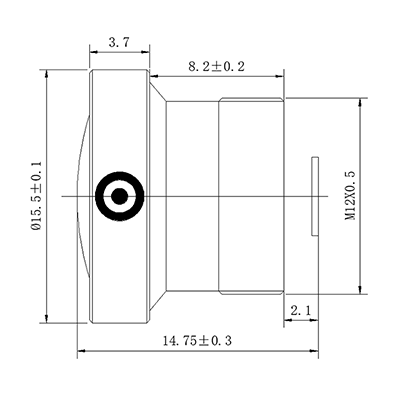
Table of Contents
Key Takeaways
- TOF Lens Definition: A 3D sensing core component that calculates distance via light signal flight time, enabling precise depth measurement.
- Hardware Composition: Consists of lens elements, sensor, IR filter, mount, and iris—critical for stable performance.
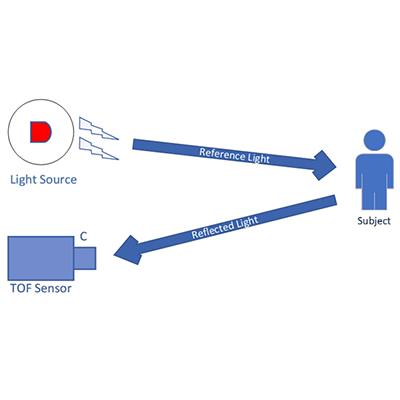
- Working Principle: Emits modulated light → captures reflected signal → calculates distance by time difference; fast and accurate.
- Key Optical Traits: FOV, distortion, resolution, aperture, and sensor compatibility directly determine application suitability.
- Tech Comparison: Outperforms structured light/binocular vision in long-distance, dynamic scenes, and low-light conditions.
- Core Applications: Security surveillance, 3D scanning, tracking, positioning, and industrial automation.
- TOWIN Advantages: Diverse FOV options, low distortion, multi-sensor support, and M12 standard mount for easy integration.
- Selection Guide: Prioritize FOV, resolution, distortion, and sensor size based on specific use cases.
Introduction
TOF (Time-of-Flight) lens are the core optical components of 3D depth sensing systems. Unlike traditional 2D lenses that only capture planar images, TOF lenses work with TOF sensors to measure the distance between the lens and target objects by calculating the flight time of light signals (typically infrared).
This technology delivers real-time, high-precision 3D depth data, making it indispensable in scenarios requiring spatial perception—from security surveillance to industrial 3D scanning. TOWIN offers a range of TOF lenses tailored to different application needs, including low-distortion models for precise monitoring and ultra-wide-angle options for large-scale spatial sensing.
TOF Lens Hardware Composition
TOF lenses combine specialized optical and mechanical components to ensure reliable depth sensing. The key hardware parts include:
- Lens Elements: Determines optical performance (e.g., FOV, resolution, distortion). TOWIN’s S04112009316IR uses a 6G+1ASPG construction for enhanced image quality.
- Image Sensor Compatibility: Supports 1/4″ or 1/2″ sensors (e.g., 1/4″ for S01714012013IRB9, 1/2″ for S08012004812IR/S04112009316IR).
- IR Bandpass Filter: Blocks visible light interference. Most TOWIN TOF lenses feature a 940nm filter for stable infrared sensing.
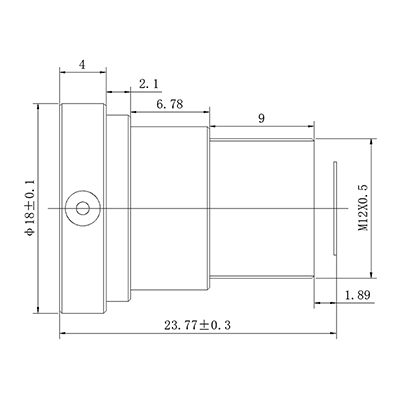
- Mount: Standard M12X0.5 mount across all TOWIN models for universal integration.
- Iris & Focus Mechanism: Fixed iris for consistent light intake; manual focus for precise calibration (available in S04112009316IR and S01714012013IRB9).
- Mechanical Housing: Compact design with TTL (Total Track Length) ranging from 14.84mm to 23.7mm for space-constrained devices.
Low-distortion M12 TOF lens
TOF Technology Working Principle
TOF technology operates on a simple yet effective mechanism, enabling fast and accurate depth measurement:
- Light Emission: The TOF sensor emits modulated infrared light (940nm for TOWIN lenses) toward the target scene.
- Reflection Capture: The light bounces off objects and is reflected back to the lens’s image sensor.
- Time Difference Calculation: The system measures the time delay between emission and reflection.
- Depth Mapping: Using the speed of light (c = 3×10⁸ m/s), the distance to each pixel is calculated, generating a 3D depth map in real time.
Key advantage: No need for complex image stitching or pattern projection—ideal for dynamic scenes and moving objects.
TOF (Time-of-Flight) lens Key Optical Characteristics
Light Source Characteristics
- Wavelength Selection: TOF lenses typically utilize specific wavelengths of light, such as near-infrared light at 850nm or 940nm. These wavelengths are invisible to the human eye and can effectively penetrate ambient light interference, enhancing measurement accuracy. For instance, 940nm light has lower energy in sunlight, making it more suitable for outdoor applications by suppressing ambient light and enabling longer-range and more precise measurements.
- Modulation Method: TOF lenses measure the flight time of light by modulating the light source. Modulation methods include pulse modulation (dToF) and continuous-wave modulation (iToF). dToF directly measures the flight time of light pulses, suitable for scenarios requiring high precision and long-range measurements. In contrast, iToF calculates flight time indirectly by measuring the phase difference between reflected and emitted light, offering higher refresh rates and better interference resistance.
- Light Source Power and Uniformity: The power and uniformity of the light source significantly impact TOF lens performance. A high-power light source provides a stronger signal, improving the signal-to-noise ratio of measurements. Meanwhile, uniform light source distribution ensures stable and consistent measurement results.
Optical Lens Characteristics
- Lens Design: The lens design in TOF lenses must consider light collection efficiency, transmittance, and stray light control. The lens should have strong light collection capabilities to capture as much reflected light as possible. High transmittance minimizes light loss during transmission, while effective stray light control prevents interference with measurement results.
- Filters: TOF lenses are often equipped with bandpass filters that allow only specific wavelengths of light to pass through while blocking others. This reduces interference from ambient light, enhancing measurement accuracy. The bandwidth and center wavelength of the filter must be precisely matched to the light source wavelength.
- Field of View (FOV): The FOV determines the range of the scene that the TOF lens can capture. A wider FOV captures more scene information but may reduce measurement precision, while a narrower FOV improves measurement precision but limits the scene capture range. Therefore, the appropriate FOV must be selected based on the specific application scenario.
Sensor Characteristics
- Pixel Size and Resolution: The pixel size and resolution of the TOF sensor affect measurement precision and scene detail capture capabilities. Larger pixel sizes enhance sensor sensitivity but may reduce resolution, while higher resolution provides more detailed scene information but may require more complex processing algorithms.
- Quantum Efficiency and Responsivity: Quantum efficiency measures the sensor’s ability to convert photons into electrons, while responsivity describes its response to light. Sensors with high quantum efficiency and responsivity provide stronger signals, improving the signal-to-noise ratio and measurement accuracy.
- Dynamic Range: The dynamic range refers to the brightness difference between the brightest and darkest parts that the sensor can capture simultaneously. A wider dynamic range ensures the sensor operates normally under various lighting conditions and provides accurate measurement results.
Overall Optical System Design Characteristics
- Optical System Architecture: The optical system architecture of TOF lenses includes imaging optical subcomponents, a TOF sensor on the receiver, and an illumination module on the emitter. These components must work together to ensure accurate light emission, capture, and measurement. The design of the optical system architecture must consider the light transmission path, signal synchronization, and the overall complexity and feasibility of the system.
- Illumination Uniformity: To ensure stable and consistent measurement results, TOF lenses must provide uniform illumination conditions. This can be achieved by optimizing the illumination module design, using diffusers, or adjusting the light source layout. Uniform illumination reduces measurement errors and enhances system reliability.
- Interference Resistance: TOF lenses must possess good interference resistance to cope with various ambient light and electromagnetic interferences. This can be achieved by using bandpass filters, optimizing the optical system architecture, and employing advanced signal processing algorithms. Improved interference resistance ensures that TOF lenses operate normally and provide accurate measurement results in various complex environments.
The performance of TOF lenses depends on critical optical parameters. Below is a detailed comparison of TOWIN’s three flagship TOF lenses:
| Parameter | S08012004812IR (Low Distortion) | S04112009316IR (Wide Angle) | S01714012013IRB9 (Ultra-Wide Angle) |
| Image Format (Sensor) | 1/2″ (Max Φ8.5mm) | 1/2″ | 1/4″ (Max Φ4.9mm) |
| Focal Length (E.F.L.) | 8.0mm | 4.1mm | 1.7mm |
| Field of View (FOV) | Diagonal: 60°, Horizontal: 48°, Vertical: 36° | Diagonal: 120°, Horizontal: 93°, Vertical: 69° | Diagonal: 147°, Horizontal: 120°, Vertical: 91° |
| Distortion | < -10% | Optical: < -41%, TV: < -13% | < -59% |
| Resolution | 640×480 | 320×480 (320×240 alternative) | 640×480 (5.6μm pixel size) |
| Aperture (FNo.) | F1.2 (high light transmittance) | F1.6 | F1.3 |
| Mount Type | M12X0.5 | M12X0.5 | M12X0.5 |
| Minimum Object Distance (M.O.D.) | 0.2m | – | – |
| CRA (Chief Ray Angle) | < 29° | < 8.5° | < 13.5° |
| Special Features | Low distortion, 940nm BPF | 6G+1ASPG construction | 940nm bandpass filter |
| TTL (mm) | 23.77±0.3 | 23.5 | 14.84 |
Key notes on optical traits:
- FOV: Wider FOV (120°–147°) suits large-space sensing; narrow FOV (60°) for long-distance precision.
- Distortion: Low distortion (< -10%) is critical for security surveillance; higher distortion is acceptable for wide-angle 3D scanning.
- Aperture: Lower F-number (F1.2 > F1.3 > F1.6) means better low-light performance.
- Resolution: 640×480 delivers more detailed depth maps than 320×480.
TOF Lens vs. Other 3D Sensing Technologies
TOF lenses compete with structured light and binocular vision technologies. Here’s a side-by-side comparison to help you choose:
| Technology | TOF Lens | Structured Light | Binocular Vision |
| Working Principle | Light flight time calculation | Projected pattern analysis | Stereo image triangulation |
| Detection Range | Short to medium (0.2m–10m+) | Short (0.1m–2m) | Medium to long (1m–50m) |
| Speed | High (real-time, up to 60fps) | Medium | Low (requires image matching) |
| Accuracy | Moderate (±1% of distance) | High (±0.1mm) | Moderate (±2% of distance) |
| Environmental Adaptability | Good (low light, outdoor) | Poor (sensitive to light/glare) | Poor (requires texture/light) |
| Cost | Medium | High | Low to medium |
| Ideal Applications | Security, 3D scanning, tracking | Facial recognition, AR/VR | Robotics, autonomous vehicles |
Why choose TOF? It balances speed, range, and environmental resistance—perfect for industrial and commercial 3D sensing.
TOF (Time-of-Flight) lens Core Application Scenarios
TOF lenses are widely used across industries, with TOWIN’s products optimized for these key use cases:
- Security Surveillance: S08012004812IR’s low distortion (< -10%) and 60° FOV ensure precise object tracking and boundary detection.
- 3D Scanning & Modeling: S01714012013IRB9’s 147° ultra-wide FOV and 640×480 resolution capture large objects/scenes efficiently.
- Motion Tracking & Positioning: Fast real-time response (enabled by F1.2–F1.6 apertures) suits robot navigation and human motion tracking.
- Industrial Automation: S04112009316IR’s 120° wide FOV and 6G+1ASPG construction support assembly line quality inspection.
- Smart Home Devices: Compact M12 mount and low power consumption fit smart cameras and doorbells.
- Automotive Sensing: (Future expansion) High environmental adaptability for in-cabin monitoring and obstacle detection.
TOWIN TOF Lenses: Core Advantages & Hot Models
As a trusted global supplier of optical solutions, TOWIN TOF lenses stand out in the market with outstanding performance and versatility. Below are their core competitive advantages and concise introductions to three hot-selling models, followed by a transposed comparative summary table for quick reference.
Core Competitive Advantages
- Diverse FoV Options: Cover 60° (narrow-angle), 120° (wide-angle), 147° (ultra-wide-angle) to meet full-scenario spatial sensing needs.
- Optimized Optical Design: Low-distortion precision models and advanced lens structures (e.g., 6G+1ASPG) ensure clear imaging.
- Broad Sensor Compatibility: Supports 1/4″, 1/2″ sensors and mainstream TOF sensors (MLX75027, KW33000).
- Enhanced IR Performance: 940nm bandpass filter reduces ambient light interference for 24/7 stable operation.
- Standardized Interface: M12X0.5 universal interface simplifies integration with cameras/sensor modules.
- Compact & Durable: Minimum length 14.84mm (for space-constrained devices); rugged housing fits industrial scenarios.
- Proven Reliability: Marked as “HOT LENSES” with strong market demand and stable performance.
Concise Introductions to Hot TOF Lens Models
1. S08012004812IR: Low-Distortion Lens
- Core feature: Low-distortion optical design for high-accuracy 3D mapping.
- FoV options: 60° (narrow-angle) / 120° (wide-angle).
- Compatibility: 1/4″, 1/2″ sensors; works with MLX75027, KW33000.
- Key configuration: 940nm bandpass filter, M12X0.5 interface.
- Advantages: Stable 24/7 operation, easy integration, ideal for precision-focused scenarios.
- Typical applications: 3D face recognition, industrial measurement, robotic navigation.
2. S04112009316IR: Advanced 6G+1ASPG TOF Lens
- Core feature: 6G+1ASPG lens structure for superior light transmittance and low chromatic aberration.
- FoV: 147° ultra-wide-angle (no blind spots in spatial capture).
- Compatibility: 1/4″, 1/2″ sensors; compatible with MLX75027, KW33000.
- Key configuration: 940nm bandpass filter, M12X0.5 universal interface.
- Advantages: HD imaging, industrial-grade durability, suitable for high-end applications.
- Typical applications: AR/VR devices, autonomous driving perception, professional 3D scanners.
3. S01714012013IRB9: Compact & Durable TOF Lens
- Core feature: Ultra-compact design (minimum length 14.84mm) for space-constrained devices.
- FoV: Optimized for compact scenarios (adapts to narrow/wide-angle needs).
- Compatibility: 1/4″, 1/2″ sensors; works with MLX75027, KW33000.
- Key configuration: 940nm bandpass filter, M12X0.5 interface, rugged housing.
- Advantages: Small size, industrial durability, no performance compromise.
- Typical applications: Wearable tech, small drones, smart home sensors, miniaturized robots.
Transposed Comparative Summary Table
| Parameters | S08012004812IR | S04112009316IR | S01714012013IRB9 |
| Core Features | Low-distortion, high precision | 6G+1ASPG structure, HD imaging | Ultra-compact, rugged |
| Field of View (FoV) | 60° (narrow) / 120° (wide) | 147° (ultra-wide) | Adaptable to compact scenarios |
| Sensor Compatibility | 1/4″, 1/2″; MLX75027, KW33000 | 1/4″, 1/2″; MLX75027, KW33000 | 1/4″, 1/2″; MLX75027, KW33000 |
| Key Configuration | 940nm filter, M12X0.5 interface | 940nm filter, M12X0.5 interface | 940nm filter, M12X0.5 interface |
| Size Advantage | – | – | 14.84mm (minimum length) |
| Typical Applications | 3D face recognition, industrial measurement, robotics | AR/VR, autonomous driving, professional 3D scanners | Wearables, small drones, smart home sensors |
TOF (Time-of-Flight) lens Selection Guide
Follow these steps to choose the right TOF lens for your application:
- 1. Define Your FOV Requirement:
- Narrow FOV (60°): Long-distance monitoring (e.g., security cameras).
- Wide FOV (120°): Medium-space sensing (e.g., factory floors).
- Ultra-wide FOV (147°): Large-scene scanning (e.g., building modeling).
- 2. Match the Sensor Size:
- 1/2″ sensor: S08012004812IR or S04112009316IR (higher light intake).
- 1/4″ sensor: S01714012013IRB9 (compact design).
- 3. Check Resolution Needs:
- 640×480: Detailed depth maps (3D scanning, precision tracking).
- 320×480/320×240: Cost-effective options (basic monitoring).
- 4. Evaluate Distortion Tolerance:
- Low distortion (< -10%): Surveillance, measurement.
- Higher distortion (> -40%): Wide-angle scanning (acceptable for spatial coverage).
- 5. Consider Environmental Conditions:
- Low light: Choose F1.2 (S08012004812IR) or F1.3 (S01714012013IRB9) for better light transmittance.
- 6. Integration Requirements:
- Compact design: S01714012013IRB9 (TTL 14.84mm).
- Manual focus: S04112009316IR or S01714012013IRB9 for calibration flexibility.
Low-distortion M12 TOF lens
FAQs
Q1: What is the operating wavelength of TOWIN TOF lenses?
A: All models use a 940nm infrared bandpass filter, ideal for low-interference depth sensing.
Q2: Can TOF lenses work outdoors?
A: Yes—940nm filters reduce sunlight interference, making them suitable for outdoor security and industrial applications.
Q3: What mount do TOWIN TOF lenses use?
A: Standard M12X0.5 mount, compatible with most TOF cameras and sensor modules.
Q4: What is the minimum working distance of TOWIN TOF lenses?
A: S08012004812IR has a minimum object distance (M.O.D.) of 0.2m; other models support close-range sensing (contact us for details).
Q5: Are TOWIN TOF lenses compatible with my sensor?
A: Supports 1/4″ and 1/2″ sensors (e.g., MLX75027, KW33000). Contact our technical team with your sensor model for custom compatibility checks.
Q6: Can I get a custom TOF lens for my application?
A: Yes—TOWIN offers OEM/ODM services for FOV, focal length, and filter customization.
Conclusion
TOF (Time-of-Flight) lens are revolutionizing 3D depth sensing with their speed, accuracy, and environmental adaptability. Whether you need low-distortion surveillance, wide-angle scanning, or ultra-compact integration, TOWIN’s TOF lens lineup (S08012004812IR, S04112009316IR, S01714012013IRB9) delivers tailored solutions.
With standardized mounts, infrared optimization, and diverse optical configurations, TOWIN TOF lenses simplify integration and enhance performance across industries. Follow our selection guide to find the perfect lens, or contact our team for personalized support.
Ready to elevate your 3D sensing project? Explore TOWIN’s TOF lenses today and unlock precise, real-time depth data for your products.