


Minimal distortion machine vision lens
09/01/2025
M12 fisheye lenses for surveillance
09/01/2025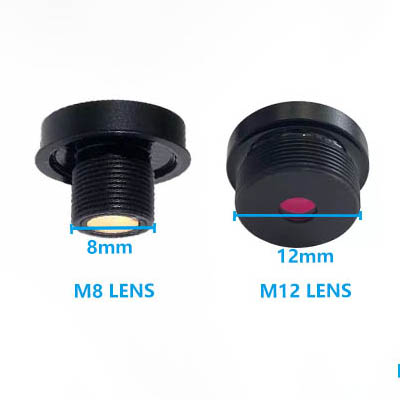
When selecting lenses for industrial, surveillance, or imaging applications, understanding the nuances between different types is crucial. Among the most common are M8 and M12 lenses, which are widely used in machine vision, robotics, and security systems. But what sets them apart?
What is the Difference Between M8 and M12 Lenses?
At first glance, M8 and M12 lenses may appear similar, but their differences lie in their physical dimensions, optical capabilities, and intended use cases. Let’s break down the key factors that distinguish these two lens types.
1. Size and Thread Diameter
The most obvious difference between M8 and M12 lenses is their thread diameter.
- M8 lenses have a 8 mm thread diameter, making them smaller and more compact.
- M12 lenses feature a 12 mm thread diameter, offering a larger housing and more space for optical elements.
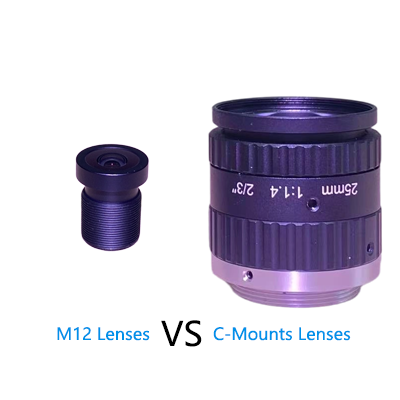
This size disparity impacts their compatibility with cameras and mounting systems. M8 lenses are ideal for applications where space is limited, such as endoscopes or compact embedded vision systems. M12 lenses, on the other hand, are better suited for standard C-mount cameras and scenarios requiring higher optical performance.

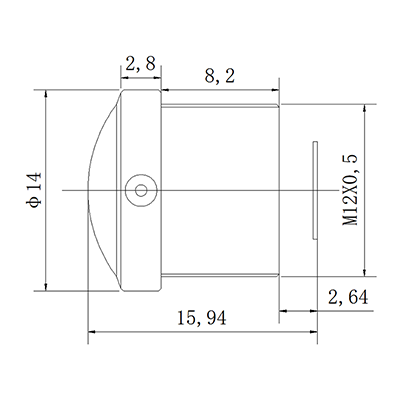
1.8mm F2.5 M12 S-Mount wide angle board lens
2. Optical Performance and Image Quality
M12 lenses generally outperform M8 lenses in terms of image quality due to their larger size. The increased diameter allows for:
- More lens elements: M12 lenses can accommodate additional glass elements, improving light correction and reducing aberrations.
- Higher resolution: The larger aperture supports better light gathering, enabling sharper images even in low-light conditions.
- Wider field of view (FOV): M12 lenses can achieve broader angles without significant distortion, making them ideal for surveillance and panoramic imaging.
M8 lenses, while more compact, may sacrifice some optical clarity due to their smaller form factor. They are best suited for applications where image quality is secondary to size constraints, such as medical instruments or drones.
3. Application Scope
The choice between M8 lens and M12 lens depends heavily on the intended application:
M8 lenses are commonly used in:
- Medical endoscopy
- Miniature robots
- Consumer electronics (e.g., smartphones, wearables)
- Hidden surveillance cameras
M12 lenses excel in:
- Industrial machine vision
- Traffic monitoring systems
- Autonomous vehicles
- High-resolution security cameras
For instance, a factory automation system requiring precise defect detection would benefit from an M12 lens’s superior resolution, while a tiny inspection robot might rely on an M8 lens for its compact design.
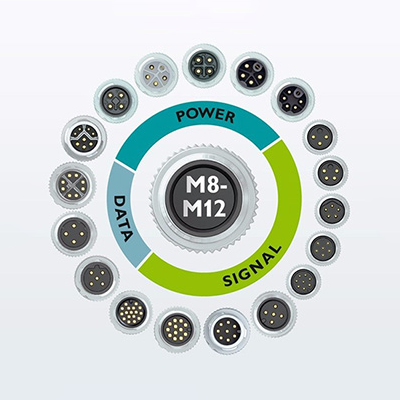
What are M8 and M12 Lenses
4. Cost and Availability
M12 lenses are more widely available and tend to be more affordable than M8 lenses due to their popularity in mainstream applications. However, specialized M8 lenses for niche markets (e.g., medical imaging) can be expensive due to their precision engineering.
If budget is a concern and your project doesn’t require extreme miniaturization, an M12 lens may offer better value for money.
5. Mounting and Compatibility
M12 lenses follow a standardized thread pitch (typically 0.5 mm), ensuring compatibility with most C-mount cameras and adapters. M8 lenses, while also standardized, may require custom mounts or spacers due to their smaller size, potentially increasing setup complexity.
For example, a Raspberry Pi camera module with an M12 lens can easily swap lenses for different FOVs, whereas an M8 setup might need additional hardware adjustments.
Which Lens Should You Choose?
The decision between M8 lens and M12 lens boils down to your project’s priorities:
- Choose M8 if: You need extreme compactness, are working with space-constrained devices, or require a lightweight solution.
- Choose M12 if: Image quality, versatility, and cost-effectiveness are paramount, and you have sufficient space for mounting.
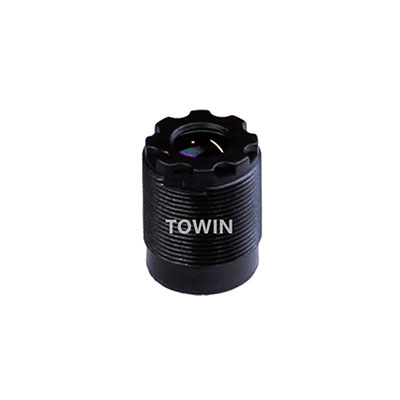
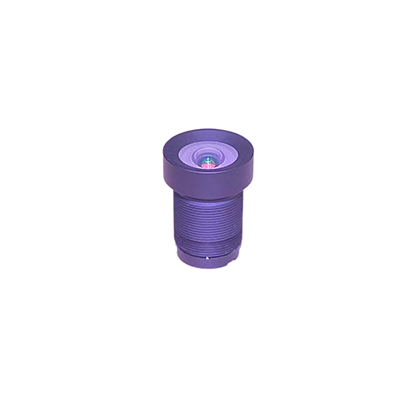
low-distortion-M8-Mount-lens
Final Thoughts
Understanding the differences between M8 and M12 lenses is essential for optimizing your imaging system’s performance. While M8 lenses shine in miniaturized applications, M12 lenses dominate in scenarios demanding high resolution and flexibility. By evaluating your project’s requirements—size, budget, and image quality—you can make an informed decision that ensures success.