Sapphire pinhole lens
08/26/2025
Studio photography lenses with wide aperture
08/26/2025
In the fast-paced world of industrial automation, precision is non-negotiable. Manufacturers rely on cutting-edge technologies to ensure product quality, reduce waste, and maintain compliance with stringent standards. Among these innovations, the telecentric machine vision lens stands out as a game-changer for applications requiring meticulous measurement and inspection.
What Is a Telecentric Machine Vision Lens?
A telecentric machine vision lens is a specialized optical system designed to eliminate perspective distortion and maintain consistent magnification across a wide field of view. Unlike conventional lenses, which may introduce parallax errors or varying image sizes depending on object distance, telecentric lenses project light rays parallel to the optical axis. This unique design ensures that the apparent size of an object remains unchanged regardless of its position within the depth of field, making it ideal for dimensional measurement, defect detection, and quality control tasks.
How Does It Work?
Telecentric lenses operate on a simple yet powerful principle: they only accept light rays traveling parallel to the optical axis. This is achieved through a multi-lens configuration that blocks off-axis light, creating a “telecentric stop” at the focal plane. The result? A crisp, distortion-free image where edges remain sharp, and measurements are consistent—even when objects are tilted or positioned at varying depths.
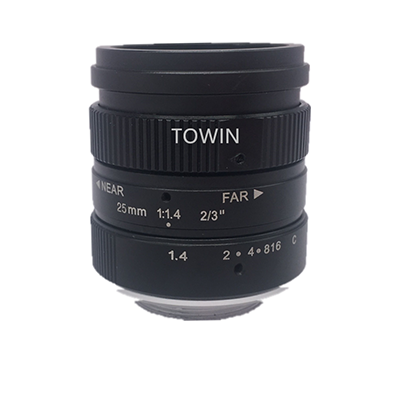
25MM Low Distortion Machine Vision Lenses
Key Benefits of a Telecentric Machine Vision Lens
Elimination of Perspective Errors
Traditional lenses suffer from perspective distortion, where objects closer to the lens appear larger than those farther away. This can wreak havoc on measurement accuracy. A telecentric machine vision lens eradicates this issue by ensuring uniform magnification, regardless of object distance. For industries like semiconductor manufacturing or automotive parts inspection, this precision is critical.
Enhanced Depth of Field
Telecentric lenses boast an extended depth of field, allowing them to capture sharp images of objects at different heights without refocusing. This is particularly useful in applications like 3D surface inspection or robotic assembly, where components may not lie perfectly flat.
Low Distortion Imaging
Distortion—such as barrel or pincushion effects—can skew measurements and lead to costly errors. Telecentric lenses minimize these distortions, delivering geometrically accurate images that adhere to tight tolerances.
Consistent Lighting Conditions
By restricting light to parallel rays, telecentric lenses reduce glare and reflections, ensuring uniform illumination across the field of view. This is invaluable in applications like glass or metal inspection, where specular highlights can obscure defects. Recommended Reading: What is a machine vision lens?
High Resolution and Contrast
Telecentric lenses are engineered to maximize resolution and contrast, enabling the detection of even the smallest features. This makes them perfect for inspecting microelectronics, medical devices, or printed circuit boards (PCBs).
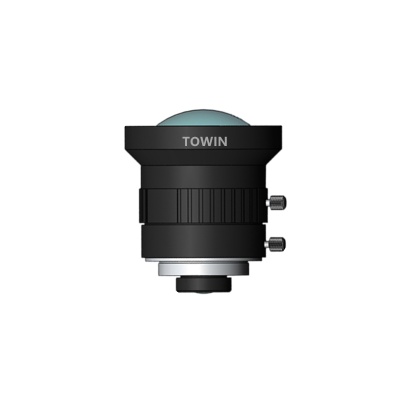
C mount machine vision lenses
Real-World Applications
The versatility of a telecentric machine vision lens spans numerous industries:
- Automotive: Inspecting engine components, gears, and connectors for dimensional accuracy.
- Electronics: Measuring solder joints, chip dimensions, and connector pins on PCBs.
- Pharmaceuticals: Verifying pill shapes, sizes, and packaging integrity.
- Food and Beverage: Detecting defects in packaging, labels, or product dimensions.
For example, a leading automotive manufacturer reduced defect rates by 30% after switching to telecentric lenses for cylinder head inspection. The lenses’ ability to maintain consistent magnification across complex geometries ensured that every critical dimension was measured with sub-micron accuracy.
Choosing the Right Telecentric Machine Vision Lens
Selecting the ideal lens depends on your specific requirements:
- Working Distance: The distance between the lens and the object.
- Field of View: The area the lens can capture.
- Magnification: The ratio of the image size to the object size.
- Wavelength Range: Whether the application requires visible light, UV, or IR.
For instance, a high-magnification telecentric lens is essential for inspecting micro-components, while a wide field of view model suits larger objects like automotive panels.

C mount IR corrected machine vision lenses
Conclusion
In the realm of industrial inspection, the telecentric machine vision lens is not just a tool—it’s a cornerstone of quality assurance. By delivering unmatched accuracy, reliability, and consistency, these lenses empower manufacturers to achieve zero-defect production and stay ahead in a competitive market.