


M12 8mm HD IR corrected CCTV lens
12/12/2025
Low light F1.6 HD M12 CCTV lens
12/15/2025
In the fields of machine vision and industrial imaging, the balance between standardization and high performance has always been a core pursuit of the industry. How to obtain stable, clear, and accurate images in complex environments has always been a topic of great concern. C-Mount Lenses, with their standardized interface, high compatibility, and reliable performance, have become the mainstream choice in imaging systems. They are not only the “imaging hub” of industrial equipment but also reliable partners in scientific research, monitoring, and diverse vision scenarios. With technological upgrades, TOWIN’s C-Mount Lenses series once again redefines the industry’s understanding of standard interface lenses, bringing even greater breakthroughs to high-performance, high-stability vision systems.
What are C-Mount Lenses?
C-Mount Lenses are optical imaging components designed based on the ANSI B1.1 international standard. Their core features include a 1-inch (25.4mm) diameter, 32-thread-per-inch threaded interface, and a fixed flange focal distance (FFD) of 17.526mm from the lens mounting surface to the camera sensor.
C-Mount Lenses Specifications and Features
The C-Mount Lenses incorporates TOWIN’s deep expertise in optics and its all-scenario adaptability into a design that combines standardization and high performance. It excels in optical imaging accuracy, environmental adaptability, multi-scenario functional adaptation, and mechanical structural reliability. The following table lists the core specifications and features of the product, allowing readers to quickly and clearly grasp its advantages, intuitively compare it with similar solutions in the industry, and accurately match their own application needs:
Category | Core Specifications & Feature Description | Ordinary C-Mount Lenses Performance | TOWIN C-Mount Lenses Upgrade Advantages |
| Basic Interface Standard | Interface Type | 1-inch (25.4mm) diameter, 32 TPI thread (ANSI B1.1 Standard) | Standard interface; optimized thread precision for stable installation |
| Flange Focal Distance (FFD) | 17.526mm (CS-mount compatible with 5mm adapter ring) | Complies with standard FFD; custom adapter for zero focus shift | |
| Optical Performance | Resolution Support | Up to 8MP | 12MP max; low-dispersion glass, 30% sharper edge-to-center consistency |
| Distortion Rate | ≤1% (≥2% for partial products) | Ultra-low distortion ≤0.1% for precise detail reproduction | |
| Spectral Adaptation Range | 450-900nm | 400-1000nm wide spectrum (visible/near-IR) for multi-scene use | |
| Coating Technology | Single or double-layer coating | Multi-layer anti-reflective coating, 40% less stray light, better contrast | |
| Mechanical Structure | Body Material | Partial metal + plastic components | Full-metal sealed; enhanced vibration/impact resistance for complex environments |
| Installation Coaxiality Error | ≤±0.01mm | Optimized to ≤±0.005mm, higher machine vision positioning accuracy | |
| IP Rating | No specific protection rating | IP67 dustproof/waterproof for outdoor/automotive use | |
| Environmental Adaptability | Operating Temperature Range | -20℃~60℃ | Automotive-grade -40℃~85℃, stable in extreme temperatures |
| Function & Adaptability | Image Sensor Size Support | 2/3 inch ~ 1 inch | Compatible with 2/3~1.1 inch sensors, flexible camera matching |
| Focal Length Configuration | Mainly fixed focal length | Custom focal lengths: 10-50mm zoom (security), macro (research), wide-angle (automotive) | |
| Focus Feature | Mainly manual focus | Fast autofocus (0.3ms latency) for high-speed moving targets (e.g., traffic capture) | |
| Core Advantages | Cost-Effectiveness | Cost-efficient via standardized design | “Low cost + high performance” balance for mass production & scientific use |
professional, reliable, and versatile
The C-Mount Lenses give the impression of being “professional, reliable, and versatile.” It fully leverages TOWIN’s deep expertise in optics and the precision and stability of industrial-grade imaging. It is not only a core component in machine vision and industrial inspection but also a powerful tool for scientific research experiments, security monitoring, and other scenarios. If you value consistent image quality, flexible equipment adaptation, and long-term durability, then the TOWIN C-Mount Lenses are definitely a choice not to be missed.
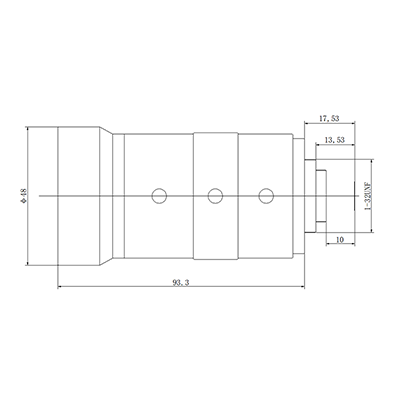
12-120mm low-distortion C mount lens
Five Scenarios Unlocking the Infinite Possibilities of C-Mount Lenses
TOWIN C-Mount Lenses, based on standardized interfaces and coupled with customized parameter optimizations for all scenarios, precisely breaks through in five core fields: industry, scientific research, and security, ensuring that every visual requirement can find a suitable solution:
I. Industrial Inspection and Machine Vision: Millimeter-Level Precision, Strengthening the Production Defense Line
- Resolution: Supports up to 12 megapixels, coupled with an ultra-low distortion rate of ≤0.1%, clearly restoring microscopic details such as the pin spacing of electronic components (minimum recognition accuracy of 0.01mm) and surface scratches on automotive parts;
- Lighting Adaptability: f/1.4 large aperture + multi-layer anti-reflective coating technology, improving stray light suppression rate by 40%, still outputting high-contrast images under complex lighting conditions in workshops (alternating strong light/shadow);
- Structural Reliability: All-metal sealed structure, vibration resistance frequency ≤50Hz, supports 24/7 continuous operation, adaptable to high-speed operation of industrial production lines (supporting up to 60fps). **Frame Rate Imaging, No Motion Glimmer (**)**
- Compatibility: Compatible with 2/3-inch to 1.1-inch sensors, compatible with mainstream industrial cameras, supports quick focal length changes (8-50mm selectable), meeting the needs of different inspection stations.
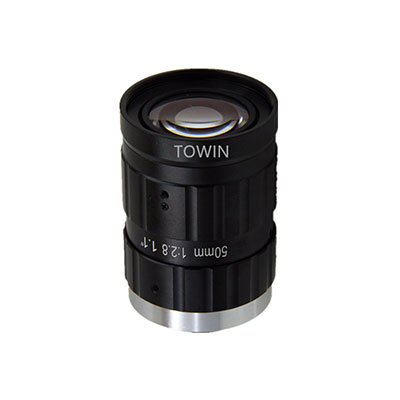
50mm-C-mount industrial lens
II. Scientific Research and Academic Observation: Precise and Stable, Supporting Cutting-Edge Exploration
- Spectral Adaptability: Wide spectral coverage of 400-1000nm, low-dispersion optical glass material, light transmission error ≤0.5%, suitable for scientific research scenarios such as fluorescence imaging and spectral analysis;
- Accuracy: Installation coaxiality error ≤±0.005mm, focal length drift ≤0.001mm during long-term operation (72 hours continuously), ensuring repeatable experimental data;
- Compatibility: Compatible with C/CS mount scientific cameras, supports seamless integration with microscopes, high-speed cameras, etc., customizable macro focal length (minimum working distance 5cm), meeting microscopic observation needs;
- Environment: Operating temperature -20℃~70℃, suitable for various scenarios including controlled laboratory environments and outdoor field observations.
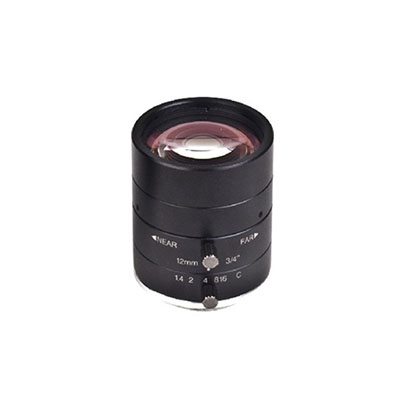
low-distortion C-mount lens
III. Security Monitoring and Intelligent Security: All-Weather Imaging, Safeguarding Security Boundaries
- Night Vision: Infrared-compatible design, 850nm infrared light transmittance ≥90%, combined with wide dynamic range technology, clearly identifies faces and license plates within 50 meters even in low-light environments (0.01 lux);
- Zoom and Field of View: 10-50mm continuous zoom focal length, maximum field of view 110°, flexibly covering different monitoring ranges such as parks and roads;
- Protection: IP67 waterproof and dustproof rating, temperature resistance range -40℃~85℃, able to withstand extreme outdoor environments such as heavy rain, sandstorms, and high-temperature exposure;
- Imaging Stability: Dynamic range ≥120dB, no overexposure/underexposure in strong light and backlight environments, ensuring no loss of critical information.

C-mount IR corrected CCTV lens
IV. Intelligent Transportation and Vehicle Vision: Rapid Response, Enhancing Travel Safety
- High-Speed Imaging: Supports up to 60fps frame rate, fast autofocus with latency ≤0.3ms, accurately capturing license plate and vehicle model information of high-speed moving vehicles (≤120km/h);
- Field of View and Recognition: 120° wide-angle design covering the entire driving field of view, combined with low-distortion optical design, clearly recognizing traffic signs and pedestrian outlines even at long distances (100 meters);
- Automotive Grade: Passes ISO 16750 automotive environment testing, withstands impact acceleration ≥100g, operating temperature -40℃~85℃, adaptable to severe temperature changes and vibrations in vehicles;
- Interface Compatibility: Compatible with mainstream automotive camera interfaces, supports seamless integration with ADAS systems, image transmission latency ≤1ms.
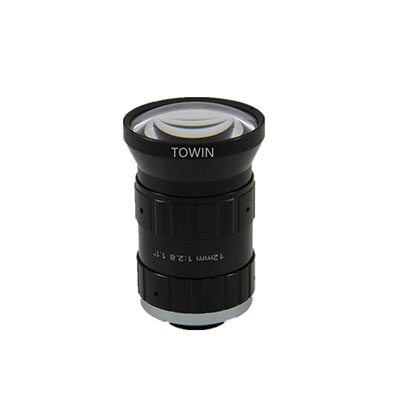
20MP 12mm low distorton C-mount FA lens
V. Consumer Electronics and Smart Home: Compact and Powerful, Upgrading Everyday Experience
- Size and Weight: Lens length ≤ 50mm, weight ≤ 80g, compatible with small devices such as smart home cameras and action cameras;
- Imaging: 12MP high-definition output, ≤0.5% low distortion rate, wide-angle focal length (16mm) for panoramic capture, no stretching or distortion;
- Low-Light Performance: f/1.8 large aperture, signal-to-noise ratio ≥ 50dB in low-light environments (0.1 lux), clearly identifying family members and visitors even during nighttime home monitoring;
- Value for Money: Standardized mass-production design, costing 30% less than similar professional lenses, achieving high cost-effectiveness for consumer products while maintaining performance.
These scenarios fully demonstrate the practicality of TOWIN C-Mount Lenses. From industrial testing to machine vision and smart home experiences, the standardized interface and adaptability of C-Mount Lenses make it the most worthwhile choice.

40mm C mount IR corrected machine vision lenses
C-Mount Lenses Compared to Other Lens Frames
In the optical lens market, how do C-mount lenses compare to other lens frames when evaluating design innovation, user experience, and operational stability? We’ve compiled a comparison table of C-mount lenses with M12 and CS-mount lenses, highlighting their core differences to help you choose the lens best suited to your needs:
| Feature | C-Mount Lenses | M12 Lenses | CS-Mount Lenses |
| Interface Standard | ANSI B1.1 (1-inch, 32 TPI) | M12×0.5 thread | Compatible with C-Mount (shorter FFD) |
| Flange Focal Distance | 17.526mm | Varies (≈5-8mm) | 12.526mm |
| Resolution Support | Up to 12MP+ | Up to 8MP | Up to 12MP+ |
| Distortion Rate | ≤0.1% (low) | ≤1-2% (moderate) | ≤0.1% (low) |
| Size & Weight | Compact (metal body) | Ultra-miniature (plastic/metal) | Compact (same as C-Mount) |
| Environmental Resistance | IP67 (optional) | IP54 (typical) | IP67 (optional) |
| Compatibility | Wide (industrial/scientific cameras) | Limited (small sensors) | C/CS-Mount cameras (via adapter) |
| Core Strengths | High precision, multi-scene adaptability | Miniature size, cost-effective | C-Mount compatibility, lower profile |
As the table shows, C-mount lenses excel in accuracy and versatility. However, due to their metal body design, they are slightly heavier, making them more suitable for consumers seeking reliable performance and adaptability to various scenarios—especially those in industrial inspection, scientific research, or professional security monitoring who prioritize imaging accuracy and long-term stability.
Who Should Buy Them? 5 Groups That Best Utilize the Value of C-Mount Lenses
C-Mount Lenses are not just for high-precision imaging needs; their true appeal lies in their balanced emphasis on precision, broad compatibility, and environmental reliability. There are suitable application scenarios for each different group of people. The editor has compiled a table to help you see which category you fall into:
| Target Audience | Key Reasons for Suitability |
| Industrial Inspection Engineers | Up to 12MP+ resolution & ≤0.1% low distortion rate meet high-precision detection needs; wide compatibility with industrial cameras fits production lines. |
| Scientific Researchers | Stable FFD (17.526mm) & low drift ensure repeatable experiments; wide sensor compatibility supports scientific imaging equipment. |
| Security System Integrators | Optional IP67 protection & infrared adaptability fit 24/7 outdoor/indoor monitoring; flexible compatibility with security cameras. |
| Automotive Vision Developers | Rugged metal body & wide temperature adaptability (-40℃~85℃) match in-vehicle harsh conditions; high resolution supports ADAS recognition. |
| Consumer Electronics Designers | Compact size + professional performance (12MP, low distortion); cost-effective standardized design fits smart home cameras/small devices. |
C-Mount Lenses are best suited for users who demand professional-grade imaging precision and require flexible adaptation across different scenarios. They perfectly suit users who value image quality and need flexibility to handle various usage scenarios.
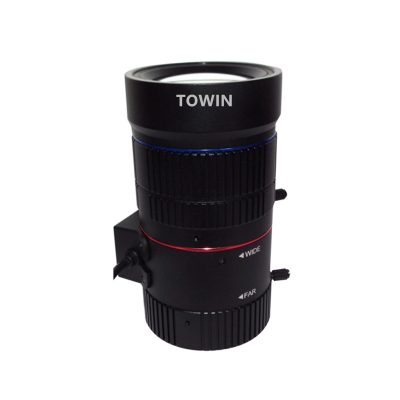
70mm C-mount ITS traffic road CCTV lens
Where is the safest place to buy C-Mount Lenses?
TOWIN offers C-Mount-specific customization tailored to the interface’s technical framework: options include custom focal lengths (8-50mm standard, with macro or telephoto extensions), IP67 waterproof/dustproof upgrades for outdoor industrial use, and wide spectral adaptation (400-1000nm) for scientific applications like fluorescence imaging. All customizations adhere to C-Mount’s ANSI B1.1 standards, ensuring the modified lens remains compatible with standard C-Mount cameras. To request customization, provide details such as target sensor size, operating environment (temperature, humidity), and optical requirements via info@towin-elec.com—the engineering team will design a solution that preserves C-Mount’s compatibility while meeting specific needs.
FAQs
Q: What are the core technical standards of C-Mount Lenses?
A: C-Mount Lenses adhere to the ANSI B1.1 international standard, defined by three key technical parameters: a 1-inch (25.4mm) diameter thread with 32 threads per inch (TPI), a fixed flange focal distance (FFD) of 17.526mm from the lens mounting surface to the camera sensor, and universal thread specifications that align with most C-Mount cameras globally.
Q: Can C-Mount Lenses be used with CS-Mount cameras?
A: Yes, C-Mount Lenses can be adapted for CS-Mount cameras, but a critical adjustment is required: CS-Mount features a shorter FFD of 12.526mm (5mm less than C-Mount’s 17.526mm) .Note that the reverse (using CS-Mount lenses on C-Mount cameras) is not feasible, as the shorter FFD of CS-Mount lenses cannot be compensated for.
Q: How to confirm if a C-Mount Lens is compatible with a camera’s sensor size?
A: C-Mount Lenses have a defined image circle that must cover the camera’s sensor to avoid vignetting (dark corners) . TOWIN C-Mount Lenses typically support sensor sizes ranging from 2/3 inch to 1.1 inch—check the camera’s sensor specifications (e.g., 1-inch, APS-C, Super35mm) and match it to the lens’ image circle parameters (provided in TOWIN’s product datasheet).
Q: What makes C-Mount Lenses stand out in industrial and scientific applications?
A: C-Mount Lenses’ unique advantage lies in the balance of standardization and performance: their ANSI B1.1-compliant universal interface allows seamless integration with most industrial and scientific cameras, eliminating the need for custom adapters.