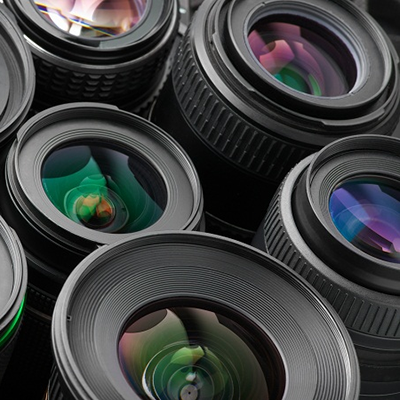



2.1mm IP67 S-Mount Automotive lens
08/12/2025Vibration-Resistant S-Mount Lens
08/13/2025
In photography, videography, and science, the pursuit of perfect image capture spurs many innovations. Among these, the low-distortion lenses stands out as a beacon of optical excellence, promising to deliver images that are true to life, free from the unwanted artifacts that plague lesser lenses. But what exactly is the working principle of a low-distortion lens, and how does it achieve such remarkable results?
The Working Principle of Low-Distortion Lenses: A Deep Dive
Every low-distortion lens features a precise optical system to reduce image-degrading distortions. Distortion in photography means straight lines appearing curved, deviating from true rectangular projection. This can manifest in two primary forms: barrel distortion, where lines bow outward, and pincushion distortion, where lines bow inward. A low-distortion lens tackles these problems, keeping images sharp, clear, and free of distortion.
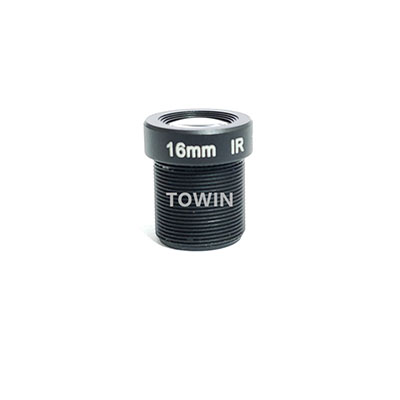
IR-corrected-Low-distortion-CCTV-16mm-M12-lens
1. Advanced Optical Design
The cornerstone of a low-distortion lens is its advanced optical design. Low-distortion lenses use complex glass/plastic elements, unlike simpler traditional lenses. These elements work in harmony to bend light rays in a precise manner, correcting for distortion before it can impact the final image. Design uses advanced computer simulations and tests to refine lens for strict distortion control.
2. Aspherical Elements
One of the key innovations in low-distortion lens design is the use of aspherical elements. Aspherical lenses vary in shape from center to edge, unlike uniformly curved spherical lenses. This allows them to correct for spherical aberration, a type of distortion that causes light rays to focus at different points, resulting in a blurred or distorted image. By incorporating aspherical elements into the lens design, manufacturers can significantly reduce spherical aberration, leading to sharper, more accurate images.
3. Precision Manufacturing
The manufacturing process for low-distortion lenses is equally critical. Even the slightest imperfections in the lens elements or their alignment can introduce distortion, undermining the lens’s performance. To ensure the highest level of precision, manufacturers employ advanced manufacturing techniques, such as computer numerical control (CNC) machining and diamond turning, to create lens elements with microscopic accuracy. These elements are then carefully assembled and aligned within the lens housing, with each step subject to rigorous quality control checks to guarantee optimal performance.
4. Coating Technologies
Another aspect that contributes to the working principle of low-distortion lenses is the use of specialized coating technologies. Lens coatings serve multiple purposes, including reducing reflections, enhancing contrast, and protecting the lens elements from scratches and other damage. In the context of distortion control, coatings can also play a role in minimizing chromatic aberration, a type of distortion that causes colors to appear fringed or out of focus. By applying advanced multi-layer coatings to the lens elements, manufacturers can further improve image quality, ensuring that colors are rendered accurately and distortion is kept to a minimum.
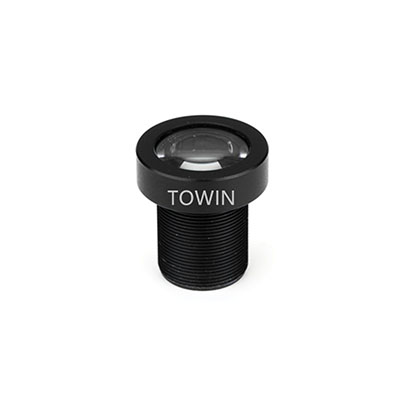
Low distortion 6mm Wide angle lens
5. Real-World Applications and Benefits
The benefits of low-distortion lenses extend far beyond the realm of photography and videography. These lenses are also widely used in scientific instrumentation, such as microscopes and telescopes, where accurate image representation is crucial. In the automotive industry, low-distortion lenses are employed in advanced driver assistance systems (ADAS) to provide clear, undistorted views of the road ahead, enhancing safety and driving experience.
In conclusion, the working principle of a low-distortion lens is a testament to the power of innovation and precision engineering. By combining advanced optical design, aspherical elements, precision manufacturing, and cutting-edge coating technologies, these lenses are able to deliver images that are true to life, free from the distortions that plague lesser optics. Whether you’re a professional photographer, a videographer, or a scientist seeking accurate image representation, a low-distortion lens is an indispensable tool in your arsenal, promising to elevate your work to new heights of excellence.