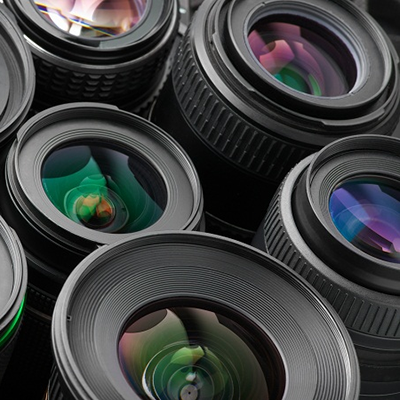



Pinhole lens 4mm 1/3″ auto iris CCTV CS-mount lens
12/04/2025
Top 5 Optical Lens Suppliers
12/05/2025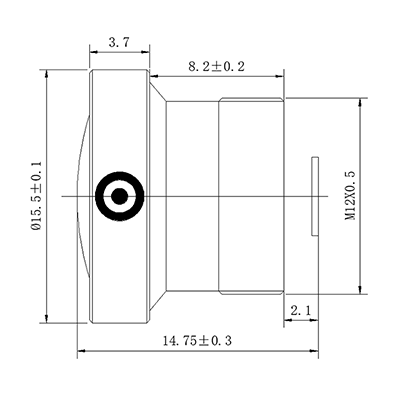
A TOF lens is a truly fascinating lens. Essentially, it calculates the distance between an object and the camera by emitting light pulses and measuring the time it takes for the light to travel from emission to reflection back to the sensor, thus generating a high-precision depth image. This is an optical lens that achieves 3D perception and distance measurement based on the Time-of-Flight (TOF) principle.
Why TOF Lenses Are So Popular in Europe and America
When it comes to the most sought-after lenses in recent years, TOF lenses are definitely among them. Their popularity extends from Europe to North America primarily because their core advantages meet a wide range of application needs.
In the past, we often thought of lenses as merely tools for recording images. However, TOF lenses combine image recording with depth perception and 3D modeling capabilities. By measuring the time of flight of light pulses to achieve high-precision 3D imaging, it has become a top-tier lens.
In Europe, TOF lenses have been deeply integrated into applications across multiple industries, from consumer electronics and autonomous driving to industrial automation, smart homes, and robotics. They are now indispensable in all these fields.
The United States, driven by autonomous driving, consumer electronics innovation, robotics and drone applications, and industrial automation upgrades, urgently needs Time-of-Flight (TOF) lenses with high-precision, fast-response depth perception and 3D modeling capabilities. Coupled with the rapid development of AI and AR/VR technologies in the US, the importance of TOF lenses is further highlighted. From core functions to industry applications, TOF lenses perfectly meet consumer needs, making them an indispensable lens option.
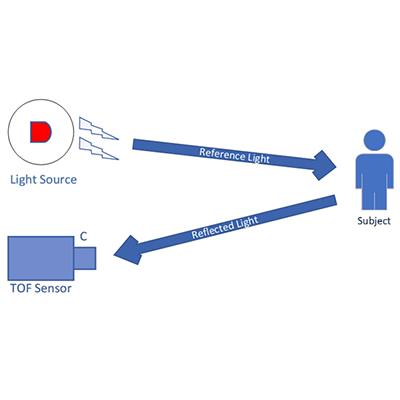
ToF sensor
TOF Lens Function Introduction: The Evolution from Image Recording to High-Precision 3D Imaging
The history of TOF lens development is full of innovation. The earliest TOF technology originated in the 1960s, primarily used in military and scientific research, especially in lidar and ranging technologies. TOF technology calculates distance by emitting light signals and measuring the time difference between the light’s travel from the source point to the object and its reflection, laying the foundation for later 3D imaging and depth perception.
In Europe, TOF lens technology has matured, and more and more companies are beginning to commercialize it, especially in consumer electronics, automotive, industrial automation, and medical fields. With technological advancements, the cost of TOF lenses will continue to decrease while their performance will continue to improve, leading to wider adoption of TOF lenses in the global market in the coming years.
A TOF lens is more than just a simple lens; it integrates a complex sensor system, combining optical imaging, sensor technology, and signal processing capabilities. With advancements in quantum and laser technologies, breakthroughs in the accuracy of TOF lenses at both short and long distances are imminent, expanding their application scenarios to a wider range.
TOF Lens: 5 Reasons to Love It
The TOF lens, a top choice in Europe and America, is not only known for its ability to “record images,” but also for its alignment with modern technological and optical advancements, solving many problems that traditional imaging technologies cannot. The TOWIN S01714012013IRB9 TOF lens is a prime example:
1. Ultra-High Precision 3D Perception, Redefining Spatial Interaction
Technological Support:
- Utilizing Time-of-Flight (TOF) technology, it generates millimeter-level depth maps by measuring the round-trip time of light pulses, achieving a distortion rate of <-59%, ensuring geometric accuracy in 3D modeling.
- A 147° ultra-wide-angle field of view combined with a 1.7mm focal length allows for wider spatial coverage per frame, reducing the need for multi-lens stitching.
Application Value:
- Autonomous Driving: Real-time perception of obstacle distance and speed improves obstacle avoidance speed in low-light environments.
- AR/VR: Enables precise hand/object tracking, reducing the sense of misalignment between virtual objects and real-world scenes.
- Industrial Robots: Optimizes grasping paths through high-precision depth mapping, adapting to complex assembly lines.
2. Stable All-Weather Imaging, Overcoming Light Limitations
Technical Support:
- A 940nm near-infrared bandpass filter effectively suppresses ambient light interference, maintaining signal purity, especially in strong direct light or low-light conditions.
- A large F1.3 aperture design increases light intake by more than 3 times, combined with a 640×480 resolution sensor, ensuring reliable depth data in low-light conditions.
Application Value:
- Security Monitoring: Clearly identifies the location of personnel/vehicles at night without supplemental lighting, improving 24-hour monitoring efficiency.
- Logistics Sorting: Accurately measures package volume in dimly lit warehouses, optimizing warehouse space utilization.
- Medical Endoscopes: Assists doctors in constructing 3D organ models in dark environments, improving surgical precision.
| Description | |
| IMAGE FORMAT | Max Φ4.9, 1/4″ |
| FOCAL LENGTH | 1.7mm |
| F.O.V. | 147°(D) |
| ( KW33000) | 120°(H) |
| 91°(V) | |
| DISTORTION | <-59% |
| RESOLUTION | 640*480 (5.6μm) |
| APERTURE | F1.3 |
| MOUNT | M12X0.5 |
| IRIS | Fixed |
| FOCUS | Manual |
| ZOOM | Fixed |
| B.F.L. | 3.4mm |
| C.R.A. | <13.5° |
| CONSTRUCTION | With 940nm band pass filter |
3. Miniaturized Design, Ushering in a Revolution in Device Lightweighting
Technical Support:
- M12×0.5 standard interface and 3.4mm back focal length (BFL), reducing size by 40% compared to traditional solutions and weighing only 8g.
- Compatible with CMOS sensor direct-mount design, reducing optical module thickness and adapting to ultra-thin devices.
Application Value:
- Smartphones: Integrated into the front camera for 3D facial unlocking, increasing thickness by <0.5mm.
- AR Glasses: Mounted on the side of the temples for eye tracking and gesture recognition, improving wearing comfort.
- Drones: Embedded gimbal camera, reducing load while improving obstacle avoidance sensitivity.
4. Ultra-Low Power Architecture for Long Battery Life
Technical Support:
- Pulsed laser emission frequency optimized to 100Hz, reducing power consumption by 60% compared to continuous wave solutions.
- Dynamic exposure control algorithm automatically adjusts light intensity according to scene brightness, with standby power consumption <50mW.
Application Value:
- Wearable Devices: Supports 24/7 heart rate and posture monitoring, extending battery life to 7 days.
- Smart Door Locks: 3D liveness detection consumes only 0.3W, meeting the requirements of Bluetooth Low Energy (BLE) devices.
- IoT Sensors: Suitable for long-term deployment in outdoor environments, operating stably with solar power.
5. Cross-Industry Compatibility, Building the Foundation of a Smart Ecosystem
Technical Support:
- Supports I2C/SPI dual-mode communication, compatible with mainstream processor architectures such as ARM and RISC-V.
- Provides an SDK development package, supporting deep integration with ROS, Android, and other systems.
Application Value:
- Smart Home: Integrates with voice assistants to achieve spatial awareness control (e.g., lights automatically adjust to human movement).
- Retail Analytics: Optimizes shelf display through in-depth customer flow heatmaps, increasing conversion rates by over 15%.
- Agricultural Robots: Combines multispectral sensors to achieve fruit ripeness detection and precise harvesting.
| Additional information | |
| SENSOR | 1/4″ |
| E.F.L. | 1.7mm |
| H. F.O.V. | 120° |
| RESOLUTION | 640*480 |
| Max Dist. | 59% |
| FNo. | 1.3 |
| FEATURE | Wide Angle |
| MOUNT | M12x0.5 |
| IRIS | Fixed |
| T.T.L.(mm) | 14.84 |
| MARK | HOT LENSES |
A TOF lens is more than just an ordinary image recording lens; it incorporates depth sensing technology, giving devices the ability to perceive space and understand their environment. The S01714012013IRB9-TOF lens achieves breakthroughs in three core technologies: an ultra-wide-angle + low-distortion optical design, a near-infrared anti-interference + large-aperture imaging system, and a miniaturized + low-power hardware architecture. These breakthroughs address the pain points of traditional TOF lenses in terms of accuracy, environmental adaptability, and integration difficulty, making it one of the core sensors for cross-industry intelligent upgrades.
Why has the TOF lens become a top-tier lens in Europe and America?
From recording images to high-precision 3D imaging, the TOF lens has proven itself to be more than just an ordinary lens; it represents a revolutionary breakthrough in optical technology. It doesn’t merely capture images in two-dimensional space, but through Time-of-Flight (TOF) technology, combines depth perception with spatial understanding, bringing unprecedented 3D vision capabilities to devices.
1. A Leap from 2D Images to 3D Perception
Traditional camera lenses only record planar images, while TOF lenses can measure the time of flight of light through the emission and reflection of laser or infrared light, thereby accurately calculating the depth, position, and shape of objects. This allows TOF lenses to provide 3D imaging, not just the projection of 2D images. Its core value lies in depth perception, enabling devices to better understand the spatial relationships of objects; for example, in augmented reality (AR), virtual objects can blend more naturally into the real world.
2. Precise Spatial Positioning and Ranging Capabilities
A significant feature of the TOF lens is its ultra-high-precision ranging capability. It can measure the distance to an object in milliseconds, with accuracy down to the micrometer level, making it extremely useful in many scenarios, especially in autonomous driving, facial recognition, and robot navigation. In autonomous driving, it helps vehicles identify obstacles ahead and their distances, thus improving safety; in robots or drones, TOF lenses provide precise spatial positioning, ensuring accurate operation and obstacle avoidance capabilities.
3. Multidimensional Data Fusion Capability
Unlike traditional cameras, TOF lenses don’t just capture images; they fuse depth data and two-dimensional images to generate richer information. By simultaneously processing depth maps and image data, TOF lenses can generate a three-dimensional space and help devices recognize and understand the structure of their environment. In virtual reality or augmented reality applications, this makes the interaction between virtual objects and the real environment more realistic and seamless.
4. Balance Between High Efficiency and Low Power Consumption
While TOF lenses provide high-precision 3D imaging, they do not sacrifice energy efficiency. Many TOF lenses are designed with low power consumption in mind, extending the battery life of devices during use. This is crucial for battery-dependent products such as smartphones, drones, and wearable devices. Even in low-power mode, TOF lenses maintain high performance.
5. Limitless Possibilities for Innovative Applications
The innovation of TOF lenses extends beyond breakthroughs in traditional imaging; they also empower numerous emerging technological applications. For example, in smartphones, they enhance the security and accuracy of facial recognition, providing a smoother interactive experience in AR applications; in health monitoring devices, they can monitor user posture and movement trajectories through depth perception; and in automation, they provide precise spatial perception capabilities for robots, drones, and other devices, driving the development of intelligent technologies.
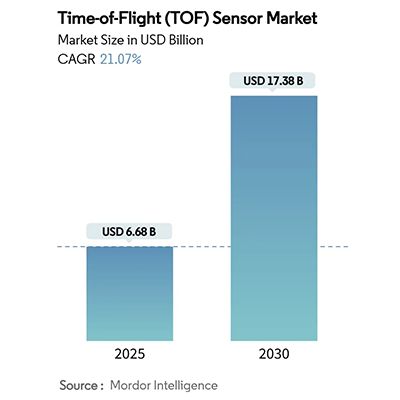
Time-of-Flight (ToF) Sensor Market Size, Trends Report & Forecast 2025 – 2030
FAQs
How does a TOF Lens work?
A TOF Lens is based on Time-of-Flight (TOF) technology. It emits near-infrared light pulses and measures the time difference between their reflection and return to the sensor to calculate the distance between the object and the camera, thus generating a high-precision depth image. This technology is independent of ambient light and can operate stably in complete darkness or bright light conditions.
What is the core difference between a TOF Lens and a traditional camera?
Traditional cameras only capture two-dimensional planar images, while a TOF Lens directly obtains three-dimensional depth information of an object by measuring the time of flight of the light pulse. This capability gives it an irreplaceable advantage in scenarios such as spatial positioning, obstacle avoidance, and AR/VR interaction.
Is a TOF lens power-hungry?
TOF lenses are designed with low power consumption in mind. Their pulsed laser emission frequency is optimized to 100Hz, reducing power consumption by 60% compared to traditional continuous wave solutions. The dynamic exposure control algorithm automatically adjusts the light intensity according to ambient brightness, with standby power consumption of only <50mW, making it suitable for long-term use, especially in wearable devices and IoT sensors.
How are TOF lenses applied to Augmented Reality (AR) and Virtual Reality (VR) technologies?
TOF lenses enable precise tracking of hands and objects, reducing the sense of misalignment between virtual objects and real-world scenes, thus making AR and VR experiences more natural and realistic. Their depth perception capabilities allow virtual objects to better integrate into the real environment, providing a more immersive experience.
How do TOF lenses benefit industrial automation?
In industrial automation, TOF lenses can optimize robot grasping paths through high-precision depth images, improving the robot’s adaptability in complex environments and reducing errors. They can accurately perceive object positions, helping robots achieve more precise assembly, inspection, and handling tasks.
Conclusion
The rise of TOF lenses represents a significant leap in optical technology, moving from two-dimensional image recording to three-dimensional spatial perception. Based on high-precision three-dimensional perception, TOF technology has become a major breakthrough in the field of technology. Its core value lies in integrating depth perception, low-light imaging, miniaturized design, low-power architecture, and cross-industry compatibility through time-of-flight technology, solving the pain points of traditional imaging technologies in terms of accuracy, environmental adaptability, and integration difficulty. With the continuous advancement of technology, TOF Lens will occupy an increasingly important position in the global market, providing strong support for future technological innovation.