


1/2″ 30mm IR corrected HD CCTV M12 Pinhole lens
01/16/2026
8mm 1/3″ IR MP HD CCTV M12 Pinhole lens
01/19/2026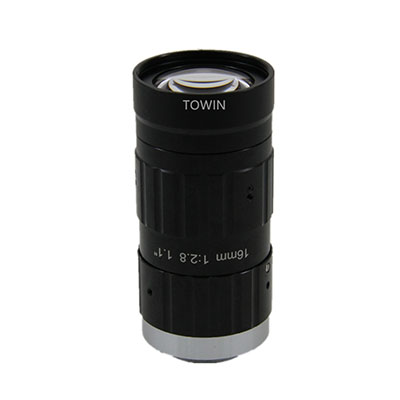
Introduction
In industrial sectors such as electronics manufacturing, automotive components, and precision machinery, Automated Optical Inspection (AOI) has become a core technology for ensuring product quality. As the “eyes” of AOI systems, AOI Machine vision lenses directly dictate defect recognition accuracy, inspection speed, and measurement precision. With the advancement of Industry 4.0, market demand for AOI machine vision lenses with high precision, low distortion, and multi-scene adaptability continues to surge. TOWIN’s 1.1-inch 20MP series C-Mount industrial lenses, tailored for AOI inspection scenarios, stand out in the industrial inspection field with core advantages like ultra-low distortion and high resolution.
Core Functions and Industry Needs of AOI Machine Vision Lenses
1. Analysis of Industrial Inspection Scenarios’ Dependence on High-Precision Imaging
- Micro-defect recognition: Defects such as pin deformation in electronic components, short circuits on PCB boards, and scratches on film surfaces are often smaller than 0.1mm, requiring high-resolution lenses to capture details.
- High-precision measurement: For dimensional tolerance and assembly gap measurement of industrial parts, lenses must produce distortion-free imaging to ensure data accuracy.
- Adaptability to high-speed inspection: As automated production line speeds increase, lenses must maintain clear imaging at high frame rates to avoid missed or false detections.
- Multi-material compatibility: For inspection objects made of metal, plastic, glass, and other materials, lenses need to adapt to multi-band light sources to enhance defect contrast.
2. How Lens Performance Directly Impacts AOI System Inspection Efficiency
- Resolution: 20MP high-resolution lenses capture more details, reducing misjudgments caused by blurred images and improving single-pass inspection rates.
- Distortion rate: Ultra-low distortion (e.g., <0.02%) prevents image stretching or compression, minimizing measurement errors and reducing re-inspection workload.
- Field of view (F.O.V.): A field of view matching the inspection area reduces the number of inspections—for example, wide-angle lenses suit large-area panel inspection to boost speed.
- Light source adaptability: Optimized spectral transmittance of lenses enables synergy with multi-band light sources, shortening exposure time and increasing inspection frame rates.
- Installation compatibility: Universal interfaces (e.g., C-Mount) and reasonable mechanical dimensions (TTL/BFL) reduce equipment commissioning time and accelerate production line deployment.
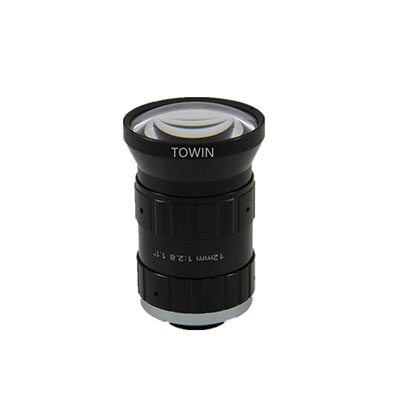
20MP 12mm low distorton C-mount FA lens
Optical Design and Imaging Principles: Technical Cornerstones of AOI Lenses
1. Comparative Analysis of Imaging Differences Between Telecentric and Non-Telecentric Lenses
In AOI inspection, the choice between telecentric and non-telecentric lenses directly affects inspection precision. Key differences are as follows:
| Comparison Dimension | Telecentric Lenses | Non-Telecentric Lenses (e.g., TOWIN C-Mount Series) |
| Imaging Characteristics | Object-side/image-side telecentric; magnification independent of object distance | Magnification varies with object distance; imaging follows perspective principles |
| Core Advantages | Extremely high measurement precision (error <0.01%), no perspective distortion | Compact structure, cost-effective, diverse field of view options |
| Application Scenarios | High-precision dimensional measurement, micro-part inspection | Surface defect recognition, QR code/OCR reading, large-area inspection |
| Limitations | Large size, high cost, relatively narrow field of view | Slight precision degradation with object distance changes |
| Typical Products | Specialized high-precision measurement lenses | TOWIN C1211028M20/C5011028M20 series, etc. |
2. Optimization Mechanism of Multi-Band Light Source Adaptability for Defect Recognition
Different inspection objects and defect types require matching specific light source bands. The multi-band adaptability of AOI machine vision lenses optimizes recognition effects through:
- Spectral transmittance design: Special coatings on lens elements ensure high transmittance for visible light, near-infrared, and other bands, adapting to different light sources (e.g., infrared light for detecting internal defects in transparent materials).
- Chromatic aberration correction: Optimized optical structure reduces chromatic aberration in multi-band imaging, ensuring clear defect edges across bands and avoiding missed detections due to color shifts.
- Contrast enhancement: Adjustable aperture design (F2.8~22) combined with light intensity regulation enhances grayscale differences between defects and backgrounds, especially for low-contrast defects (e.g., plastic scratches).
Classification and Application Scenarios of AOI Machine Vision Lenses
AOI machine vision lenses can be categorized by focal length (corresponding to field of view) into four types, adapting to different industrial inspection scenarios:
| Lens Category | Focal Length Range | Typical F.O.V. (1.1-inch Sensor) | Core Features | Application Scenarios |
| Short Focal Length | 8~15mm | 50°~70° (Diagonal) | Wide field of view, short working distance | Large-area surface inspection (e.g., panels, films), rapid screening of bulk small parts |
| Short-Medium Focal Length | 20~30mm | 30°~40° (Diagonal) | Balanced field of view and precision | Industrial measurement, surface defect inspection of medium-sized parts |
| Medium-Long Focal Length | 35~45mm | 20°~30° (Diagonal) | High precision, low distortion | OCR character recognition, precision component assembly inspection |
| Long Focal Length | 50~80mm | 15°~25° (Diagonal) | Ultra-high precision, narrow field of view | QR code reading, micro-defect inspection (e.g., chip pins) |
Key Parameter Analysis for AOI Lens Selection
Focus on the following core parameters to ensure precise matching between lenses and AOI system requirements:
| Parameter Name | Definition | Core Impact | Recommended Standard (TOWIN Reference) |
| Resolution | Maximum number of pixels a lens can image clearly | Ability to capture defect details | ≥20MP, compatible with 1.1-inch large sensors |
| TV Distortion | Shape deviation between imaged and actual objects | Measurement precision and recognition accuracy | <0.1% (high-precision scenarios), <1.5% (large-area inspection) |
| Focal Length | Distance from lens center to imaging plane | Field of view and magnification | 12mm (wide F.O.V.) ~50mm (narrow F.O.V.), selected as needed |
| Field of View (F.O.V.) | Imaging range of the lens (diagonal/horizontal/vertical) | Inspection coverage and efficiency | Matches inspection object size to avoid multiple shots |
| Minimum Object Distance (M.O.D.) | Minimum clear distance from lens to inspection object | Installation space and working distance | 0.1m~0.3m, adapting to different production line layouts |
| Aperture | Range of light intake adjustment | Imaging brightness and depth of field | F2.8~22 adjustable, suitable for both strong and weak light environments |
| Mount Type | Connection method between lens and camera | Equipment compatibility | C-Mount universal interface, compatible with mainstream industrial cameras |
| Total Length (T.T.L.) | Overall length of the lens | Installation space adaptability | 65.1mm~99.5mm, meeting compact layout requirements |
| Back Focal Length (B.F.L.) | Distance from last lens element to imaging plane | Filter/light source installation | 10.6mm~29.6mm, compatible with additional optical components |
5-Step Selection Process for AOI Lenses
Follow this 5-step process to efficiently select the optimal lens for AOI systems:
1: Define Core Inspection Requirements
- Identify inspection objects: Size, material, surface characteristics (e.g., reflective/transparent).
- Define defect types: Scratches, deformation, character errors, assembly deviations, etc.
- Set precision indicators: Measurement error range, minimum detectable defect size, required inspection frame rate.
2: Confirm Installation and Environmental Conditions
- Installation space constraints: Lens total length (T.T.L.), mounting method (fixed/adjustable).
- Working distance limitations: Minimum/maximum object distance (M.O.D.) to avoid interference with production lines.
- Environmental factors: Temperature, humidity, light source type (visible/infrared/ultraviolet).
3: Match Camera Sensor Specifications
- Sensor size: Prefer sensors matching the lens imaging format (e.g., TOWIN lenses for 1.1-inch sensors).
- Pixel density: Ensure lens resolution ≥ camera pixels to avoid wasting camera performance.
- Interface compatibility: Confirm matching between camera interface (e.g., C-Mount) and lens.
4: Screen Core Performance Parameters
- Priority ranking: Prioritize distortion rate and resolution for high-precision scenarios; prioritize field of view and M.O.D. for large-area inspection.
- Parameter balance: Aperture range should adapt to light intensity; focal length balances field of view and magnification.
- Eliminate non-compliant products: Reject products with subpar key parameters like distortion rate and resolution.
5: Verify Practical Compatibility and Performance
- Sample testing: Validate imaging quality and defect recognition rate through real-world inspection scenarios.
- Compatibility check: Confirm synergy between lens, light source, and software algorithms.
- Cost evaluation: Balance performance and budget while meeting requirements.
TOWIN Specialized Solutions for AOI Machine Vision Lenses
TOWIN’s 1.1-inch 20MP C-Mount series lenses, designed for AOI inspection, include four core models, all featuring high resolution, low distortion, and universal adaptability. Key parameters and characteristics are as follows:
| Model | Focal Length | Resolution | Distortion Rate | F.O.V. (D/H/V) | Minimum Object Distance (M.O.D.) |
| C1211028M20 | 12mm | 20MP | <1.5% | 67°/57°/45° | 0.1m |
| C2511028M20 | 25mm | 20MP | <0.1% | 38°/30°/23° | 0.1m |
| C3511028M20 | 35mm | 20MP | <0.02% | 28°/23°/17° | 0.2m |
| C5011028M20 | 50mm | 20MP | <0.04% | 20°/16°/12° | 0.3m |
| Model | Total Length (T.T.L.) | Back Focal Length (B.F.L.) | Core Advantages | Application Scenarios |
| C1211028M20 | 88.8mm | 10.6mm | Wide F.O.V., short working distance | Large-area surface inspection, rapid screening of bulk parts |
| C2511028M20 | 99.5mm | 29.6mm | Low distortion, balanced F.O.V. and precision | Industrial measurement, defect inspection of medium-sized parts |
| C3511028M20 | 65.1mm | 22.9mm | Ultra-low distortion, high-precision imaging | OCR character recognition, precision assembly inspection |
| C5011028M20 | 71.4mm | 21.1mm | High magnification, strong detail capture | QR code reading, micro-defect inspection |
Common Advantages of TOWIN AOI Lenses
- Standard high resolution: All models feature 20MP resolution, compatible with 1.1-inch large sensors to capture micro-defect details.
- Ultra-low distortion design: Distortion rate as low as 0.02% (C3511028M20) ensures measurement and recognition precision.
- Universal interface compatibility: C-Mount interface adapts to mainstream industrial cameras, reducing equipment replacement costs.
- Flexible manual adjustment: Aperture (F2.8~22), focus, and zoom are manually adjustable for multi-scene adaptation.
- Compact structural design: Total length of 65.1mm~99.5mm fits compact production line layouts.
- Proven reliability: All marked as “HOT LENSES,” validated through long-term industrial use with high stability.
Scenario-Based AOI Lens Recommendations
Precisely match TOWIN lens models to core requirements of different industrial inspection scenarios for optimal balance of efficiency and precision:
| Application Scenario | Core Requirements | Recommended Model | Recommendation Reasons |
| QR Code Reading in Electronics Manufacturing | High magnification, low distortion, clear details | C5011028M20 | 50mm focal length provides high magnification; <0.04% distortion ensures clear QR code edges, improving recognition success rate |
| Optical Character Recognition (OCR) | Ultra-low distortion, accurate character reproduction | C3511028M20 | Industry-leading <0.02% distortion rate prevents character stretching, suitable for high-precision small-font recognition |
| Dimensional Measurement of Industrial Parts | Low distortion, balanced F.O.V. and precision | C2511028M20 | <0.1% distortion guarantees measurement accuracy; 38° F.O.V. covers medium-sized parts; 0.1m short M.O.D. suits close-range measurement |
| Large-Area Panel/Film Inspection | Wide F.O.V., rapid coverage | C1211028M20 | 67° ultra-wide F.O.V. covers large areas in one shot; 0.1m close working distance adapts to production line layouts, boosting inspection efficiency |
| Precision Assembly Defect Inspection | High precision, narrow F.O.V. focus | C3511028M20/C5011028M20 | Low distortion + high resolution accurately identifies micro-defects like assembly gaps and pin deformation |
Why Choose TOWIN AOI Machine Vision Lenses?
- Precise AOI scenario adaptation: All models optimized for industrial inspection, with key parameters addressing core needs.
- Full focal length coverage: 12mm~50mm options seamlessly adapt from large-area inspection to high-precision detail recognition.
- Cost-effective advantage: 20MP high resolution and ultra-low distortion at competitive prices reduce project costs.
- Strong universal compatibility: C-Mount interface + 1.1-inch imaging format compatible with mainstream industrial cameras and AOI systems.
- Industrial-grade reliability: Designed for complex production environments with low long-term failure rates.
- Proven popularity: All four models are “HOT LENSES,” widely used in electronics, automotive, and machinery industries.
FAQs
Why do AOI machine vision lenses emphasize low distortion rates?
Distortion causes shape deviations between images and real objects, directly impacting measurement precision and defect recognition accuracy (e.g., OCR character deformation, dimensional measurement errors). TOWIN AOI machine vision lenses feature distortion rates as low as 0.02%, minimizing image deformation to ensure reliable inspection data and reduce missed/false detection risks.
What are the advantages of C-Mount interface AOI machine vision lenses?”,
1. Strong compatibility: Adapts to most industrial cameras (including 1.1-inch sensor models) without additional adapters; 2. Stable threaded connection: Easy installation and commissioning; 3. Cost-effectiveness: Suitable for mass deployment with higher value than specialized interfaces; 4. Mature technology: Widely used and validated, ensuring low maintenance costs.
How to select AOI lens focal length based on inspection object size?”,
Focal length is inversely proportional to field of view: ≥500mm (large-sized objects) → 12mm short focal length (wide F.O.V.); 200-500mm (medium-sized) → 25mm short-medium focal length (balanced F.O.V. and precision); 100-200mm (small-sized) → 35mm medium-long focal length (high magnification); <100mm (micro-sized/detailed recognition) → 50mm long focal length (high precision
Which sensor sizes are compatible with TOWIN 20MP AOI machine vision lenses?
Perfectly matched with 1.1-inch sensor cameras, also compatible with smaller sensors (e.g., 1-inch, 2/3-inch) with reduced field of view. For optimal performance, 1.1-inch sensors are recommended to fully leverage the lenses’ capabilities.
How does the AOI lens aperture range (F2.8~22) affect inspection results?
Large aperture (F2.8): High light intake suits low-light/high-speed inspection but has shallow depth of field (ensure objects are on the same focal plane); Small aperture (F22): Deep depth of field ideal for uneven surfaces or multi-layer imaging; Adjustable aperture design adapts flexibly to environments and objects, enhancing AOI system versatility.
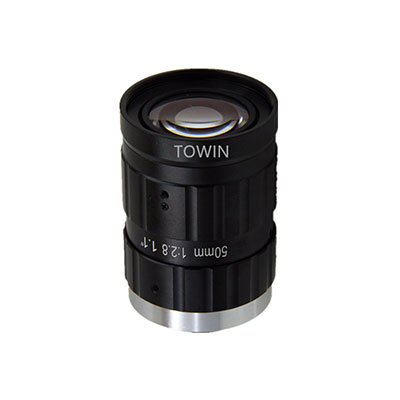
50mm-C-mount Machine Vision FA lens
Conclusion
As core components of industrial inspection systems, AOI machine vision lenses directly determine the efficiency and precision of product quality control. TOWIN’s 1.1-inch 20MP series of specialized AOI machine vision lenses, with core advantages including high resolution, ultra-low distortion, full focal length coverage, and universal compatibility, perfectly adapt to multi-scene needs such as QR code reading, OCR character recognition, industrial measurement, and large-area surface inspection.
Through the selection guide and scenario-based recommendations in this article, enterprises can quickly identify AOI machine vision lenses matching their requirements. In the future, TOWIN will continue to deepen its focus on the industrial vision sector, launching more high-precision lens products tailored for Industry 4.0, helping enterprises upgrade automated inspection and enhance core competitiveness. For further product details or customized solutions, visit the official TOWIN website for more information.