


Fixed focus low distortion lens
11/05/2025
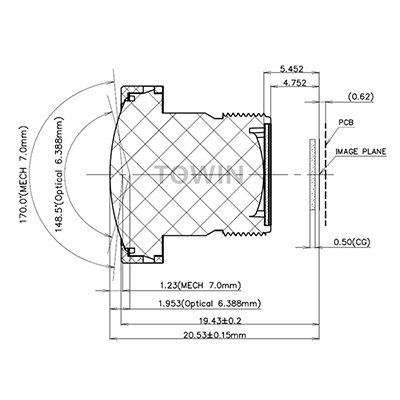
M12 Lenses with 120° Horizontal FoV
11/05/2025
Selecting the right Machine vision lens is pivotal for the success of industrial automation, robotics, and quality control applications. A poorly chosen lens can lead to blurry images, inaccurate measurements, or system failures, costing businesses time and money. To avoid these pitfalls, understanding the Factors affect Machine vision lens selection is essential.
1. Focal Length and Working Distance
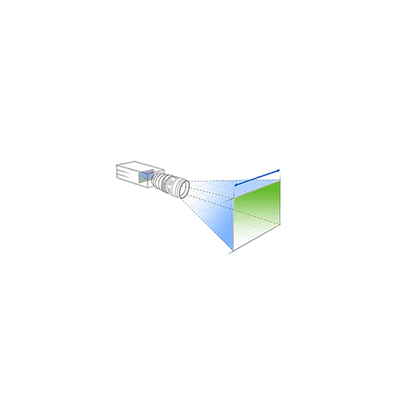
The focal length of a Machine vision lens determines the field of view (FOV) and working distance—the space between the lens and the object being inspected. A shorter focal length provides a wider FOV but requires closer proximity to the object, while a longer focal length narrows the FOV but allows greater working distances.
For example, inspecting small electronic components on a production line may demand a telecentric lens with a long focal length to maintain accuracy over varying object positions. Conversely, a wide-angle lens suits applications like package sorting, where a broad FOV is necessary.
Pro Tip: Use online calculators to match focal length with your desired FOV and working distance.
2. Resolution and Image Quality
Resolution refers to the lens’s ability to distinguish fine details, measured in line pairs per millimeter (lp/mm). Higher resolution lenses capture sharper images but often come at a higher cost. The sensor resolution of your camera must also align with the lens’s capabilities to avoid bottlenecks.
For instance, a 5-megapixel camera paired with a low-resolution lens will underperform, as the lens cannot resolve details beyond its limit. Always ensure the lens resolution exceeds or matches the camera’s sensor resolution.
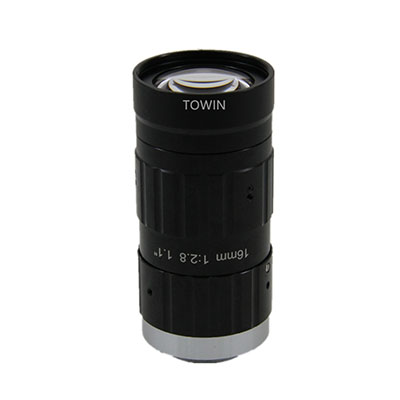
C-mount Machine Vision lens
3. Aperture and Light Sensitivity
The aperture (f-number) controls how much light enters the lens. A lower f-number (e.g., f/1.4) allows more light, making it ideal for low-light environments or high-speed applications. However, a wider aperture reduces the depth of field (DoF), which may blur parts of the image.
In contrast, a higher f-number (e.g., f/8) increases DoF but requires brighter lighting. Balancing aperture with lighting conditions is critical for consistent image quality.
4. Depth of Field (DoF)
DoF is the range of distances where objects appear acceptably sharp. Applications like 3D inspection or varying object heights demand a large DoF, achievable with smaller apertures or specialized lenses like telecentrics.
For example, a telecentric lens eliminates perspective distortion and maintains focus across the entire object, crucial for precision measurements in semiconductor manufacturing.
5. Mount Compatibility and Sensor Size
The lens mount must align with your camera’s interface (e.g., C-mount, F-mount). Mismatched mounts can lead to vignetting or mechanical instability. Additionally, the lens’s image circle must cover the camera’s sensor size to avoid dark corners or cropped images.
6. Environmental and Application-Specific Factors
The operating environment significantly impacts lens performance. Factors like temperature fluctuations, vibrations, or exposure to chemicals require ruggedized lenses with protective coatings. For instance, lenses used in food processing must resist contamination and easy cleaning.
Similarly, high-speed applications (e.g., conveyor belt inspection) need lenses with minimal distortion to prevent motion blur.

40mm C mount IR corrected machine vision lenses
7. Cost vs. Performance Trade-offs
Balancing budget constraints with performance requirements is unavoidable. While premium lenses offer superior optics, mid-range options may suffice for less critical tasks. Evaluate long-term costs, including maintenance and replacement, to justify investments.
FAQs
What is the most important factor in Machine vision lens selection?
The most critical factor depends on your application. For precision tasks, resolution and DoF matter most, while low-light environments prioritize aperture size.
How does sensor size influence lens choice?
The lens’s image circle must fully cover the sensor to avoid vignetting. Larger sensors (e.g., full-frame) require lenses with wider image circles.
Can I use a consumer camera lens for industrial Machine vision?
No. Consumer lenses lack the ruggedness, resolution, and mount compatibility needed for industrial environments. Always opt for specialized Machine vision lenses.
What is telecentricity, and why does it matter?
Telecentric lenses eliminate perspective distortion, ensuring consistent measurements regardless of object position. They’re ideal for metrology and 3D inspection.
How often should I replace my Machine vision lens?
Replace lenses if you notice reduced image quality, scratches, or alignment issues. Regular maintenance extends lifespan, but high-usage systems may need annual replacements.
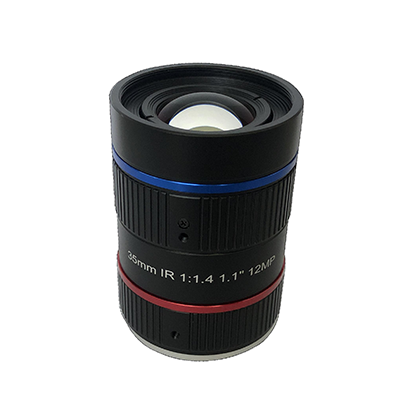
IR 12MP Low Distortion Machine Vision Lens
Conclusion
Choosing the right Machine vision lens involves evaluating focal length, resolution, aperture, DoF, mount compatibility, environmental factors, and cost. By prioritizing these Factors affect Machine vision lens selection, you can enhance system accuracy, reliability, and efficiency.