



Wide-angle CS-Mount lenses for surveillance
11/19/2025
Thermal Imaging M12 Lenses
11/19/2025
When selecting a C-Mount lens for industrial, surveillance, or machine vision applications, understanding its specifications is critical. C-Mount lenses are versatile, cost-effective, and widely used in systems requiring precise imaging. However, deciphering technical jargon like focal length, aperture, or back focal distance can be overwhelming.
What Is a C-Mount Lens?
A C-Mount lens is a type of optical lens designed with a standardized threaded interface (1 inch in diameter with a 17.52mm flange distance). This design allows compatibility with cameras and sensors across industries, from microscopy to robotics.
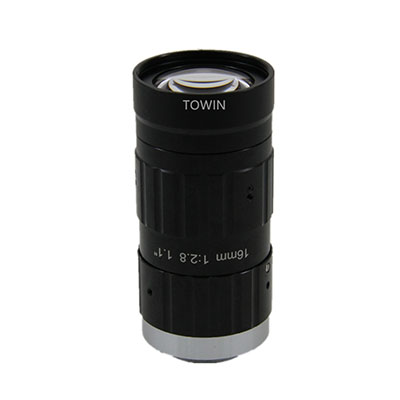
C-mount Machine Vision lens
Key Specifications of C-Mount Lenses
1. Focal Length
The focal length determines the field of view (FOV) and magnification. Shorter focal lengths (e.g., 8mm) offer wider angles, ideal for capturing large areas like warehouse floors. Longer focal lengths (e.g., 50mm) provide narrower views with higher magnification, suitable for inspecting small objects like electronic components.
2. Aperture (f-number)
The aperture controls light intake and depth of field. A lower f-number (e.g., f/1.4) means more light enters the lens, enabling clearer images in low-light conditions. However, a wider aperture reduces depth of field, making focusing critical. For applications requiring sharpness across varying distances, a higher f-number (e.g., f/8) is preferable.
3. Image Circle
The image circle is the diameter of light the lens projects onto the sensor. For a C-Mount lens to work correctly, its image circle must match or exceed the sensor size. Most C-Mount lenses support 1/2-inch to 2/3-inch sensors, but some high-resolution models accommodate 1-inch sensors. Using a lens with an insufficient image circle results in vignetting (dark corners).
4. Back Focal Distance
This is the distance from the lens’s rear element to the sensor plane. C-Mount lenses typically have a fixed back focal distance of 17.52mm, ensuring compatibility with C-Mount cameras. Variations in this distance can cause focusing issues, so always verify compatibility with your camera model.
5. Resolution and Modulation Transfer Function (MTF)
Resolution measures how well a lens reproduces fine details, often expressed in line pairs per millimeter (lp/mm). The MTF chart quantifies contrast and sharpness across the image plane. A higher MTF value indicates better performance, especially at the edges of the frame. For machine vision systems, prioritize lenses with high MTF ratings to ensure accurate defect detection.
6. Distortion and Chromatic Aberration
Distortion bends straight lines, appearing as barrel (outward curvature) or pincushion (inward curvature) effects. Chromatic aberration causes color fringing at high-contrast edges. Modern C-Mount lenses use aspherical elements and low-dispersion glass to minimize these issues, but budget models may exhibit noticeable artifacts.
7. Mount Type and Compatibility
While C-Mount lenses share a standard thread, some variants like CS-Mount (12.5mm flange distance) exist. Adapters can bridge gaps, but they may affect image quality. Always confirm your camera’s mount type before purchasing.
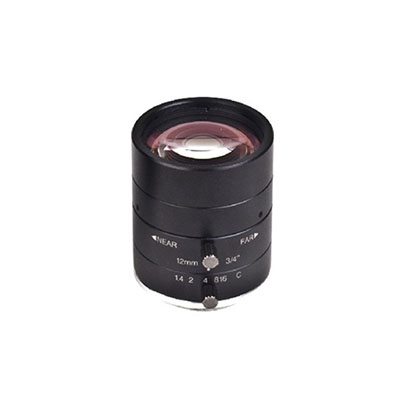
low-distortion C-mount lens
Why Choose a C-Mount Lens?
C-Mount lenses strike a balance between affordability and performance, making them ideal for:
- Industrial automation: Quality control in manufacturing lines.
- Surveillance: High-resolution monitoring in low-light environments.
- Medical imaging: Endoscopy and microscopy applications.
- Machine vision: Robotic guidance and barcode scanning.
Their standardized design simplifies upgrades and replacements, reducing downtime.
Common Mistakes to Avoid
- 1. Ignoring sensor size: Using a lens with a smaller image circle than your sensor causes vignetting.
- 2. Overlooking aperture needs: A lens too slow (high f-number) may struggle in dim lighting.
- 3. Neglecting distortion: High-distortion lenses can misrepresent object shapes in inspection systems.
- 4. Forgetting compatibility: Mixing C-Mount and CS-Mount without adapters leads to focusing errors.
FAQs
What is the difference between C-Mount and CS-Mount lenses?
C-Mount lenses have a 17.52mm flange distance, while CS-Mount lenses use 12.5mm. CS-Mount cameras require CS-Mount lenses or C-Mount lenses with a 5mm spacer.
Can I use a C-Mount lens on a mirrorless camera?
No, mirrorless cameras use proprietary mounts (e.g., Sony E-Mount). Adapters may exist but often compromise image quality.
How do I calculate the field of view for a C-Mount lens?
Use the formula: FOV = (Sensor Size × Working Distance) / Focal Length. For example, a 16mm lens with a 1/2-inch sensor (6.4mm horizontal) at 500mm distance gives a 200mm FOV.
Are C-Mount lenses weather-sealed?
Most standard C-Mount lenses lack weather sealing. For outdoor use, opt for industrial-grade models with IP67 ratings.
Do C-Mount lenses support autofocus?
Few C-Mount lenses offer autofocus, as machine vision systems typically rely on fixed focus. Manual focus lenses are more common and cost-effective.

C-mount IR corrected CCTV lens
Final Thoughts
Understanding C-Mount lens specifications explained empowers you to select the right lens for your application. By prioritizing focal length, aperture, and compatibility, you can optimize image quality and system efficiency.