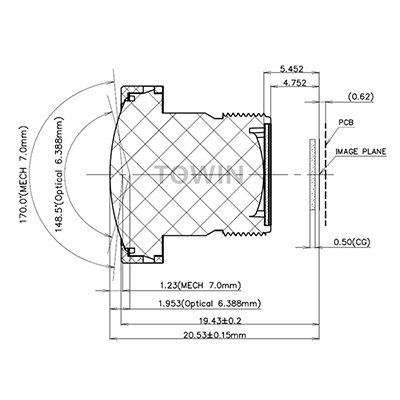



Low-Distortion vs. Standard Lenses
10/14/2025
Best M12 lenses for low-light surveillance
10/14/2025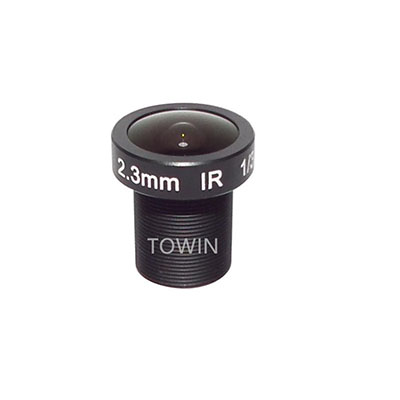
In the rapidly evolving world of machine vision, precision and versatility are non-negotiable. Among the array of lenses designed to meet these demands, the fisheye machine vision lens stands out as a revolutionary tool. Offering ultra-wide-angle views and minimal distortion, this lens is transforming industries from robotics to autonomous vehicles.
What is a Fisheye Machine Vision Lens?
A fisheye machine vision lens is a specialized optical component engineered to capture an extremely wide field of view (FOV), often exceeding 180 degrees. Unlike traditional lenses, which rely on linear projection, fisheye lenses use a hemispherical distortion model to bend light and compress the image into a circular or near-circular frame. This design allows machines to “see” more of their environment in a single shot, making it ideal for applications requiring panoramic visibility.
The term “fisheye” originates from the lens’s ability to mimic the convex view of a fish’s eye, where peripheral details are distorted to fit into a narrower visual field. In machine vision, this distortion is intentionally controlled to maintain clarity while expanding coverage.
How Does a Fisheye Machine Vision Lens Work?
The core mechanism of a fisheye machine vision lens involves two primary optical designs:
- Full-Frame Fisheye: Captures a rectangular image with extreme barrel distortion at the edges, preserving straight lines in the center.
- Circular Fisheye: Projects a 360-degree circular image within a square frame, sacrificing some corner resolution for maximum FOV.
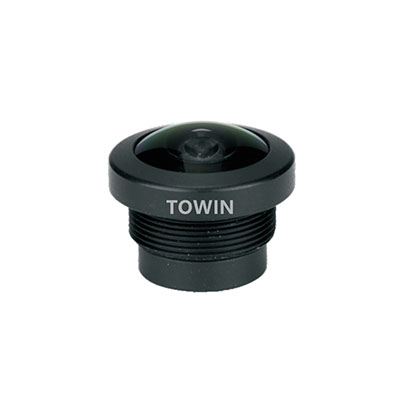
4-Megapixel F2.4 M12 mount fisheye lens
Key Features of Fisheye Machine Vision Lenses
- 1. Ultra-Wide FOV: Captures up to 220 degrees, reducing the need for multiple cameras.
- 2. Compact Design: Smaller footprint compared to multi-lens arrays.
- 3. High Resolution: Supports megapixel sensors for detailed analysis.
- 4. Robust Build: Often rated for industrial environments (IP67, shock resistance).
- 5. Low Distortion Models: Some variants correct distortion algorithmically for measurement accuracy.
Applications of Fisheye Machine Vision Lenses
The versatility of fisheye machine vision lenses makes them indispensable across sectors:
- Autonomous Vehicles: Provides 360-degree environmental awareness for obstacle detection.
- Robotics: Enables SLAM (Simultaneous Localization and Mapping) in navigation systems.
- Surveillance: Monitors large areas with fewer cameras, reducing costs.
- Agriculture: Inspects crop health via drone-mounted panoramic imaging.
- Quality Control: Detects defects in curved or irregularly shaped objects.
For example, a company like Basler integrates fisheye lenses into their vision systems to streamline factory automation.
Advantages Over Traditional Lenses
- Cost Efficiency: Single fisheye lens replaces multiple standard lenses.
- Speed: Faster data acquisition due to wider coverage.
- Flexibility: Adaptable to both stationary and mobile vision systems.
- Durability: Built to withstand harsh industrial conditions.
Challenges and Considerations
- While powerful, fisheye machine vision lenses have limitations:
- Distortion Handling: Software correction is often required for precise measurements.
- Edge Resolution: Image quality may degrade at extreme angles.
- Sensor Compatibility: Requires high-resolution sensors to leverage full FOV.

Fisheye IR Cut Filter S-Mount Lens
FAQs
1. What industries benefit most from fisheye machine vision lenses?
Automotive, logistics, agriculture, and security sectors leverage these lenses for panoramic monitoring and spatial analysis.
2. How do fisheye lenses differ from standard wide-angle lenses?
Fisheye lenses offer a much wider FOV (up to 220° vs. ~120° for wide-angle) but introduce intentional distortion, whereas wide-angle lenses aim for linear projection.
3. Can fisheye lenses be used for 3D mapping?
Yes! When paired with stereo vision or LiDAR, fisheye lenses enable dense 3D point cloud generation.
4. Are fisheye machine vision lenses expensive?
Prices vary based on resolution and build quality, but they often provide cost savings compared to multi-camera setups.
5. What software is needed to process fisheye images?
OpenCV, HALCON, and proprietary tools like MVTec’s MERLIC offer distortion correction and stitching algorithms.
Conclusion
The fisheye machine vision lens is redefining how machines perceive the world. By merging ultra-wide FOVs with industrial-grade durability, it addresses critical challenges in automation, surveillance, and mobility. As AI and machine learning advance, these lenses will play a pivotal role in enabling smarter, faster, and more reliable vision systems.