


Professional Optical Lens Selector Tool Online
03/14/2026
How to Calculate FOV for Machine Vision: FOV Calculation
03/16/2026
Table of Contents
Key Takeaways
- Automotive-Grade Non-Negotiables: ADAS camera lens require compliance with IATF 16949 (quality management) and adherence to AEC-Q100 temperature-grade testing (-40°C to +125°C for Grade 1, -40°C to +150°C for Grade 0).
- Optical Core Tradeoffs: FOV and focal length balance distance (narrow FOV) vs. coverage (wide FOV); 8MP resolution is emerging as the new benchmark for long-range front-view systems.
- Low-Light Performance: Apertures of F1.6–F2.0 maximize photon capture, critical for night driving and tunnel transitions.
- Thermal Stability: All-glass or G+P (glass-plastic hybrid) designs minimize focus shift (thermal drift) in extreme temperatures—plastic-only lenses fail automotive durability requirements.
- Application-Specific Design: Front-view (LKA/ACC) demands high stability; surround-view (AVM) prioritizes low distortion; DMS requires 940nm IR compatibility.
Introduction
ADAS cameras are the “eyes” of modern vehicles, powering life-saving functions like Automatic Emergency Braking (AEB), Lane Keeping Assist (LKA), and 360° Surround View (AVM). Unlike consumer or industrial lenses, ADAS camera lens operate in unforgiving environments—from Arctic cold to desert heat, heavy vibration, and intense electromagnetic interference—while needing zero downtime over an 8–15 year vehicle lifespan.
For Tier 1 suppliers and vision system integrators, selecting the right ADAS lens means looking beyond datasheet numbers. It requires verifying compliance with automotive industry standards, validating thermal and environmental robustness, and matching optical performance to specific ADAS use cases.
This guide breaks down the non-negotiable specifications for automotive-grade ADAS lenses, clarifies critical tradeoffs, and provides actionable selection criteria to streamline your procurement process. Towin, a leader in high-precision optical design, brings decades of experience engineering lenses that meet the strictest automotive reliability demands.
Core Optical Specifications: The Foundation of ADAS Performance
Optical performance directly impacts a camera’s ability to detect, classify, and track objects—especially at high speeds or in poor light. Below are the foundational specs to evaluate.
Field of View (FOV) & Focal Length
FOV and focal length define a lens’s “field of responsibility.” ADAS applications require precise FOV tuning to balance detection distance and coverage area.
- Narrow FOV (20°–35°): Long focal length (e.g., 25mm+). Ideal for long-range front-view (ACC/AEB) to detect vehicles, pedestrians, or traffic signs up to 250m away.
- Medium FOV (50°–120°): Balanced focal length (e.g., 6mm–12mm). Used for main front-view (LKA/TSR) to cover lanes and cross-traffic at 60–150m.
- Wide FOV (150°–180°): Short focal length (e.g., 1.8mm–4mm). For side/rear-view (BSD/RCTA) and surround-view (AVM) to map the vehicle’s immediate surroundings (0–15m).
- Fisheye FOV (190°–220°): Ultra-wide for AVM stitching. Requires strict distortion correction to ensure accurate parking line detection (error ≤2cm).
Resolution & Pixel Size
Resolution dictates how much detail a lens can resolve—critical for identifying small objects (e.g., cyclists, debris) at distance.
- Mainstream: 1MP–2MP (1920×1080) for AVM, DMS, and entry-level front-view systems.
- High-End: 8MP (3840×2160) for premium front-view systems. An 8MP lens can detect a pedestrian at 220m—far beyond the 60m range of a 1MP lens in the same scenario.
- Pixel Size Compatibility: Lenses must match sensor pixel pitch (e.g., 2.4μm–3.0μm for 2MP, 1.0μm–1.5μm for 8MP). Mismatched lenses cause aliasing and reduced sharpness.
F-Number (Aperture)
The f-number (f/#) measures light transmission. Lower values mean larger apertures, critical for low-light performance.
- ADAS Standard: F1.6–F2.0 for front-view and DMS lenses. Maximizes photon capture in night driving, tunnels, or overcast weather.
- Tradeoff: Apertures wider than F1.4 may reduce depth of field (DOF), making it harder to keep both near and far objects in focus—balance with your system’s focus strategy (fixed vs. autofocus).
Optical Distortion
Distortion is the deviation of straight lines from their true shape. For ADAS, controlled distortion is non-negotiable to avoid misleading the perception algorithm.
- Radial Distortion: The most common type. For AVM fisheye lenses, tangential distortion correction is required to limit edge deformation to ≤5%.
- Orthographic Projection: Preferred for AVM stitching to ensure accurate 360° mapping and obstacle distance calculation.
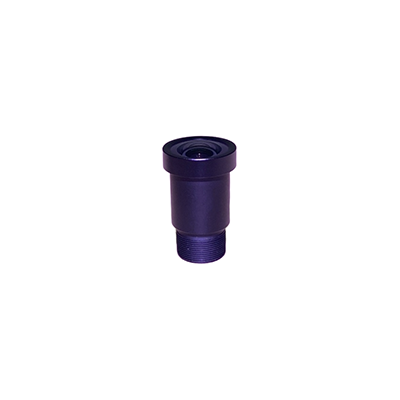
1.9mm 8-Megapixel M12 Fisheye CCTV lens
Automotive-Grade Requirements: What Separates ADAS Lenses from Industrial Lenses
Consumer or industrial lenses fail in automotive environments. ADAS lenses must meet rigorous durability and stability standards to ensure safety. Below are the key differentiators.
Thermal Stability (Focal Drift)
Vehicles operate in temperatures from -40°C (arctic) to +105°C (engine bay). Thermal drift—focus shift caused by temperature changes—can render a camera useless.
- Material Choice:
- All-Glass: Best for extreme temperatures (-40°C to +125°C). Low thermal expansion coefficient (CTE) ensures zero focus shift; ideal for front-view and engine bay applications.
- G+P (Glass-Plastic Hybrid): Balances cost and performance. Uses glass for critical elements (e.g., aperture, focus) and plastic for lightweighting. Ideal for AVM and DMS (interior temperatures: -40°C to +85°C).
- Plastic-Only: Not recommended for ADAS. High CTE causes significant focus shift (>50μm) at temperatures above 60°C.
- Testing Standard: AEC-Q100 Grade 1 (body electronics) or Grade 0 (powertrain) thermal cycling (-40°C to +125°C/+150°C, 1000 cycles).
Stray Light & Ghosting Suppression
Night driving or bright sunlight can create ghosting (artificial reflections) or flare, obscuring critical objects (e.g., oncoming cars, pedestrians).
- Design Features:
- Baffles & Stops: Internal light traps to block off-axis light.
- Anti-Reflective (AR) Coatings: Multi-layer coatings (e.g., MgF₂) to achieve ≥98% transmission per surface and reduce ghosting intensity to ≤1e-6.
- Black Glass Edges: Prevents internal reflections from lens edges.
- Real-World Test: Verify performance with high-beam simulation—lenses should maintain contrast and object visibility without flare.
Environmental Durability
ADAS camera lens face water, dust, chemicals (e.g., road salt), and vibration daily.
| Specification | Requirement | Application |
| IP Rating | IP67 (dust/waterproof) or IP69K (high-pressure wash) | Exterior lenses (front/side/rear) |
| Vibration Resistance | 10–2000Hz, 1g RMS (per IEC 60068-2-6) | All exterior lenses |
| Chemical Resistance | Resistant to road salt, brake fluid, and UV radiation | Exterior lenses |
| Humidity Resistance | 85% RH, 85°C (1000h per IEC 60068-2-78) | All lenses |
Quality Management & Certification
Compliance with automotive standards ensures consistent quality and traceability.
- IATF 16949: Mandatory quality management system for automotive suppliers. Includes APQP (Advanced Product Quality Planning), PPAP (Production Part Approval Process), and FMEA (Failure Mode and Effects Analysis)—critical for Tier 1 partnerships.
- AEC-Q100: Reliability standard for automotive electronics. Validates lens performance under thermal, mechanical, and environmental stress.
- Traceability: Each lens must have a unique serial number to track materials, production batches, and test results—non-negotiable for automotive recalls.
ADAS Application Lens Selection: A Comparative Guide
Different ADAS functions demand distinct lens specifications. Use the tables below to match lenses to your application—optimized for Google Featured Snippet visibility.
Table 1: Core ADAS Application Lens Specifications
| ADAS Function | Primary Use Case | Target FOV (Horizontal) | Typical Resolution | Key Optical Requirements | Temperature Range |
| Front View (LKA/ACC/AEB) | Long-range detection, lane keeping, emergency braking | 30° (narrow) – 120° (medium) | 2MP – 8MP | High resolution, low distortion, F1.6–F2.0, all-glass | -40°C to +105°C |
| Surround View (AVM) | 360° parking assist, low-speed obstacle detection | 180° – 200°+ (fisheye) | 1MP – 2MP | Ultra-wide FOV, low distortion (<5%), G+P | -40°C to +85°C |
| Driver Monitoring (DMS) | Driver attention, drowsiness detection | 40° – 60° (medium) | 1MP – 2MP | 940nm IR compatibility, fixed focus, low ghosting | -40°C to +85°C |
| Blind Spot Detection (BSD) | Lateral obstacle warning, lane change assist | 100° – 120° (wide) | 1MP – 2MP | Wide coverage, fast focus, IP69K | -40°C to +85°C |
Table 2: Lens Material Selection by Application
| Application | Recommended Material | Rationale | Cost Profile |
| Front View (Engine Bay) | All-Glass | Extreme thermal stability, zero drift | Premium |
| Front View (Windshield) | All-Glass or High-End G+P | Balances stability and weight | Mid-Premium |
| Surround View (Exterior) | G+P | Lightweight, cost-effective, meets durability | Mid-Range |
| DMS (Interior) | G+P | IR compatibility, low weight, cost-efficient | Entry-Mid |
FAQs
Q1: Why are glass lenses preferred over plastic for ADAS front-view systems?
Glass lenses with low CTE avoid focus drift in extreme temperatures, unlike plastic (>50μm drift). All-glass is required for AEC-Q100 Grade 1 and front-view ADAS safety.
Q2: How does a high f-number (small aperture) impact night vision performance?
A high f-number (e.g., F2.8) reduces the amount of light entering the sensor, leading to noisy images and reduced object detection range at night. ADAS lenses require apertures of F1.6–F2.0 to maximize photon capture, ensuring pedestrians, cyclists, and traffic signs are visible in low-light conditions. This is especially important for AEB systems, which rely on clear imagery to trigger braking in time.
Q3: What role do lens coatings play in ADAS performance?
Q4: How do I verify a lens meets automotive-grade reliability standards?
Look for IATF 16949 certification (quality management) and AEC-Q100 test reports (reliability). Request the following from your supplier:
- Thermal cycling test results (-40°C to +125°C, 1000 cycles).
- IP69K waterproof/dustproof test reports.
- Vibration and shock test data (per IEC 60068-2-6).
- PPAP documentation (for Tier 1 production).
- Towin provides full test reports and certification for all automotive-grade lenses, ensuring compliance with global OEM requirements.
Conclusion & Call to Action
ADAS camera lens specifications are more than numbers—they are the foundation of automotive safety. For Tier 1 suppliers and vision integrators, selecting the right lens means balancing optical performance with automotive-grade reliability: compliance with IATF 16949 and AEC-Q100, thermal stability in extreme temperatures, and application-specific design.
Towin combines decades of optical engineering experience with a rigorous automotive-grade testing process to deliver lenses that meet the strictest ADAS requirements. Our all-glass and G+P designs are optimized for front-view, surround-view, and DMS applications, ensuring consistent performance over an 8–15 year vehicle lifespan.
Ready to Source Your ADAS Lens Solution?
- Contact Our Optical Engineers: info@towin-elec.com
- Get a custom technical datasheet tailored to your ADAS application (LKA/ACC, AVM, or DMS).
- Explore Our Automotive Lens Series: View our full range of IATF 16949-certified ADAS lenses, designed for global OEMs and Tier 1 suppliers.
- Request a Sample: Test our lenses in your vision system to validate performance in real-world conditions.
Towin—Precision Optics for Safer Roads.